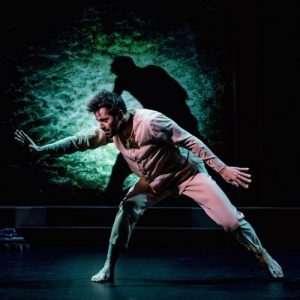
Robert Fairchild in Mary Shelley’s Frankenstein at the Signature Theatre, New York. Picture: Shirin Tinati
Mary Shelley’s Frankenstein continues at the Signature Theatre, New York until 7 January.
Star rating: four stars ★ ★ ★ ★ ✩
For the past 16 years, concert pianist and writer Eve Wolf and her producing organisation, Ensemble for the Romantic Century, have been putting together musical theatre pieces that might well be defined – with nary a tongue in cheek – as classical jukebox.
Her aim is to celebrate iconic cultural events and personages of the 19th century, assembling texts from the literature, letters and diaries of the people involved and then deepening the exploration with music from the period, both vocal and instrumental, in fully staged mountings.
With her latest effort, Mary Shelley’s Frankenstein, playing a very limited Off-Broadway run at the inviting Signature Theatre complex, Wolf has acquired some undeniable marquee lustre with the collaboration of ballet heartthrob and Broadway star (late of An American in Paris) Robert Fairchild.
Fairchild not only portrays Shelley’s immortal creation, Frankenstein’s monster, but makes his debut as choreographer as well. And Fairchild delivers a heroic performance, exposing in arresting movement and dance – sometimes achingly convulsive, sometimes soaring – the yearning soul inside the hideous exterior of Frankenstein’s human – and yet non-human – contraption.
As indicated by the title, Wolf intermingles the story of Shelley’s novel with the travails she suffered in her own life. Mary is portrayed by Mia Vallet, and her husband, Percy Bysshe Shelley, by Paul Wesley. We hear of the early deaths of three of their children, of Mary’s various miscarriages, how her mother died in giving birth to her, and finally of the death of Percy in an accident while sailing in the open sea.
We also hear how Shelley was prompted to write the novel during a rainy summer stay in Switzerland when a neighbour, Lord Byron, proposed that they each pass the time by creating a ghost story.
Wolf’s script, by juxtaposing such events with passages from the novel, provides an arresting mirroring of the creative imagination with the unpredictability of reality.
Providing yet another emotional dimension are the rich musical selections that punctuate the text, pieces by Johann Sebastian Bach and Franz Liszt, played on piano (by Steven Lin), organ and harpsichord (Parker Ramsay) and oboe (Kemp Jernigan). There are also four Franz Schubert lieder sung with an outpouring of grand compassion by mezzo-soprano Krysty Swann.
Donald Sanders’ fluid staging pretty much helps to define the fictional storytelling and the exposition of real events, while Vanessa James’ set and costume designs help to take us into the time and place. Also important are the grandly atmospheric projections by David Bengali.
Granted, such proceedings could well smack of an over-abundance of artiness, but the show avoids any sense of this with its ardent performances and passionate musicianship.
The only drawback is the rather quotidian American diction used by most of the performers, including Fairchild, when delivering text.
The plain-spoken delivery, while at times compellingly emotional, is a bit jarring against the eloquence of the words themselves, the heightened atmosphere created by the music and the aura of the characters involved.
Only Rocco Sisto, portraying both the blind man who befriends the monster in the Frankenstein story and Shelley’s loving but rather dispassionate father, speaks in an elevated tone that further enriches the overall ambiance of the production.
But such criticism aside, Wolf – and Fairchild – deserve monstrous credit for providing another look at and dimension to this oft-told tale of science and creativity gone awry.
Ron Cohen
SHARE THIS POST:


Comments are closed.