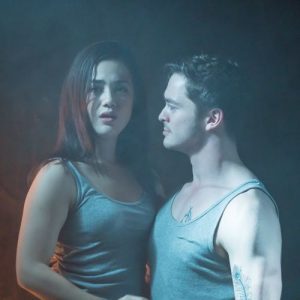
Picture: David Ovenden
Metropolis continues at Ye Olde Rose and Crown Theatre, London until 29 October.
Star rating: five stars ★ ★ ★ ★ ★
The musical version of Fritz Lang’s groundbreaking 1927 sci-fi classic Metropolis famously tanked at the Piccadilly Theatre in 1989.
The 1980s was an era of overblown, epic rock musicals, often with a sci-fi sensibility – Starlight Express (1984), Time (1986), Return to the Forbidden Planet (1989) – and Joe Brooks’ and Dusty Hughes’ multi-million-pound production out-budgeted them all, thanks largely to its spectacular set. It ran for just six months before the plug was pulled, although it did garner its female lead, Judy Kuhn (in her London debut), an Olivier nomination.
Fast forward to 2017 and this long-forgotten show has found a champion in actor/director Tim McArthur, who as a teenager saw the original production and vowed to one day bring it back to London.
With MD Aaron Clingham’s All Star Productions, he has taken on the audacious task of rebooting Metropolis and, like the show’s devilishly ingenious inventor Dr Warner, has breathed life into what was – in the UK, at least – an inert entity.
The plot closely follows that of the original film, which in turn was based on a novel of the same name by Lang’s wife Thea von Harbou. Beneath the surface of a futuristic city – in the film 2026 – a subjugated labour force of Workers toil on machines to supply power to the Elites above ground.
Keeping an Orwellian eye on things is the city’s creator and megalomaniac machine-lover John Freeman (Gareth James, in the role made famous by Brian Blessed).
When his son Steven (Rob Herron) makes an illicit visit beneath the city to see what keeps Metropolis ticking, he encounters Maria (Miiya Alexandra) breaking the law by teaching children about the old world pre-Metropolis.
He also witnesses the horrendous conditions faced by the enslaved and decides to swap places with Worker George (Michael Levi). He, of course, falls in love with the rebellious young Maria, setting off a chain of events that I won’t spoil for you.
The iconic turning point, though, is the creation of the robot Futura by the brilliant Dr Warner (Kitty Whitelaw). This archetypal mad scientist – in this production, an ingenious hybrid of Dr Strangelove, Josef Mengele and Frank‘n’Furter – uses the likeness of Maria to create confusion with the rebelling Workers.
Confusion does indeed follow, but thanks to McArthur’s deft handling of the material, it’s not too difficult to keep track of proceedings.
So, yes, it’s a bonkers plot, yet one that somehow resonates with our current bonker state of affairs: them and us, enslaved workforces, political mayhem, the rise of artificial intelligence and the impending end of the world thanks to a crazed megalomaniac.
Dusty Hughes’ ridiculous book aside (and while we’re at it, his often- atrocious lyrics), the All Star creatives do an outstanding job of boiling the material down to its essence, serving up an adventurous romp that allows the excellent young cast to make the most of the mouldy material.
A number of the leads shine brightly in their professional debuts. All round, the voices are impressively strong, and despite no amplification they hold their own against Clingham’s four-piece band.
Herron and Alexandra in particular are destined for greatness, giving us complete and compelling performances, and shouldering much of the weight of the show – a remarkable achievement given their inexperience.
Bravo also to “veteran” James, whose evil Freeman is a model of seething anger; he blessedly avoids the temptation to mimic Brian Blessed, giving us his own characterful villain. He’s ably assisted by the even-more-evil henchman Jeremiah, played with vein-throbbing delight by Alex Ely.
Where this production truly earns its five stars is in the handling of the show’s scale, musically, visually and dramatically. Clingham’s own transcriptions of the vocals and orchestrations are outstanding – a project six months in the making, apparently – and the ensemble numbers are spine-tinglingly good. The final chorale is worth the (very affordable) ticket price alone.
Justin Williams and Jonny Rust’s steampunky design is also the best I’ve ever seen at the Rose and Crown, perfectly establishing the dystopian setting, ably amp’d up by Vittorio Verta’s lighting. For a show that originally relied so much on its set, it’s a thing of wonder to see such effective downsizing.
Choreographer Ian Pyle also deserves to be commended for his creative efficiency. Repetitive manual labour is rendered in a series of jerky snaps and strenuous stretches, and the potentially cringeworthy dancing indulged by the Elite feels authentically futuristic. As, too, do Joana Dias’ costumes. I might even aspire to that single-shirt-sleeve look…
What I’ve always appreciated about All Star is their encouragement of emerging talent as well as their risk taking, staging long-forgotten gems or tackling shows that most other Fringe venues wouldn’t touch. The same goes for their Metropolis, which I can now tick off my list of shows I’d otherwise never get to see.
Yes, the plot is nuts and you can see why it never really worked – the (many many) songs are often generic or derivative (particularly of Boublil and Schönberg) and they’re severely lacking lyrically.
But when channelled down to this scale, it all becomes more intimate, personal and powerful, and it just works. There’s also no doubting the passion, enthusiasm and talent of the cast and creatives, and for just £20 a seat, this makes Metropolis a must see.
Craig Glenday
SHARE THIS POST:


Comments are closed.