 Nowadays theatre-goers are used to enjoying musical theatre productions at the London Palladium, but before British theatre impresario LOUIS BENJAMIN came along, the art form was rarely represented at the iconic venue. Internationally-renowned writer Warner Brown, who witnessed Mr Benjamin at work first hand, pays tribute to a great man of entertainment in his centenary year.
A musical at the London Palladium! Nothing odd about that, you might say, but in the mid-1980s such a thing was unthinkable. The Palladium had always been a variety house… the variety house… and the powers-that-be at Stoll Moss Theatres, the company who owned the venue, saw no reason to change things. But things were changing in spite of them. The Palladium was sinking – and fast. Public taste was on the move. What had been good for the 1950s and 60s – even the seventies – was now old hat. Jugglers and comics, animal acts and ventriloquists… even the fabulous Tiller Girls… were not what the customers craved for any more. A generation grown up on television had more sophisticated tastes. When even Ethel Merman could open to rave reviews but play to little cash, something had to change if the great old lady of Argyll Street was to survive.
Louis Benjamin was the new boy at Stoll Moss and he saw the writing on the wall. Benjamin thought outside the box and – initially – ‘outside the box’ was Las Vegas.
But we’re rushing ahead of ourselves. Who was Louis Benjamin and why am I writing about him today? Well, Mr Benjamin… or Benjie to his friends… was a kid from the back streets of Stoke Newington, 5,000 miles and a planet away from Sin City, Nevada. And I’m writing about him today because, amongst other things, it is his centenary year. My credentials? In my mid-20s I knew him well. I was lucky enough to see him work at first hand. He was a young man’s guide to the commercial side of theatre.
Stoke Newington may be a very fine place, but the bright lights of Vegas beckon. Benjie realised that ‘names’… big American ‘names’… were what was needed to fill those empty Palladium seats. And so he embarked on a shopping trip to the city where many of those ‘names’ appeared. On his wish list was Shirley MacLaine, Debbie Reynolds, Frank Sinatra – and, through a mix of persistence and chutzpah, he got them all. Vegas stars lit up Argyll Street and for a while it worked. But only for a while. Something more was needed. Something more permanent.
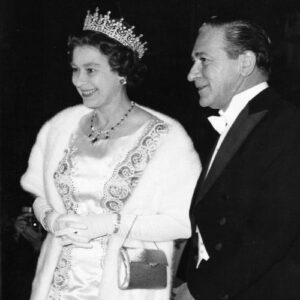 Benjie thought that ‘something’ was musicals. But, whereas Sinatra and MacLaine had met with no resistance, musicals were a different matter. A musical at the Palladium? Sacrilege!
It was then… just at the moment it was needed… that Benjie found an ally. Harold Fielding was a ‘character’. He reminded me of one of those wind-up toys… a whirr of energy buzzing around… but one where the battery never ran down. He was also one of the foremost musical theatre producers of the day.
Out of the blue, Benjie had been approached by a young producer called Martin Gates with an idea for a musical based on the story of Hans Christian Andersen. The thought was that Tommy Steele would star in the show – and that it should be staged at the London Palladium. As we’ve said, a musical at the Palladium was like booking Max Miller into a Moral Re-Armament Convention. If this was to work, Benjie needed the help of an expert. Enter Mr Fielding.
When word got around the manor that Fielding and Benjamin might be going into business together, the reaction was shock and disbelief. Both men were known to be mercurial. How was it going to work?
The answer was ‘very well’. ‘Hans Andersen’ packed them in. And, in the process, the old lady of Argyll Street got a new burst of life.
Musicals at the Palladium now seemed a good idea. But it was a special theatre and it had to be a special kind of show. It’s time for the King of Siam to make an appearance.
On an auspicious day in 1979, Yul Brynner stood on the stage of the London Palladium and surveyed the empty auditorium, Benjamin at his side.
“Do you like the décor?” he asked of the star, who was towering arms-akimbo.
Mr Brynner peered about him, auditioning the world’s most famous theatre. Finally a single word emerged from the caverns of his chest: “Yes.”
Benjie breathed a sigh of relief. Before he appeared in The King and I on Broadway, Brynner had demanded the entire theatre be repainted. Benjie had no plans to redecorate the Palladium but a stand-off with Brynner was not to be recommended. He was a star and he knew it. Fortunately, the Palladium had passed the audition. Brynner was to bring the Rodgers and Hammerstein masterpiece to grace its stage
Naturally it was a smash. And now it seemed utterly normal for the great old house to be staging musicals. It was almost as if it had always been the case. Many dazzling shows were to follow: from Singin’ in the Rain to Scrooge. Musicals suited the Palladium and the Palladium suited musicals.
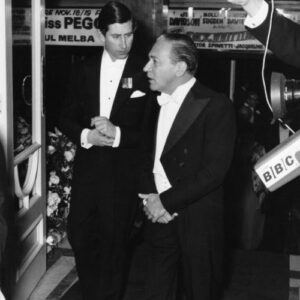 Of course, Benjamin was to present musicals in other Stoll Moss Theatres, right up to Phantom of the Opera and Miss Saigon. I’d love to tell you the story of ‘Windy City’ at the Victoria Palace, but that’s a saga for another time, another place!
One thing I have to mention, though, is another dream of Benjie’s: the notion of giving the annual Royal Variety Performance a theme, rather than making it solely a variety bill. Again, this break with tradition didn’t please everyone, but the royal show of 1985, staged at Drury Lane, was one of the first with a theme – and that theme was musicals.
I was fortunate enough to witness its preparation at first hand and what a celebration of the form it was. Stars from Jean Simmons to Jose Carreras… even Hollywood legend Alice Faye… took us on a toe-tappin’-jazz-hands excursion to Musicals Land. I still remember Paul Nicholas and Celeste Holm, an original star of the movie High Society, performing ‘Well, Did You Evah?’. And Su Pollard as Gracie Fields is something you don’t forget in a hurry!
But, in his centenary year, my thoughts return to Argyll Street again and again. A musical at the London Palladium! Nothing odd about that, you might say. But it could have been otherwise – were it not for Louis Benjamin.
SHARE THIS POST:


Comments are closed.