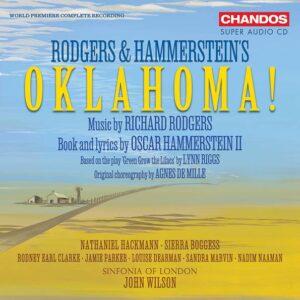
 OKLAHOMA! – Complete CD Recording [Chandos Digital CHSA 5322(2)].
Star rating: five stars ★ ★ ★ ★ ★
The musical Oklahoma! has a recognised place in theatrical history for several reasons. For starters it was the first show written by the partnership of Richard Rodgers and Oscar Hammerstein II. Secondly it was arguably the first time that music, lyrics and choreography had been created to form a complete whole rather than just dialogue interspersed with song and dance. The songs were integrated with the drama to move the story on, and it was more or less the first time that a Broadway show had become a musical drama rather than a musical comedy.
Some may say that in 1927 Show Boat was the first American musical to marry music with drama, which is true up to a point but it still had its origins in operetta, even though it integrated song, drama and comedy with production numbers. What it did have, however, was Oscar Hammerstein II writing the lyrics to Jerome Kern’s classic score. Sixteen years on Hammerstein continued to write dramatic lyrics along with the lighter songs but there is not too much comedy as such in Oklahoma! The songs are either romantic ballads or out-and-out dramatic tunes.
With Oklahoma! Rodgers and Hammerstein set the trend for what was to become the serious Broadway musical, leading the way for others to take up the baton, such as Jerry Bock and Sheldon Harnick, Alan Jay Lerner and Frederick Loewe, Harvey Schmidt and Tom Jones and, of course, Stephen Sondheim. The reason that Sondheim was so good as both a composer and lyricist was due to the fact that he had been mentored by Hammerstein.
With Oklahoma! gone was the humorous and glamorous upper class set often depicted in the musicals of Cole Porter, George and Ira Gershwin and Irving Berlin and in came, well, ordinary people with whom audiences could identify. The origins of Oklahoma! lie in the 1931 play Green Grow the Lilacs by Lynn Riggs which tells the everyday story of down-to-earth farming folk in Claremore in Indian Territory in 1906. There was nothing more ordinary than that, but the music and the lyrics made the setting more extraordinary and more palatable – irresistible, even.
The book of the musical tells of the locals and their common problems such as the ongoing disputes between farmers and cowboys and, naturally enough, a love story between Laurey Williams, a farm girl, and her awkward relationships with cowboy Curly McLain and farmhand Jud Fry. This is juxtaposed with another would-be romance between cowboy Will Parker and his fiancee, Ado Annie, the girl who cain’t say no.
 The show was an immediate hit when it opened on Broadway in March 1943, running for well over 2,000 performances and later enjoying successful tours and constant revivals. It originally starred Alfred Drake, Jan Roberts, Celeste Holm, Howard da Silva and Lee Dixon. It took four years, however, before it reached London where it starred Howard Keel and Betty Jane Watson as Curly and Laurey and ran for over 1,500 performances. It has been regularly revived around the world ever since, remaining popular for some 80 years.
At the time of the original Broadway and West End stagings audiences would have been surprised by the opening scene of Oklahoma! The show begins without the usual chorus number generally hitherto performed by the company. Immediately the scene is set with talk of the imminent box social dance. Curly invites Laurey to the social and tries to persuade her to go with him. Then Jud Fry also asks Laurey and she accepts because she is afraid of him. And so this drama gets underway with the minor problems of a lovelorn girl having to choose between a farmboy and a cowboy, in contrast to the more important parallel scenes where the farmers and the cowboys fight over fences and water rights, rather than who gets the girl.
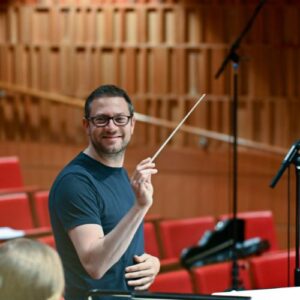
John Wilson has made a splendid job of re-creating and recording Oklahoma! as it might have been witnessed on the opening night in 1943. He considers it to be a landmark musical of which until now there has never been a complete recording. In the double album’s booklet all the song lyrics and the dialogue are included. As Wilson says: “Every note is played and where they are played as originally written… and the marriage between Robert Russell Bennett’s orchestrations and the piece itself is perfect: they sound like the piece looks. There’s an honesty and a freshness about them which absolutely mirror what is happening on stage.”
Wilson is well-known for the thoroughness of his preparation of scores and if copies do not exist of the original music, he will laboriously copy them out himself, note by note, line by line. For a long time he has recorded albums with his own orchestra including Celebration of the MGM Film Musical, Rodgers & Hammerstein at the Movies, Cole Porter in Hollywood, Gershwin in Hollywood and Hollywood Soundstage etc.
He has also recorded albums of the music of British composers such as Eric Coates, Angela Morley, Edward German, Anthony Collins, Robert Farnon, John Ireland, Vaughan Williams, Elgar, Walton, Britten, Bliss, Richard Rodney Bennett, Frank Bridge and Lennox Berkeley, and that is apart from all the other composers’ music he has recorded. His concerts always sell out and his BBC Henry Wood Proms at the Royal Albert Hall are legendary. His eclecticism knows no bounds.
Apart from his own John Wilson Orchestra, he has worked with other outfits including the BBC Concert and the BBC Philharmonic, the BBC Scottish Symphony, the Royal Ballet Sinfonia, the Royal Liverpool Philharmonic, the Halle, the Philharmonia and, from 2018, he created another orchestra, the Sinfonia of London which are now his permanent musicians. It is the last named who are playing on this new recording of Oklahoma! However, he did not use a full symphony orchestra but just 20 or so musicians to re-create the sound of the Broadway theatre orchestra playing all those years ago on opening night in 1943.
 In his endeavours to include all the music from the show, Wilson was indebted to the late Bruce Pomahac of the Rodgers & Hammerstein Organisation who spent years collating the original manuscripts, orchestral parts and any changes that were made before the show opened on Broadway. The recording is therefore dedicated to the memory of Bruce Pomahac who died in 2022. Wilson has assembled an amazing cast of singers who all rise to the occasion with musical brilliance. They include Nathanial Hackmann as Curly, Sierra Boggess as Laurey, Rodney Earl Clarke as Jud Fry, Jamie Parker as Will, Louise Dearman as Ado Annie and Sandra Marvin as Aunt Eller, plus another 13 singers in other roles, some of whom are in the chorus ensemble. And there’s even a tap dancer (Alistair David) to boot. Of course no cast would fail to perform to strength when they have such good material to work with.
The music in Oklahoma! has never lost its appeal and any performance reveals the songs to be evergreen classics that are some of the best in musical theatre. This recording opens with the regulation overture, a medley of all the major songs from the show, but the first scene is just Aunt Eller churning butter and instead of the usual chorus, on comes just Curly singing ‘Oh, What a Beautiful Mornin’’ which here is sung beautifully by Hackmann, followed by a short reprise to introduce Laurey (Boggess). Curly offers Laurey a ride in the ‘The Surrey With the Fringe on the Top’ but she tries to fight him off. The music here imitates the cantering pace of a horse and carriage. Hackmann and Boggess make a good pair vocally – he a tough guy with a strong voice, she a light soprano but vocally passionate too. Later on they provide a charming duet with ‘People Will Say We’re In Love’. Laurey also has a brightly upbeat number, ‘Many a New Day’ which has her looking forward to a happy future.
With Ado Annie (Louise Dearman) her song is ‘I Cain’t Say No’, a semi-comic number and Dearman makes it a delight. Here it is Will Parker who wants her hand as he has just won $50 at the Kentucky City fair – cue for the riotous number of ‘Kansas City’ where everything is up to date. Parker leads the chorus in a rumbustiously lively sequence. Later on he does the same for ‘The Farmer and the Cowboy’ in another boisterous number extolling the fact they should all be friends. Together Annie and Will decide that for them it’s ‘All or Nothin’’.
If most of the songs are either sweetly romantic or bouncing with energy, there is one section that approaches the darker side of the protagonists’ lives and that is Jud Fry’s solo that sums up his position as an outsider – ‘Lonely Room’ to which Clarke brings a sense of loss and he even gets to sing his own swan song in a duet with Curly for ‘Pore Jud is Daid’. I suppose Rodgers and Hammerstein left the best song for the end of the show, not that the rest of the score is anything but excellent. It is of course the title number, ‘Oklahoma!’ which brings the show to a magnificent finish and includes, naturally enough, an encore.
With every note from the original production, every scene change and every dance sequence included on John Wilson’s magnificently complete recording of Oklahoma!, who could want or ask for anything more?
Michael Darvell
SHARE THIS POST:



Comments are closed.