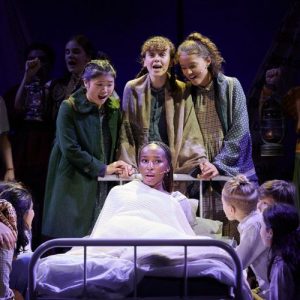
Picture: Konrad Bartelski
A Kiss For Cinderella, performed by National Youth Music Theatre, continues at MCT at Alleyn’s until 20 August.
Star rating: three stars ★ ★ ★ ✩ ✩
The story of Cinderella, of a girl reduced to penury after death of her family before a magical intervention sets her on the path to royalty, is often thought as a European folk tale, thanks to the popularity of the likes of Perrault and the Brothers Grimm’s collections of such stories. But variations of the fable exist all over the world, with China’s Ye Xian being one of the oldest.
That universality is one of the driving forces behind A Kiss For Cinderella, a new musical by Jack Trzcinski and Annabel Mutale Reed. Loosely based on JM Barrie’s play of the same name, the action takes place during the First World War in a rambling old house in Kensington Gardens, not too far from where Barrie once despatched the Darling children out of the nursery window and on to Neverland.
Like Peter Pan, this musical features a disparate collection of lost children. Here, they are refugees from all over the world, hiding out in the kitchens and tended to in secret by Jane (Simi Jolaoso), who does all the household chores because her stepmother and bullying stepsisters are indolent wretches.
Needless to say, the children recognise Jane’s plight from their home countries’ folk legends, so they want to do their best to help their real-life Cinderella find her prince.
The notion of a large gang of children certainly works for National Youth Music Theatre’s ensemble, although at times the sheer numbers on stage risk overwhelming the ensemble numbers. With narration duties also spread over multiple performers, there are times where Reed’s direction loses a grasp on the narrative drive.
But when the action is able to focus on the core characters, the intriguing new spin on the story gets a chance to shine. As with all great historically set dramas, there are plenty of contemporary parallels, not least in the characterisation of Lord Henry Hermes-Howard (Liam Heap), known as “Mister Times” because he is owner, and the editorial voice, of London’s principal newspaper. It is his news stories that are demonising refugee children as traitors trying to steal British secrets to undermine the country in a time of war. Heap demonstrates a fine singing voice and grasp of Lucinda Lawrence’s choreography in an introductory song which also utilises the power of a large ensemble to good effect.
Every Cinderella needs her prince, of course, and Jane has hers in Charlie Weaver’s Lord Edward Jones, a would-be writer who hides his wealthy background when the pair first meet. There is another twist: just as Jane suffers with her stepmother and stepsisters, Edward has a wicked stepfather – in the shape of Mister Times.
Weaver and Jolaoso work well together as the romantic heartbeat of the story. As the characters’ undeniable attraction to each other unfolds, Jane is reticent – not because she doesn’t deserve him, but because he doesn’t deserve her: with all his wealth, after all, what is he doing to help the children she is spending every last penny to feed and clothe while Edward’s stepfather sets the world against them.
The set-up allows for some beautiful numbers, from the balladic ‘I Believe in the Sun’ (perfomed with elan by Weaver) and a powerful ‘Where Are You Now?’, as Jane laments the absence of both a mother and a fairy godmother in her life. Especially in that number but throughout, Jolaoso demonstrates an ability to tell a story through her song performance that will surely work in her favour in future years.
Any Cinderella story needs a ball, and this musical dares to have two. The first, a fiction dreamt up by Jane’s wards, is the more traditional fare we know from many a pantomime rendition, albeit with Charleston-infused choreography. This is followed by the second party, held by Edward’s mother and his wicked stepfather. And while the pastiche of upper class behaviour in ensemble number ‘Chin, Chin, Sip, Sip’ is amusing, it is perhaps telling that the dreamlike party is much the more interesting of the pair.
As the story meanders to its conclusion (the whole piece runs at approximately two and a half hours, and could do with tightening up throughout) some redemption is offered to Katie Hackman’s Baroness, the stepmother whose wickedness only ever extends to a disinterest in the world beyond her art studio. It is a welcome inversion to the idea of an evil matriarch that permeates so many retellings of this perennial tale.
With a sharply written feminist hero, important messages of tolerance and acceptance for today’s audiences and warnings about the dangers of listening to the media and the aristocracy, it feels like Reed and Trzcinski are delivering everything that Emerald Fennell’s book for Andrew Lloyd Webber’s recent West End version of Cinderella promised but struggled to deliver.
So while this musical may feel overlong, while some of its desires to give every one of its ensemble something to say or sing in the large group numbers may work against the work, A Kiss For Cinderella remains a welcome addition to the numerous versions of this age-old tale.
Scott Matthewman
SHARE THIS POST:


Comments are closed.