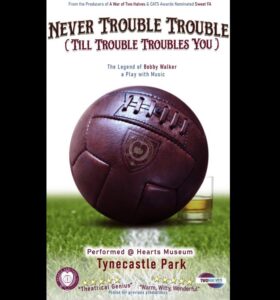
 Never Trouble Trouble (Till Trouble Troubles You) continues at Tynecastle Park – Hearts Museum until 28 August 2023.
Star rating: four stars ★ ★ ★ ★ ✩
“Come away in and hae a drink” exhort Paul Beeson and Nicola Auld, as we meet in the Hearts Supporters Bar for the start of Never Trouble Trouble (Till Trouble Troubles You); the title refers to a favourite saying of Robert ‘Bobby’ Walker, the legendary Heart of Midlothian footballer, whose story is told in this new piece of Scottish musical theatre, written by Beeson.
The opening number sets the tone: storytelling, folk-flavoured songs and earthy banter that consistently breaks the fourth wall. Then we’re off to the Hearts Museum (aka a living room in 1930s Stockbridge) where Mrs Walker descends on her celebrated son’s home, despairing at the state of his housekeeping. “A mother’s work is never done,” she confides, “even when he’s 51.”
Her chief concern is Bobby’s drinking; true to form, he staggers in three sheets to the wind, unable to conceal this from his sharp-eyed Ma. He’s living a maudlin existence, sustained by drinks bought by admirers and memories of his glory days. Mrs W is having none of this, urging her laddie to buck up his ideas while remaining coy about the reason for her visit, which proves pivotal to the plot.
What follows is a picaresque account of Walker’s career, from his Hearts debut at 17 to becoming the team’s most-awarded player, with 29 caps. Early successes are soured by perceived arrogance and bad behaviour (Bobby claims he is simply protesting his poor treatment by management) and by his increasing love of the bottle.
Matthew Brown’s score and Beeson’s lyrics are by turns rousing, heartfelt and toe-tapping, while Beeson and Auld’s voices blend nicely over Alison McNeill’s excellent fiddle playing. Cleverly, the songs sound familiar; at one point, a well-refreshed audience member joined in and kept singing after the cast had stopped.
Auld has just the right gallus attack for Mrs Walker, no slouch when it comes to negotiating contracts and not above wiping her grown son’s face with ‘a wee spittie hankie’. Her spiky energy contrasts nicely with Beeson’s genial, laid-back Bobby, although both are adept at shifting emotional gears when called for. You can hear a pin drop during Bobby’s moving account of the 1902 Ibrox disaster, the collapse of a stand which led to the deaths of 26 supporters. He wryly notes the result of the match was declared void, denying him an international cap against England.
They also play all the other parts. This largely falls to Auld, who sharply delineates a succession of characters, male and female, including Walker’s no-nonsense wife, unable to cope with her husband’s fecklessness. However, Beeson shows good range (and accent skills) as two contrasting football managers.
There are football in-jokes and digs at rival Edinburgh team Hibernian; Auld channels the Child Catcher as the mysterious Mr Farmer, trying to lure Walker across town to Easter Road (her choked ‘Sunshine on Leith’ exit line gets one of the night’s biggest laughs).
However, the show isn’t aimed exclusively at fans of the beautiful game. What we have here is a wee gem, and a Fringe rarity; a two-handed folk musical telling an Edinburgh story, created and performed by an Edinburgh theatre company. A local audience will certainly appreciate it, but it deserves a far wider airing.
Mark Kydd
SHARE THIS POST:


Comments are closed.