Patrick Honoré reflects on a few Off-Broadway gems from a recent visit to New York…
Picture: Joan Marcus
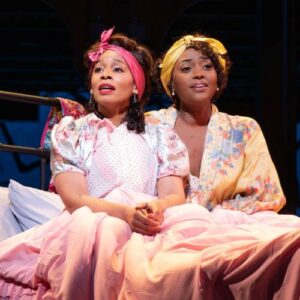
Wonderful Town, New York City City Center Encores!
Wonderful Town, as part of Lincoln Center’s venerated Encores! series, continued to affirm its status as a Broadway classic, primarily thanks to Leonard Bernstein’s immortal score, which includes iconic compositions such as ‘Ohio’ and ‘One Hundred Easy Ways to Lose a Man’, evoking with finesse the bohemian essence of 1930s Greenwich Village. Here the score was interpreted with sumptuous fidelity by the 28-musician Encores! Orchestra under the musical direction of Mary-Mitchell Campbell.
Directed by Zhailon Levingston, this revival breathed new energy into the Sherwood sisters’ adventures, striving to overcome the pitfalls of Joseph A Fields and Jerome Chodorov’s somewhat dated book. The cast’s remarkable performances attempted to transcend this difficulty through captivating character portrayals. This was notable in the nuanced and thoughtful interpretation of Ruth, the aspiring writer, by Renée Reid (standing in for Tony Award winner Anika Noni Rose), as well as Aisha Jackson’s charismatic interpretation of Eileen, whose vocal and choreographic excellence in ‘A Little Bit in Love’ was the production’s most memorable moment.
Supported by an ensemble of distinguished talents – including Jimmy Ray Bennett as Officer Lonigan, Etai Benson as the comically awkward Frank Lippencott, Allison Blackwell as Mrs Wade, DeWitt Fleming Jr as Speedy Valenti and Javier Muñoz as Robert Baker – the work overflowed with vibrant energy, despite a noticeable lack of chemistry in certain romantic relationships, a factor that occasionally diminished the expected emotional impact.
The production’s choreography, developed by Lorin Latarro, though far less spectacular than Kathleen Marshall’s, elevated the musical comedy’s dance sequences, particularly the tumultuous Act I finale ‘Conga’ and the Act II ‘Swing!’, which seduced with contagious enthusiasm. The tap elements from Ayodele Casel were definitely a plus, as well as a first for Wonderful Town.
Meanwhile, set designer Teresa L Williams, costume designer Linda Cho, lighting designer Ben Stanton and sound engineer Megumi Katayama created a visually captivating if sometimes disjointed theatrical universe, while creative consultant Eisa Davis brought a contemporary sensibility that shaped the production’s aesthetic choices.
Despite its ambitions, comparisons with the 2000 Encores! production of Wonderful Town, directed by Marshall, revealed the challenges this latest iteration faced. The earlier version, with Donna Murphy as Ruth and Laura Benanti as Eileen, established an exceptionally high standard with its impeccable comic sense, contagious vitality and dynamic sisterly chemistry that made the narrative naturally captivating and ultimately led to a Broadway transfer in 2003, where it confirmed its status as the definitive revival.
On the other hand, this new 2025 production, though boasting remarkable performances and an ambitious vision, struggled to maintain a consistent rhythm and less effectively integrated contemporary sensibilities, creating moments where the humour seemed dated rather than revitalised, a shortcoming that contrasted with its predecessor’s brilliance.
This reality further illuminated the fact that the 2025 interpretation ultimately missed the opportunity to fully explore the implications of casting Rose and Jackson in the lead roles, as their presence certainly enriched the sisters’ journey but leaft their African-American identity unexplored in the context of 1930s New York, resulting in certain moments missing their target. Nevertheless, despite these obstacles, the production’s musical excellence and spirited performances nourished hope for a future revival that would modernise the humour while preserving the essence of this classic.
 Donna McKechnie, 54 Below
Broadway icon Donna McKechnie returned to the city where her illustrious career, gracing New York’s 54 Below stage with Take Me to the World: The Songs of Stephen Sondheim, a heartfelt, and now a bit melancholic, tribute to the late composer that blended personal memories and masterful interpretations, captivating an audience aching to celebrate both Sondheim’s genius and her own legacy as his acolyte.
McKechnie’s deep connection with Sondheim spans several decades, from her iconic role in Broadway’s original Company cast in 1970 (and its West End production in 1972) to choreographing and performing in the first Sondheim tribute at the Shubert Theatre in 1973. She later shined in the role of Sally in the Paper Mill Playhouse revival of Follies in 1998 and toured nationally in A Funny Thing Happened On the Way to the Forum and A Little Night Music, making this evening a love letter to what now feels like an eternal collaboration.
Accompanied by a stellar trio – Ian Herman, Ray Kilday and Ray Marchina – McKechnie was on exquisite vocal form, her presence radiant as she offered a vibrant medley of Anyone Can Whistle numbers, including a playful ‘I’ve Got You to Lean On’, the poignant title song (Sondheim’s favourite from this show) and ‘There Won’t Be Trumpets’, followed by a charming interpretation of ‘Lovely’ from A Funny Thing Happened On the Way to the Forum.
A highlight of the evening was her selection from Company, presenting ‘You Could Drive a Person Crazy’, a song she helped create, alongside a deeply moving ‘Being Alive’, while her Follies segment proved equally powerful, with the rarely performed ‘Pleasant Little Kingdom’ alongside ‘Too Many Mornings’, ‘The Road You Didn’t Take’ and a breathtaking ‘Losing My Mind’. McKechnie’s interpretation of ‘Send in the Clowns’ from A Little Night Music was deeply, even mournfully, touching. An enchanting rendition of ‘Take Me to the World’ from Evening Primrose followed.
McKechnie’s anecdotes about Sondheim were warm and insightful, but her most poignant reflection captured his essence: “His music and lyrics could be described as a guide for living. Yes, lyrics for living! Through his art, Sondheim found the most beautiful and poetic expression of every experience of the human condition, I think.” The evening constituted a triumphant celebration of Sondheim’s legacy by one of his most devoted performers – too bad McKechnie wasn’t included in his big Broadway tribute, Old Friends, where she belonged as much as anyone.
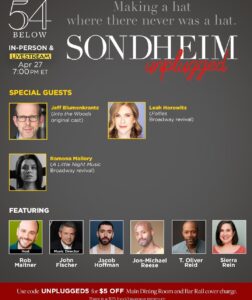 Sondheim Unplugged: The Cut Songs, 54 Below
More Sondheim was to follow the next evening as 54 Below was again transformed into a sanctuary for his devotees, with another, always eagerly anticipated, instalment of Sondheim Unplugged, a cabaret series that, now in its 15th year, continues to honour the master’s genius with unequalled intimacy and artistry.
It didn’t fail to offer another unforgettable evening (this time focusing on cut songs), harmoniously weaving those trunk melodies, complex lyrics and raw emotional power by a first-rate cast, all under the skilful direction of musical director Lucia Spina, with co-director John Fischer at the piano, and the warm and erudite emcee-ing by Rob Maitner, creating an evening that was nothing less than a masterclass in a very special slice of musical history.
The stripped-down ‘unplugged’ format – voice and piano alone – offered a rare opportunity to appreciate the genius of Sondheim’s compositions through these rarely heard gems in their purest form.
Jon-Michael Reese began the evening with ‘There Won’t Be Trumpets’ (cut from Anyone Can Whistle, but now included in most concert versions), offering a passionate interpretation that highlighted the song’s quiet defiance – while throughout, Maitner guided the audience with delectable and deeply insightful pearls from Sondheim’s extraordinary life and works.
This was followed by Sierra Rein with ‘Flag Song’ (cut from Assassins), bringing powerful clarity to its political aspect, while Leah Horowitz’s tender interpretation of ‘Dawn’ (Singing Out Loud) evoked a poignant sense of melancholy.
Ramona Mallory energised the room with ‘Boom! Crunch’ (cut from Into the Woods), capturing the song’s playful yet threatening nuances, while Jacob Hoffman’s sparkling ‘Smile, Girls’ (cut from Gypsy) added a moment of light charm.
The evening continued with remarkable duets, as Reese and Hoffman delivered a biting ‘There’s Always a Woman’ (Anyone Can Whistle), demonstrating their acute sense of comic timing, while Mallory’s ‘Silly People’ (cut from A Little Night Music) established a delicate balance between humour and nostalgia.
Jeff Blumenkrantz’s performance of ‘That Old Piano Roll’ (cut from Follies) offered a vivid contrast with the evening’s more introspective moments, and T Oliver Reid’s elegant interpretation of ‘Uptown Downtown’ (Follies) was imbued with effortless sophistication.
The second half of the evening featured exceptional solo performances, including Rein’s sensual ‘Ah, but Underneath’ (cut from Follies), Reese and Horowitz”s soulful ‘All Things Bright and Beautiful’ (cut from Marry Me a Little), and Hoffman’s expressive ‘Pleasant Little Kingdom’ (Follies), each highlighting in their own way Sondheim’s narrative and musical versatility.
Blumenkrantz then captivated the audience with ‘Multitude of Amys’, a haunting rarity from Company, performed with striking nuance, Maitner delivered a moving ‘Happily Ever After’ (Company), embracing the song’s sardonic honest, before Reid’s interpretation of ‘Marry Me a Little’ (Company) brought the evening to an intimate and poignant conclusion.
As always, Sondheim Unplugged paid tribute not only to Sondheim’s genius but to the lasting emotional impact of his music. Produced and conceived by Phil Geoffrey Bond, this cabaret remains one of New York’s most essential theatrical treasures, preserving the spirit of Sondheim’s work with fresh interpretations while remaining true to its essence.
 Billy Stritch, Birdland
I had the pleasure of attending the Billy Stritch Trio’s final performance of their sold-out six-show run at Birdland, the intimate jazz club buzzing with anticipation as Stritch, alongside his stellar backups, bassist Neal Miner and drummer Aaron Kimmel, held a cosy get-together full of effortless charm and musical sophistication. Their set, a vibrant assortment of standards and surprises, showcased Stritch‘s exceptional piano artistry, rich vocal tone and elegant presence, making the night something extraordinary.
Opening with a radiant interpretation of Cole Porter’s ‘Do I Love You?’ (Du Barry Was a Lady) before a sparkling rendition of Burton Lane and Alan Jay Lerner’s ‘You’re All the World to Me’ (Royal Wedding). The trio’s interpretation of Harold Arlen nad Dorothy Fields’ ‘Out of Sight, Out of Mind’ revealed new emotional depths to the song, while their take on ‘Alone Together’ (Flying Colors) again demonstrated Stritch’s gift for improvisation.
The evening continued to sparkle with Bobby Short’s ingenious ‘Sand in My Shoes’, followed by a Antônio Carlos Jobim’s track, the audience carried along with Stritch’s dreamlike vocals, and a novelty song by Bob Hilliard and Dick Miles, ‘The Coffee Song’, first recorded by Frank Sinatra, bursting out as a joyful, pulsating samba.
The crowning achievement came with a medley from Sweet Charity, the most famous musical written by Stritch’s favourite composer Cy Coleman, where the confident swagger of the cut ‘You Wanna Bet’ transitioned effortlessly into the heartfelt tenderness of ‘Baby, Dream Your Dream’, culminating in the brilliance of ‘My Personal Property’, written for the movie version.
Throughout the night, Stritch’s natural warmth and musical connection with his exceptional bandmates made each song feel as intimate as if we were in their living room. The standing ovation at the evening’s end wasn’t just applause, it was a collective acknowledgment of having witnessed jazz performance at its finest, a reminder of why live cabaret remains so vital.
SHARE THIS POST:


Comments are closed.