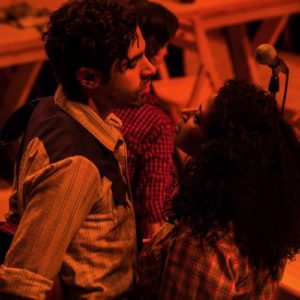
Damon Daunno & Rebecca Naomi Jones in Oklahoma! at Circle in the Square, New York. Picture: Little Fang Photo
Oklahoma! continues at Circle in the Square, New York until 1 September 2019.
Star rating: five stars ★ ★ ★ ★ ★
Oklahoma!, the Richard Rodgers-Oscar Hammerstein II classic, is back on Broadway, where it all began in 1943. But what a difference some three-quarters of a century can make.
In this reworking, avant-garde director Daniel Fish has found and brought to the fore the dark, dark colours underlying R&H’s buoyant tale of cowboys and farmers learning to live together, after their long-time rivalry for the acreage of turn-of-the-20th-century Oklahoma on the verge of United States statehood.
The plot also centres on the romantic triangle made up of raffish but lovable cowboy Curly McLain; Laurey Williams, the comely farm girl; and Jud Fry, the strange outsider who works as a farmhand for Laurey’s Aunt Eller. The sexual tension, heightened by the mysterious pull Laurey feels for the threatening Jud and the love twisted into antagonism that Laurey has for the show-off Curly, is, in Fish’s depiction, beyond riveting.
But the wonder of the production is how all this shares the stage so comfortably with the glories of the R&H score, loaded with songs that pretty much define 20th century American musical theatre: ‘People Will Say (We’re in Love),’ ‘Oh, What a Beautiful Mornin’,’ ‘The Surrey With the Fringe on Top,’ to name but a few. Back in 1943, these songs were game-changers for Broadway musicals for their close integration into the book and furthering of plot, and they work with similar dexterity here as well.
True, the orchestrations and arrangements by Daniel Kluger for the seven-piece on-stage orchestra, have a country-western twang or pop flavouring, but they still delight. And if you don’t believe me, check out the smiling faces on the audience when the show moves into one of those numbers. It’s like they’re meeting an old, dear friend.
Those audience faces aren’t too hard to see, either. For most of the show, the audience is nearly as brightly lit as the almost-in-the-round playing area, bordered by a series of long banquet tables, which seat some of the onlookers. It has the feel of a community hall gussied up for a party. Along with the festivities, though, there’s a hint of violence in the multitudinous shotguns mounted on the walls of the theatre.
Luckily, the production has come to Broadway accompanied by a plethora of rave reviews from its earlier mountings. Fish first unleashed his vision for the show in a student production at artsy Bard College in upstate New York State. Then in 2015 the buzz began when Bard mounted it with a professional cast as part of a summer festival. Last year a cluster of commercial producers brought the show Off-Broadway to the St. Ann’s Warehouse in Brooklyn, a haven for unusual work, and the praise pretty much reached the heavens.
Thus, Broadway audiences, at least the savvier ones, know what to expect, and they’re prepared to take in stride and even admire Fish’s more outré choices. They know this is not going to be the Oklahoma! they may have seen before in its various Broadway incarnations, or on tour, or even one they may have performed in high school.
For example, there’s Laurey’s dream sequence minus the eloquent pas de deux and vivacious can-can girls that marked Agnes De Mille’s original choreography. Now, it’s pretty much just one terrific modern dancer, Gabrielle Hamilton, with shaved head and wearing a sparkling T-shirt emblazoned with ‘Dream Baby Dream’, going through an extended series of jaw-dropping moves in a seeming expression of erotic frustration unleashed.
There’s also the theatre’s jolting pitch into total blackness, for the scene between Jud and Curly in Jud’s abysmal shack, and a really serious rendering of ‘Pore Jud (Is Dead)’, with a gigantic video projected onto a wall of the theatre, so that we can absolutely see the tears forming in Jud’s eyes.
Then, there’s the violent blood-splattered climax, in which Jud meets his end, and how it reveals a corrupt community out to protect its own. And since at intermission we’ve already partaken of the town’s chili and cornbread, cooking on set through Act I, we’re part of that community as well. Accomplices, you might say.
A lot of the audience enticement has to do with the splendid cast carrying out Fish’s vision. Most of them were at St. Ann’s, including Rebecca Naomi Jones as the conflicted, emotionally compelling Laurey; Damon Daunno as the boyishly sexy Curly; Patrick Vaill as the deeply complex Jud; and Mary Testa as the wisecracking, authoritarian Aunt Eller.
Also key to the show’s pure entertainment value are Ali Stroker who makes an infectious Ado Annie, the town’s irrepressible playgirl, and James Davis as Will Parker, her unwavering suitor. As the peddler Ali Hakim, an unwilling contender for Annie’s hand, Will Brill is a figure of affable smarminess.
The move to Broadway has maintained the show’s intimacy, while somehow enriching the musicality, as unconventional as it often is, and added even a bit more ingrained depth to its characters.
Advertising for the production calls it a classic “reimagined for the 21st Century”, With Daniel Fish’s dark vision, that may not be much of a commendation for our current century, but it surely makes for dynamic theatre.
Ron Cohen
SHARE THIS POST:


Comments are closed.