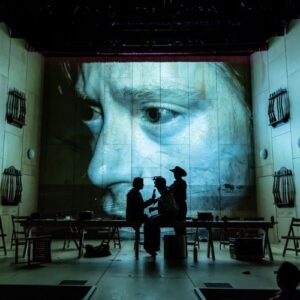
Patick Vaill, Arthur Darvill and James Patrick Davis in Oklahoma! at the Wyndham’s Theatre, London. Picture: Marc Brenner
Oklahoma! continues at Wyndham’s Theatre, London until 2 September 2023.
Star rating: five stars ★ ★ ★ ★ ★
This year sees the 80th anniversary of the debut of Richard Rodgers and Oscar Hammerstein’s first collaboration. Oklahoma!, based on Lynn Riggs’ play Green Grow the Lilacs, is often cited as the first in a new style of musical theatre production.
While that’s not completely true (indeed, the same accolade has sometimes been given to Hammerstein’s earlier work with Jerome Kern, Show Boat, among others) there is something about Oklahoma! that solidified the transition of musicals’ book work from slight joining material that moved events along between songs, to complex stories with songs that expanded upon the intricacies and difficulties of the characters’ lives.
Over the years, though, the sense of innovation within Oklahoma!’s staging succumbed to a sort of chintzification, replacing the muscularity of Hammerstein’s book with a light, romanticised vision of life in the Old West.
Daniel Fish stripped everything back in his 2007 college production, which after revival in 2015 went on to a sell-out run at the Young Vic last year. It now arrives in the West End freshly accompanied by seven Olivier Award nominations, representative of the quality present throughout.
Fish moves the action off from golden-hazed meadows to a plywood-lined, overlit community hall. The in-the-round setting of the Young Vic is replaced by a more conventional proscenium arch staging (in line, one suspects, with the changes Fish made when taking his production on its US national tour). The sense of the immersion is emulated by extending Lael Jellinek and Grace Laubacher’s set outwards, wooden panels festooned with gun racks covering the Wyndham’s boxes.
The lighting, too, extends into the audience: there is little concept of house lights here, implicitly telling us that we are part of the action (and, when the time comes, are complicit). As with so much else in this production, the lighting is taken to extremes: with a stage and audience normally flooded in light, the occasions in which Scott Zielinski’s lighting design plunges the theatre into total darkness – once in Act I for the first tense confrontation between Arthur Darvill’s cowman Curly McLain and Patrick Vaill’s farmhand Jud Fry, again in Act II for Jud’s time alone with Anoushka Lucas’ Laurey, the woman both men desire – carry with them a sense of foreboding evil.
And it is that dark tone that may surprise those who think of Oklahoma! as still being a sanitised vision of frontier life with a 1950s Hollywood sheen. There is danger here. But there is ambiguity, too: Vaill’s Jud is withdrawn, damaged, twitchy, almost fearful of being around other people. Liza Sadovy’s Aunt Eller, the closest this small community has to a matriarch, tempers her kindly air with an edge of pure steel.
Tempering the air of menace are some beautifully observed comedic elements, thanks to Georgina Onuorah’s Ado Annie (more than ably taking over from Olivier nominee Marisha Wallace), James Patrick Davis as her suitor Will Parker and a scene-stealing Stavros Demetraki as travelling pedlar Ali Hakim, forever trying to extricate himself from the weird love triangle the trio have together.
Less well drawn are the musical’s romantic leads. While there is more than a touch of Beatrice and Benedick to their constant verbal jousts, the Curly-Laurey relationship never feels quite as rooted in Fish’s vision as some of the other characters. But both make up for this with their musical performances: when Curly picks up a guitar to jam with the nine-piece band (led by musical director Huw Evans) or to serenade Laurey, Darvill comes alive. Lucas, for her turn, expresses Laurey’s inner vulnerability within her outer shell of stone through a vocal performance that is as remarkable as it is self-assured.
For all the modern trappings (the costumes are modern-ish, lunchboxes are replaced by coolers full of beer cans) Fish is slavish to Hammerstein’s book. Anachronisms abound but are not dwelt upon: instead, in this simmering melting pot, they are signs that everyone is playing a role to a lesser or greater extent.
What is markedly different is the approach to Richard Rodgers’ music. Daniel Kluger’s orchestrations and arrangements, eschewing a traditional musical theatre orchestra in favour of banjo and guitars both acoustic and electric, bring as fresh a perspective on the musical’s songs as the staging brings to Hammerstein’s words.
This approach reaches its zenith in the reimagining of Laurey’s “dream ballet”, a fantasy sequence in which the heroine tries to reconcile her conflicted feeling about the two men vying for her affections. Marie-Astrid Mence performs choreography by John Heginbotham that has nods to ‘’s original work, but which is darker, sexier, more dangerous, and yet more emotionally ambiguous.
Perhaps the greatest innovation – while still remaining true to the letter of the original – is the relationship between Curly and Jud. The cowman’s taunting of the farmhand in Act I, suggesting that Jud hang himself, shows a cruel, sadistic streak to the lead character. Darvill’s blisteringly aggressive rendition of ‘Pore Jud is Dead’ heightens that sense that, perhaps, our traditional sense of loyalty to his character may be misplaced. Performed in near darkness, illuminated only by a night-vision extreme close up of Vaill’s face, it’s a chilling sequence.
That sense of brutality surfaces again in the pair’s final confrontation. Originally written, Jud tries to attack Curly and ends up falling on his own knife. His death is much more explosively explicit here. What was originally written as the community coming together around Curly to ensure an innocent man is not punished becomes something crueller, more visceral: territory folks sticking together.
The lone voice of dissent comes from one of the show’s Black characters: there are layers upon layers of meaning within the show’s final moments, suggesting perhaps that a messy, extrajudicial approach to upholding the law is a part of America’s DNA that plagues it to this day.
One might suggest that Oklahoma! does not need such allegories, and that their inclusion detracts a little from the musical’s central plot and message. That may be true – but for every small misstep, there is a raucous two-step into thrilling reinvention.
Daniel Fish’s reinterpretation may not be to everyone’s taste. It certainly won’t be regarded as presaging a new form of musical theatre the way the original production did. But what it does do is return the musical to what Rodgers and Hammerstein did 80 years ago: a proof that musical theatre can tell thrilling, involving stories of human struggle in captivating, breathtaking ways.
Scott Matthewman
SHARE THIS POST:




Comments are closed.