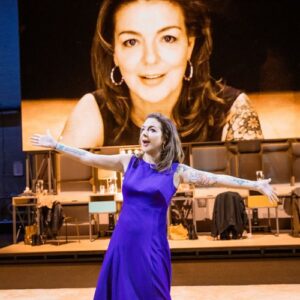
Sheridan Smith in Opening Night at the Gielgud Theatre, London. Picture: Jan Versweyveld
Opening Night continues at the Gielgud Theatre, London until 27 July 2024.
Star rating: two stars ★ ★ ✩ ✩ ✩
John Cassavetes’ 1977 film Opening Night is a psychological drama set behind the scenes (and on the stage) of a Broadway play. The cast is led by mercurial, troubled leading lady Myrtle Gordon. Unable to connect with her material and haunted by the ghost of a young fan who is hit by a car at the stage door, Myrtle descends into despair. Her increasingly erratic behaviour produces an ever-worsening situation as the play struggles through previews and heads towards its opening night.
Given how much musical theatre has always loved a behind-the-scenes melodrama, from 42nd Street to Sunset Boulevard, in many ways, it’s a surprise that it’s taken nearly 50 years to adapt Cassavetes’ work for the stage. It is a shame that now that it has, the production is as fractured and flailing as the play-within-a-play.
Director Ivo van Hove – who has also written the book – places the action on a deconstructed stage. Actors’ dressing room mirrors stand against the back wall, while backstage corridors are built out from the Gielgud’s own backstage area to emerge in front of us. When they are not needed, actors assemble in the visible wings of the stage.
At first glance, this arrangement seems sensible for a play that seamlessly moves the action between onstage and off, like its film predecessor. But what harms the musical, very probably beyond repair, is the insistence on including a giant video screen with live visuals above the actors’ heads.
In van Hove’s version of events, a documentary crew is filming the play’s production, and it is the crew’s footage we watch on the screen. Characters are introduced in captioned close-ups, and as rehearsals go on, camera operators move their steadicams around the performers. The size and scale of the video screen diminishes everything being played out in front of it, constantly taking our attention away from the live actors in favour of the digital facsimile above their heads.
We are lucky that this musical’s leading lady is Sheridan Smith. There may be a metatextual relevance to Myrtle, a performer who struggles with her mental health and alcohol dependency, being played by an actor who has battled similar demons in real life. However, Smith’s true advantage is her combined experience in stage performance and television. Here, she is required to draw on both of these subtly different skill sets; Smith makes the subtle shifts between acting for the camera and acting for the stage look effortless.
As the musical progresses, the opportunities to find creative satisfaction in the onstage antics become harder. Hove seems to care little for his characters’ well-roundedness, seemingly believing that the documentary captions have explained who these people are so well that engaging dialogue and meaningful characterisations are unnecessary foibles.
Hadley Fraser and Amy Lennox do their best as the play’s director and his long-suffering wife, who must endure her husband desperately sweet-talking his leading lady when he should instead focus on his marriage. But when there’s nothing in van Hove’s book but vapid shallowness, the best actors’ struggles come to nought.
The nine-piece orchestra, under musical director Nigel Lilley, provides an explosive, brassy underscore and some multi-layered songs. Rufus Wainwright’s music captures the piece’s weird, disintegrating mood, but the lyrics often fall short. Melodic lines that imply that the actor’s singing performance is to be an extension of their spoken one are accompanied by mismatched lyrics with uncomfortable phrasing and trite rhyming schemes.
It is noticeable that when, in Act II, the video shuts down so that Smith’s Myrtle and the play’s writer, Sarah (Nicola Hughes), can have a heart-to-heart as they try to resolve their differences, the musical kicks itself up a gear. It is as if, miracle of miracles, Opening Night has remembered that its audience is in the same room. Tragically, such moments are short-lived, and that colossal screen flickers back into life, draining the same from all around it.
Not all of the video usage is bad. A fight between Myrtle and the demon she has constructed for herself in the form of her fan’s ghost (Shira Haas’ Nancy) plays out in front of a shot of the same stage, which also shows the video screen, turning the display into a recursive tunnel of madness, with time delays echoing the performers’ actions. And the use of an overhead camera, which previously gave us shots of Smith as she danced solo in Act I number ‘Magic’, is utilised again in Act II as Nancy harasses Myrtle’s co-star, Gus (Jos Slovick). Here, the overhead video shows Slovick alone.
But most of the time, van Hove’s obsession with the video makes us feel as if rather than watching a stage musical, we’re part of a studio audience, incidental to proceedings except to stroke the ego of a director and book writer who feels no compulsion to make his production accessible. Characters do not always have to be sympathetic or likeable as long as we become invested enough in finding out why they behave the way they do and want to see the outcome of their actions. There is little chance of anyone sufficiently caring about Opening Night’s characters to want to find out.
It is heartbreaking that such a great cast has to endure this work. But even more so is the expectation that West End audiences will sit through it. Cassavetes’ creation of a film about an imploding play was a creative success in 1977; in 2024, the adaptation is even more of a mess than the play at its heart.
Scott Matthewman
SHARE THIS POST:




Comments are closed.