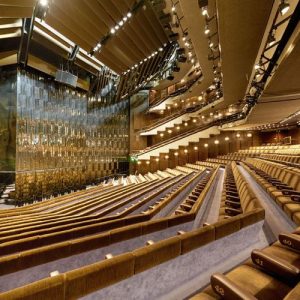
The performing arts industry has given a cautious welcome to the Prime Minister Boris Johnson’s hopes for the return of live socially distanced indoor performances from 17 May 2021 followed by a return to full capacity operations from 21 June.
Announced as part of the four-stage ‘roadmap’ for the phased lifting of lockdown restrictions, the return of any form of live indoor entertainment performances in May falls under step three of the plan and is, like all phases of the plan, subject to change if the data produced following the previous two stages proves concerning and fails the ‘four tests’ outlined by the PM in the House of Commons.
Responding to the PM’s statement, the chief executive of the Society of London Theatre and UK Theatre, Julian Bird said: “We welcome the Government’s roadmap announcement as the country takes the first steps towards easing lockdown – in particular, the news that theatre and live arts can resume performances for Step 3 with social distancing, potentially as early as 17 May. The real route back for the sector will be the Step 4 announcements hopefully enabling full auditoriums from 21 June.”
Pointing to the fact that none of the dates are set it stone, he went on to say: “These dates are still subject to change, however, and even once confirmed it will take time for many of our theatres and productions to get back up and running. While they remain closed and as they return to full operation, we urge the Chancellor to continue with the financial support packages needed for businesses and individuals.”
Commenting on behalf of the Creative Industries Federation, CEO Caroline Norbury added: “Today’s roadmap includes some welcome milestones for reopening parts of the UK’s creative industries, including our world-leading theatres, cinemas and live events. However, it is critical that everyone in our sector is supported until they are able to resume normal levels of operation, which could be well beyond summer.
“It is vital that the Job Retention Scheme and Self Employment Income Support Scheme are extended, and support must also be guaranteed for the many who continue to fall through the gaps of existing schemes. Further Budget interventions, including Creative Industries tax reliefs and a government-backed insurance scheme for live events, are urgently needed.
“The creative sector is integral to the future of the UK. With the right support, it can not only bounce back; it can drive the UK’s economic recovery, regenerating our towns and cities, creating jobs and making our communities happier, healthier places for everyone.”
Step two (beginning no earlier than 12 April) will mark the beginning of the Government’s scientific Events Research Programme which includes a series of pilots using ‘enhanced testing approaches and other measures to run events across various sectors and in different settings with larger crowd sizes and reduced social distancing to evaluate the outcomes… to determine a consistent approach to lifting restrictions on these events’.
However, the first key date for theatre-lovers and practitioners will fall no earlier than 17 May when it is hoped all outdoor entertainment including outdoor theatres and most indoor entertainment will be allowed to resume with measures including social distancing still in place.
According to the official Government documents some large events, including conferences, theatre and concert performances and sports events will be allowed in step three. These are described as ‘controlled indoor events of up to 1,000 people or 50% of a venue’s capacity, whichever is lower’ and ‘outdoor events with a capacity of either 50% or 4,000 people, whichever is lower’.
The Government will also make a special provision for large, outdoor, seated venues where crowds can be safely distributed, allowing up to 10,000 people or 25% of total seated capacity, whichever is lower.
If all goes well, the Government hopes to move onto step four from 21 June when it hopes the majority of the restrictions that have made it impossible for theatres and other venues to operate at full capacity will be lifted. In his statement the prime minister said there would be a minimum of five weeks between each step to allow the Government four weeks to study any adverse effects of the lifting of each set of restrictions and to enable the Government to give businesses a week’s notice before the next set of restrictions are relaxed.
In notes accompanying the details of step three, the document highlights the extent of the hit the arts, entertainment and recreation sector (excluding sports, amusement and recreation) has taken during the pandemic. Pre-Covid-19, it states, this sector was worth £18.3 billion GVA UK wide (£15.5 billion in England) with 473,000 jobs (400,000 in England). GVA output in the arts, entertainment and recreation sector as a whole compared to February fell by 46% in April, and subsequently to 33% in November 2020. In no month since March 2020 has output been above 77% of pre-pandemic levels. The sector as a whole has also had a high take-up of the furlough scheme, with 455,000 furloughed at peak in spring, and 293,000 furloughed at the end of November 2020. Between 25 January and 7 February 2021, 44% of businesses in the arts, entertainment and recreation sector had paused trading.
Angela Thomas
SHARE THIS POST:


Comments are closed.