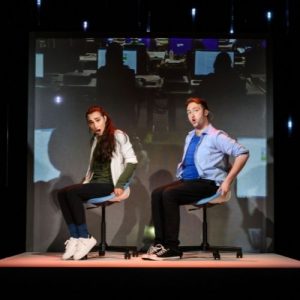
Picture: Jane Hobson
Public Domain continues at the Vaudeville Theatre, London until 30 May 2021.
Star rating: three stars ★ ★ ★ ✩ ✩
Remember when Facebook used to be about connecting with friends and sharing life updates, rather than being bombarded by ads and conspiracy theories?
So do Francesca Forristal and Jordan Paul Clarke, who created verbatim musical Public Domain from the germ of an idea first explored in Newsfeed, a 2019 evening of musical theatre songs written in response to news events. That show’s curator, Adam Lenson, helped Forristal and Clarke develop their idea, first through his Signal series of concerts and then, in January, by directing a live-streamed production of the full one-act piece from the stage of the Southwark Playhouse.
That production utilised the enforced viewing on a computer screen to great effect, using dynamic overlays and other effects, particularly when it came to two of the show’s vlogging characters. Forristal plays Millie, a girl who gives up a legal career to become a lifestyle and wellness coach; Clarke, a teenager who vlogs about how to be popular at school when it’s obvious he’s anything but.
For the in-person premiere, those video effects are replaced with projections, Libby Todd’s set and Matt Daw and Sam Waddington’s lighting design combining to place Forristal and Clarke in portrait-mode frames.
This strand of the musical bears most of what could be described as the show’s narrative structure, as the pair attempt to deliver cheery videos to their subscribers no matter what they are feeling inside.
That arc is placed alongside songs revolving around Facebook, most notably its CEO Mark Zuckerberg. The verbatim nature of the musical pits Zuckerberg’s testimony to a US Congressional committee with a soft-soap “at home” interview he and his wife, Priscilla Chan, gave to US television.
Clarke’s Zuckerberg impression plays the straight man to Forristal’s numerous characterisations, from Chan’s fine-honed PR vapidness to a succession of US politicians. Much merriment is made of the befuddlement of Senator Orrin Hatch, whose lack of understanding about ad revenues was widely mocked at the time. More effective is Forristal’s portrayal of the forensic questioning by Rep. Katie Porter, whose grilling of the CEO exposes that, away from the headline bullet points, Zuckerberg was unprepared for a full discussion of the impact Facebook was having on people’s lives.
That Facebook angle is compounded in ‘Nine Minutes to Cry’, a piece based on news interviews of two members of a moderation team who have to endure watching the most vile content so that others don’t have to, but whose personal welfare is all but ignored by their employer. The grimness of their situation is contrasted by the overly cheery tone of Clarke’s music, making the moderators’ plight all the more tragic.
If this progression of the narrative feels incomplete, it is because Facebook’s story – and that of social media’s impact on our lives – is ongoing. Video clips of then-President Trump declaring war on TikTok, and of the 6 January insurrection which, even now, Republican senators are denying even happened, show that this is just a sliver of a story which has no end.
And that makes Public Domain’s surface scratching all the more frustrating. Musically, there is so much to enjoy, especially the show’s penultimate number, ‘Lovely Boat’, in which old people from 80 to 100 extol the virtues of the technology they use. It is a lovely piece, but thematically it doesn’t quite gel with the show’s other moments.
In its 75-minute running time, Forristal and Clarke’s musical tries to grab at multiple facets of how the internet impacts our lives, and as a result doesn’t quite get enough purchase on any single one. But, just as the internet’s story is not finished, it feels that neither is Public Domain’s. A West End debut should not prevent a musical from being further developed, especially one which has a lot to say about the state of our world.
At the beginning of the show, a tannoy voice warns that we may want to delete our socials afterwards. Public Domain never comes close to living up to that promise, but in its most effective moments it does encourage us to think more critically about what we view online.
Anyway, on Twitter we’re @MusicalTheatreR and I’m @scottm. Like and subscribe, yeah?
Scott Matthewman
SHARE THIS POST:


Comments are closed.