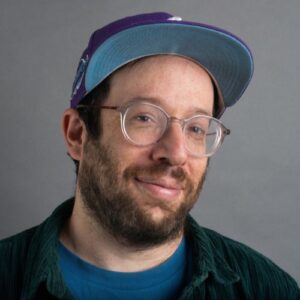
Picture: Guy J Sanders
We are very sorry to hear of the death of director, dramaturg and champion of new musical theatre Adam Lenson, who had been living with cancer. We are sending much love to his family and friends.
Lenson’s recent directorial credits included new musicals Flyby at Southwark Playhouse and the much-acclaimed London runs of Cable Street at Southwark Playhouse and Marylebone Theatre.
In August this year he took his own show Is It Too Late Now To Say Sorry?, a funny, hopeful exploration of guilt, shame & the terrifying possibility of forgiveness, to the Edinburgh Festival Fringe.
Other directing work credits were Superhero, Wasted, The Rink, The Fabulist Fox Sister (Southwark Playhouse), Public Domain (Vaudeville Theatre), Songs For a New World, Whisper House, 35mm (The Other Palace), Ordinary Days (Trafalgar Studios), Little Fish, Saturn Returns (Finborough Theatre), See What I Wanna See (Jermyn Street Theatre), Dark Tourism (Park Theatre), The Goodbye Girl (Upstairs at the Gatehouse), The Sorrows of Satan (Tristan Bates Theatre), Shift+Alt+Right (ALP Musicals), Come Fly With Me (Salisbury Playhouse), The Leftovers (Sheep Soup, national tour), Stages, Lock & Key (Vault Festival), The Storm (Helios/ENO) and The Family (Old Vic US/UK Exchange, Public Theater, NY).
Lenson also directed productions for several drama schools including the Royal Central School of Speech and Drama, the Guildford School of Acting and LAMDA.
In 2018 Lenson founded ALP musicals with the goal of developing artist-driven musical theatre that played against traditional notions of what musicals looked like, sounded like or were about. He also produced and hosted SIGNAL, a concert series that held more than 20 events both as live performances and as digital and hybrid live streams.
SIGNAL gave over 300 writers a platform to share new songs and shows, sold out London venues and was watched by more than 70,000 people online.
Producer Neil Marcus, who collaborated with Adam Lenson on Cable Street amongst other projects, pays tribute below.
To say that Adam was passionate about musical theatre would be a gross understatement. He possessed an encyclopedic knowledge of the art form, from its roots in vaudeville and operetta to the most exciting emerging talents breaking through on both sides of the Atlantic and beyond.
Like everything he cared about, Adam was a bold champion, enthusiast and defender. He was never afraid to be provocative, challenge assumptions, or make the case for what he loved. His book Breaking Into Song: Why You Shouldn’t Hate Musicals remains a perfect example of that spirit.

Adam Lenson recently directed Flyby at Southwark Playhouse, London. Picture: AlexBrenner
Adam cared deeply about great music, lyrics and storytelling. His SIGNAL series, which began as a live event before moving online during lockdown, was created to give composers, lyricists and librettists the freedom to write and showcase the work they wanted to create, rather than what they had been commissioned to produce. Countless shows found their beginnings there, not least Cable Street, which Dylan Schlosberg and I picked up directly from a SIGNAL showcase.
After training on the National Theatre’s Directors Course, Adam developed his craft by assistant directing for an extraordinary range of talents, including John Doyle, Terry Johnson, Stephen Daldry, Nancy Meckler, Roxana Silbert, Lindsay Posner, Victoria Wood and Maria Friedman.
As a director and theatre-maker, his work was both varied and prolific, and he expanded his creative practice into producing, video design and sound design. His productions included Ordinary Days at Trafalgar Studios and Songs for a New World at The Other Palace. I know he was especially proud of Flyby, created with his close friend Theo Jamieson, which recently enjoyed a run at Southwark Playhouse. There, he also directed The Rink, Cable Street, Superhero and Public Domain, the latter transferring to the Vaudeville Theatre.
Adam’s Jewish identity was an important part of who he was, and he took great pride in creating and presenting the long-running Great Jewish Songwriters series at London’s Jewish Community Centre JW3 alongside Theo Jamieson and me.
His impact was far-reaching. Through his artistry and advocacy he helped shape the landscape of modern British musical theatre. That tapestry is undoubtedly less rich without him, and his influence will continue to be felt by many wherever original musical theatre is celebrated.
SHARE THIS POST:


Comments are closed.