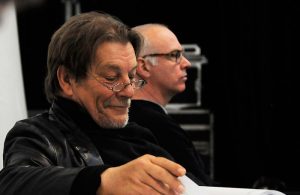
 Remembering Bob Carlton (1950-2018)
The name Bob Carlton may in many people’s minds just mean the author of Return to the Forbidden Planet, the Olivier Award-winning musical version of Shakespeare’s play The Tempest.
Understandably it is the piece than the writer-director is most famous for, but there was a lot more to Bob Carlton than just one show.
Although he occasionally worked in television on Emmerdale, Streetwise and Brookside, he was in fact a total man of the theatre and had probably acquired more experience than most in not only writing and directing for the stage and TV, but also running a theatre, the Queen’s at Hornchurch in Essex, where he installed a company and staged his own work and that of others.
Michael Darvell recalls a man whose world was the theatre.
Bob Carlton was born in Coventry in 1950. Theatre became his life from the minute he left school and went to work as a student assistant stage manager for three years.
He then decided to educate himself formally in theatre, so went to Hull University to study drama. After graduating he immediately gained an Arts Council training bursary at the Belgrade in Coventry and then never looked back. He was in the theatre for ever more.
Asked to describe himself, he claimed to be a director who also writes. As a director he amassed a great deal of experience with such companies as Bubble Theatre, which toured London in its Big Top tent. It was at Bubble that the idea of casting actors who are also musicians came about, presumably as a way of saving money.
In his time Carlton was also associate director at the Dukes Playhouse in Lancaster and at the Theatre Royal in York. He also worked all over the country as a freelance director for Watford Palace, the Oxford Playhouse, Newcastle Playhouse and the Everyman in Liverpool, among others.
For a self-styled part-time writer Carlton was quite prolific. He wrote You’ll Never Walk Alone for Liverpool as well as many Christmas shows. He did Keep On Running for the Birmingham Rep as well as From a Jack to a King which also played the Ambassador’s Theatre in London.
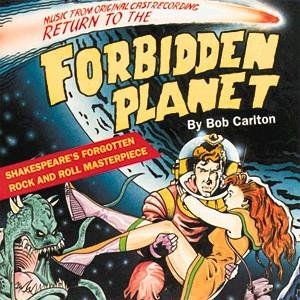 Return to the Forbidden Planet was written for Bubble Theatre. Carlton had seen Forbidden Planet, the MGM film based on The Tempest but set in space, and decided he could make a musical out of it.
It was probably his most successful show ever, be it in town, on tour or overseas where it played New York, Australia and Japan. He always wanted to make populist theatre out of anything he worked on. This is demonstrated by his tenure for some 18 years from 1997 of the Queen’s Theatre in the Essex outpost of Hornchurch, a local house that was failing before Carlton arrived to put it back on the community map.
In his time he not only turned the Bard into a rock‘n’roll musical but also staged new plays, classic revivals and shows with an obvious popular appeal such as Gerry Sweeney’s play The Good Intent about a Coventry City football fan.
A show called Face, which he wrote with Bob Eaton, Julian Littman and Phil Whitchurch played at his own theatre in Essex.
He obviously had a great affection for both his Hornchurch creative team and their audience as he explained to the local Hornchurch Life magazine when he resigned in 2014: “I am so proud of everything we have achieved over the last 17 years. It has been a true team effort involving a lot of very dedicated and ingenious people who have created quality theatre on shoestring budgets. I’m looking forward to new adventures but will always think fondly of the Queen’s. I hope it continues to be a place where our whole community comes to enjoy professional, affordable, truly fantastic theatre.”
Bob Carlton was born on 23 June 1950 and died from cancer on 18 January 2018. He was married to Caroline Wildi. R.I.P.
Michael Darvell
SHARE THIS POST:


Comments are closed.