 How will audiences remember Olivia Newton-John, who has died from breast cancer at age 73? Michael Darvell looks back at an artist who was very much more than just a pop singer with an astonishing musical career…
Will they remember her as a singer of 11 chart-topping singles and 15 albums, with over 100 million sales and four Grammy awards, or as the actress playing Sandy Olsson in Grease, one of the most successful recent classic film and stage musicals, or as a tireless worker for environmental and animal rights causes and in particular a spokesperson for breast cancer research?
In fact the answer is that Olivia Newton-John will be remembered for all these aspects of her life in which she started out as a singer and recording artist only to achieve global success in everything she did. Olivia Newton-John was born on 26 September 1948 in Cambridge, England to Brinley Newton-John and his wife Irene Helene. Her father was Welsh while her mother was born in Germany but had emigrated to the UK in 1933 to flee from the Nazis. Her maternal grandfather was Max Born, the Nobel Prize-winning physicist.
Olivia’s father, an MI5 officer working at Bletchley Park on the wartime Enigma code, had to arrest Hitler’s Deputy Fuhrer Rudolf Hess prior to his trial as a war criminal in Nuremberg. Brinley Newton-John later became headmaster of Cambridgeshire High School for Boys and subsequently the master of Ormond College at the University of Melbourne.
In 1954 the family moved to Australia when Olivia was six and since then she had always considered herself as being Australian, the country where she received most of her education. At 14 she was in an all-girl singing group called Sol Four and after they split she worked for Australian Television under the name of Lovely Livvy. She met her singing partner Pat Carroll and they worked together for a time. Olivia won a talent competition in 1965, the prize being a trip to the UK where she subsequently recorded her first single, ‘Till You Say You’ll Be Mine’.
When Carroll also moved to the UK they formed a duo which toured the nightclubs of Europe including Raymond’s Revue Bar in London’s Soho. After Carroll returned to Australia in 1970 Olivia stayed on and joined a group called Toomorrow [sic]. They made an album and a film of the same name but both flopped. A year later, however, Olivia released If Not For You, her first album which had a title track by Bob Dylan. She went on to make appearances on the Cliff Richard TV show and recorded more singles and an album just called Olivia which included songs by George Harrison and John Denver, but it was only a modest hit. In 1973 her luck changed with her ‘Let Me Be There’ single which won her a Grammy for Best Country Female Singer. It also gave rise to an album of the same name.
Then came the Eurovision Song Contest in 1974. Her song, ‘Long Live Love’, came fourth after ABBA who won with ‘Waterloo’. However, her next single, ‘I Honestly Love You’, became her first No. 1 pop song and also something of a signature tune as well as the Grammy Award-winning Record of the Year. She fast became a successful country singer acknowledged by a Country Music Association award and a personal tribute from Dolly Parton’s sister Stella. This led to Olivia leaving the UK to move to the USA where she garnered more plaudits and awards, culminating in her first Platinum award for Olivia Newton-John’s Greatest Hits album in 1977.
 Alongside her successful recording career another venture for Olivia was to make her even more popular, the advent of the film version of Grease. The musical stage show had originated in 1971 at the Kingston Mines nightclub in Chicago with book, music and lyrics by Jim Jacobs and Warren Casey. It was based on the experiences of Jacobs’ high school days during the 1950s rock‘n’roll era. It was originally written just as a play until their budding producers decided it would work better as a musical. After an Off-Broadway staging in 1971 its fate was sealed and it moved on to Broadway and played for the next nine years in over 3,000 performances. The cast included Barry Bostwick as Danny and Carole Demas as Sandy but some cast changes later included Richard Gere as Sonny.
Following a try-out in Coventry, the first West End production at the New London Theatre in 1973 featured Richard Gere as Danny and Stacey Gregg as Sandy, later to be replaced by Paul Nicholas and Elaine Paige. However, the show ran for only eight months. When it was revived at the Astoria in 1979 it lasted just three months. So, it then had to wait until 1993 to be the great success it eventually became in London at the Dominion, later transferring to the Cambridge Theatre in 1996 where it ran for another three years. It has had two more revivals on Broadway and another four in London, the latest being a new production at the London Dominion in 2022, following a UK and Ireland tour from 2019. The London production was dedicated to the memory of Olivia Newton-John for the rest of its run.
Grease is a stage musical that has eventually played all over the world, proving that you cannot keep a good show down for very long. Faced with its eventual success it was a foregone conclusion that it should then become a movie musical. However, it was not that straightforward a passage from stage to screen. Work on casting the new film began in 1976. Whereas the film’s co-producer Robert Stigwood had already worked with John Travolta on John Badham’s Saturday Night Fever and the actor had already been in a stage production of Grease, although not in the leading role of Danny, Olivia however had had little experience of acting, apart from a couple of minor pieces, Funny Things Happen Down Under in Australia, and the aforementioned Toomorrow in New Zealand.
Olivia herself asked for a screen test as she felt that at 28 she was a little too old to play a high school teenager. By then Travolta was only 22 but he had been in three other films apart from Saturday Night Fever, namely Robert Fuest’s The Devil’s Rain with William Shatner, the TV movie of The Boy in the Plastic Bubble by Grease director Randal Kleiser, and Brian De Palma’s Carrie with Sissy Spacek.
The other co-producer, Allan Carr, had his own list of possibles for the part of Sandy including Carrie Fisher, Marie Osmond, Deborah Raffin, Susan Dey and Ann-Margret. All the other potential Sandys were much younger than Olivia, except Ann-Margret who, in 1976, was 35! Ann-Margret’s maiden name of ‘Olsson’ was given to Olivia’s part of Sandy in the film version because she did not sound American enough, so the character became an Australian immigrant. She continued, however, to work in both the US and Australia.
Of course the eventual film of Grease (released in 1978) was a huge hit and enjoyed several re-releases, while the soundtrack produced at least three major hit singles, ‘You’re the One That I Want’, ‘Hopelessly Devoted to You’ and ‘Summer Nights’. Olivia was nominated for a Golden Globe and sang ‘Hopelessly Devoted to You’ at the 1979 Academy Awards where the song had been Oscar-nominated. The other two songs remain among the 20 best-selling singles of all time in the UK, while the soundtrack album has sold over 30 million copies worldwide, having stayed at the top of the charts for 13 weeks.
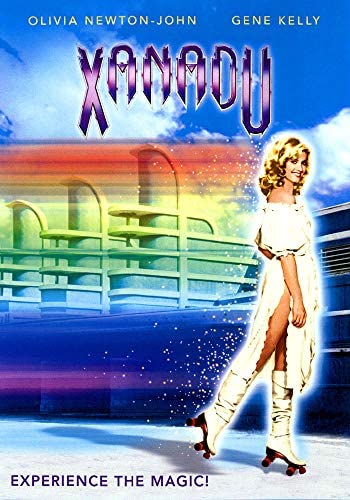 After Grease Olivia’s film career sadly did not repeat the same success. In 1980 she appeared with Gene Kelly and Michael Beck in Xanadu, a musical fantasy by Richard Christian Danus and Marc Reid Rubel. It had music by Olivia Newton-John, the Electric Light Orchestra, Cliff Richard and the US rock band The Tubes. In the film ‘Xanadu’ was the title of a nightclub named after Kublai Khan’s Chinese city. The film was a critical and box office flop but the soundtrack album was a global commercial hit, going double Platinum in the US, and there were No. 1 hits for both Olivia singing ‘Magic’ and for the Electric Light Orchestra’s title track, making the film become almost a cult classic.
Olivia made another film with Travolta in 1983. This was Two of a Kind, a mixture of rom-com and crime fantasy in a plot about a poor inventor (Travolta), so short of money that he decides to rob the bank where Newton-John works. The film failed but the soundtrack album was a success and reached Platinum status. Olivia’s other movie work included It’s My Party, a film about AIDS with Eric Roberts, Margaret Cho, George Segal, Lee Grant et al, but its writer-producer-director Randal Kleiser couldn’t repeat the success of Grease. There were a few other films and television movies for Olivia but nothing considered outstanding. Her last film appearance was in the Australian comedy The Very Excellent Mr Dundee, with Paul Hogan, Chevy Chase, John Cleese and Kerry Armstrong. It was released in 2020.
Following Grease Olivia had a change of image from the girl-next-door type to a more raunchy, leather-clad look accompanied by spiky hair in a kind of acceptably punkish way, while her music was rockier, more upbeat and in your face. The Totally Hot album yielded some hit numbers and so she continued with her music career. In 1981 her album Physical went double Platinum and the title song became one of her signature numbers from then onwards. It was so good (or bad?) that one of the US radio stations banned it from the air on account of its alleged sexual content. Olivia then went on tour with the second volume of her Greatest Hits and produced a TV special for HBO.
The singer decided to expand her interests in 1983 with her former duet partner Pat Carroll by opening the Koala Blue stores for imported Australian clothes but, after the chain of shops was set up, the business went bankrupt. Then she took a three-year break to have her daughter Chloe. Afterwards she carried on working with some success, making hits and collecting awards along the way, until 1992 when she was hit by a health scare and was diagnosed with breast cancer. After that and following the death of her father she became a spokesperson for breast cancer research and The Liv, a breast self-examination kit, and she became co-owner of the Byron Bay Gaia Retreat and Spa in New South Wales. Her other interests included a horse ranch outside Santa Barbara and a 187-acre farm in Byron Bay.
She worked tirelessly on the research and produced albums to illustrate the fate of women with cancer, inviting the likes of Diahann Carroll, Patti LaBelle, Mindy Smith and other survivors of cancer to contribute. Later on she opened the Olivia Newton-John Cancer and Wellbeing Centre in Melbourne. Her popularity remained and she continued to work by recording, going on tour and making public appearances in aid of her cancer research work. Having beaten cancer herself in 1992, it was a shock when the disease returned in 2013 and again in 2017 by which time it had spread through her body. She carried on until her death on 8 August 2022 at age 73. It was a sad ending to a life lived with great musical vigour and heartfelt compassion for others, a popular singer with a global legion of fans who will remember the singer not only for the great talent she was, but also for her work for charity and her concerns for the global health community.
Olivia Newton-John married actor Matt Lattanzi in 1984 and they had a daughter, Chloe. She also had relationships with Bruce Welch of The Shadows and businessman Lee Kramer who became her manager. After divorcing Lattanzi in 1995 she lived with cameraman Patrick McDermott but he went missing in 2005, only to be found four years later in Mexico. She was married to producer John Easterling from 2008 until her death.
Among her many international and public awards Olivia Newton-John was honoured with the OBE in 1979 for her services to charity, cancer research and entertainment. She became Dame Commander in 2000 and published her autobiography, Don’t Stop Believin’ in 2008. A brave soul sadly now departed.
Olivia Newton-John: Born 26 September 1948, died 8 August 2022. R.I.P.
SHARE THIS POST:


Comments are closed.