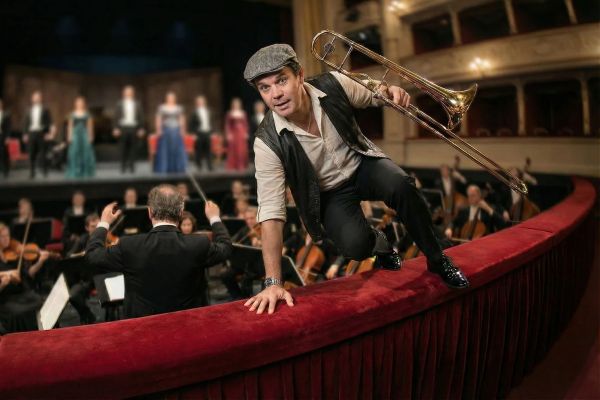
Solo from the Pit continues at Studio at theSpaceTriplex until 29 August 2026 (except 16).
Star rating: three stars ★ ★ ★ ✩ ✩
It’s well worth the journey down to the centre of the earth to join unusual trombonist Elias Faingersh in his pit. There are stories, emotions and reminiscences galore but the heart of the experience is to hear the trombone as never before, entering the heights of its full glory. Alleluia!
This musical stand-up show, presented by Teater KEF, sees performer/trombonist Faingersh occasionally lying down, with just enough room for his slide to exploit all angles of his relationship with the trombone – from his training days to years playing professionally in the Metropolitan Opera, New York. Faingersh lets out secrets concerning the activities of pit musicians during ‘rests’ which will amaze non-musicians and strike a chord with those in the know. Opera will never be the same again.
At the heart of the show are tangled explorations of reasons for moving on from an establishment musical job to a life of creative freedom. In sharing this journey, he presents an extraordinary portrayal of a drunk man attempting to play ‘The Drinking Song’ from Verdi’s Traviata. Here our guide to grand opera is suggesting perhaps that the pit tames musical emotions a bit too much and his instincts are to let rip.
Recalling other aspects of his dream job involves the re-creation of incredible sound worlds and a multitude of trombone tones, resonances and sounds which show music-making to be both tortuous and sanctifying forms of therapy. But there is grand comedy in his reassessment of past ‘neighbourly’ relations – always an issue for musicians who need to practice, daily and often.
Some casual misogyny does stray into this comedic retelling of arguments and making up (‘kissy-kissy’, ‘mwah-mwah-mwah’), maybe because grand opera plots rarely present life from a female perspective, even when the title bears a woman’s name, and all the works discussed are by men.
In Faingersh’s retelling of what might really have happened to Puccini’s Tosca, an alternative reason for her demise is suggested, but sadly it is no less misogynistic. Perhaps it is time to stop reinforcing these outdated but revered grand narratives?
Following abstract minor-key wails that evoke crying into the void, loneliness and other frustrations, the trombone seems to develop a voice of its own, speaking back from deep within the bell and enticing him towards other musical possibilities..
Clearly, despite leaving his job in the orchestra pit, where the story ends, this is a player who adores his instrument and has never abandoned her. She is his adorable Carmen. We hear warm, mellow, brassy, triumphal and velvety tooting from the pit, but we also bear witness to a reenactment of the last performance, which was Aida.
Faingersh chooses not to remain sealed in the vault of the pit and to die a slow death as she did, he solos out of there. And that’s where it ends, and begins. Appropriate sentiments for the real-time acoustic looping that creates a solipsistic soundscape, filled with the murmurings of ghosts.
Charlotte Purkis
SHARE THIS POST:


Comments are closed.