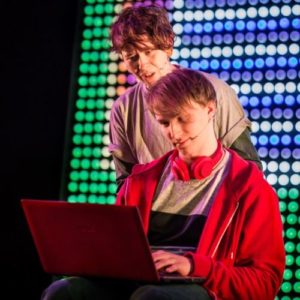
 Stages: A Video Game Musical continues at the Network Theatre at Vault Festival, London until 8 March 2020.
Star rating: three stars ★ ★ ★ ✩ ✩
Branching narratives, where the story plays out in different ways according to the consumer’s choice, are perhaps best known from the Choose Your Own Adventure books that were popular in the 1980s, or the Fighting Fantasy series that took the “if you want to take the left passage, turn to page 163” format of the former and included Dungeons and Dragons-style statistics and dice-rolling.
The overall principle is also present in many video games, the story playing out in different ways according to a player’s actions, the events that emerge not always being obviously immediate consequences of such a choice. And it is video games that writer Christian Czornyj has used as the inspiration for Stages, a musical produced by director Adam Lenson as the first full production by ALP, Lenson’s venture supporting artist driven new musicals.
Set within a family struggling to cope with the mother’s cancer diagnosis, the title of Stages immediately gains multiple meanings: both the levels of a video game, and the stages of progression of cancer in the body. It gains a third, too, as the stages of grief are used to represent the different scenes of a year in the family’s life.
Czornyj’s story uses the 16th and 17th birthdays of Max Alexander-Taylor’s Aiden, an autistic boy with a love of video games, as the anchor points for a year in the family’s life. As the realisation that his mother (Anna-Jane Casey) is gravely ill hits home, the reactions of each family member are determined by the audience, asked to hold up blue or red cards in response to one-word prompts on the impressive screen that makes up the musical’s pixellated backdrop. ‘Open’ or ‘Closed’, ‘Solo’ or ‘Team’; as each option is selected, a new branch of the narrative plays out.
Or does it? For the strands of interactive fiction in video games rarely branch out for ever. If they didn’t, a sequence of four binary choices would result in 16 different stories, the number doubling with every new choice. IF writers often gather those strands back up, providing the illusion of choice while driving the reader or player towards a very limited set of outcomes.
And so it must be here, too: for Casey’s Alice, there are only two possible outcomes: death, or survival. Even then, the odds are not always 50-50, and sometimes the choices we make never change the outcome however much we try. Certainly that’s borne out halfway through the musical, when Alexander-Taylor’s Max chooses to replay his last year, choosing the options that were not selected the first time through. With this second run through, we see that rather than 16 combinations, the choices we make cannot always force a deviation from the path of inevitability.
Thus we get to see different solos from the strong cast: Aitch Wylie as Aiden’s older sibling Ellie impresses as a young person struggling to write a personal statement on their university admissions form under the joint pressure of her mother’s health and their own quest to explore their identity.
And Casey, who as ever is incapable of anything less than the complete inhabitation of a role, is the undoubted star. The decision whether to undergo chemotherapy, or to go home and enjoy a high quality of life for the time she has left, has the biggest effect on her and her family. That said, a fractious scene with Andrew Langtree as Alice’s husband, in which the dialogue is repeated both times, works more poorly the second time around, giving the impression that the repeat is to underline the game mechanics than as a genuine response to the family’s plight.
And that is, unfortunately, true for so much of Stages’ acts of self-sabotage that deny it the chance to fulfil its own promising premise. Czornyj’s score is dominated by the sort of 8-bit sounds that match the primary coloured video backdrop (a triumphant collaboration between Lenson, who designed the videos, and set designer Libby Todd). However, the over-amplification of the same leads to memories of the time when the games console was limited to being plugged into the worst quality portable television, strangling the sound quality.
Some of Czornyj’s lyrics feel like they are not quite there yet, either, with occasional scansion issues or rhymes that feel like they need more work. More positively, though, the song in which Alexander-Taylor’s Aiden sings of a “glitch” in his family, framing his mother’s illness as a disruption of the sort that can prevent the smooth running of a video game, does interesting things with rhythm to reinforce the song’s theme, and shows the sort of promise that Lenson has clearly seen in this work.
It does not feel as if Stages is too far away from fulfilling that promise for its audience, either. In video games terms, if this production is an open beta, then the experience of a paying public should feedback into further refinements. Where it does succeed is that feeling that, just as in modern video games, musicals and life can both present us with choices that are ultimately incapable of affecting the outcomes we dearly want to change.
Scott Matthewman
SHARE THIS POST:


Comments are closed.