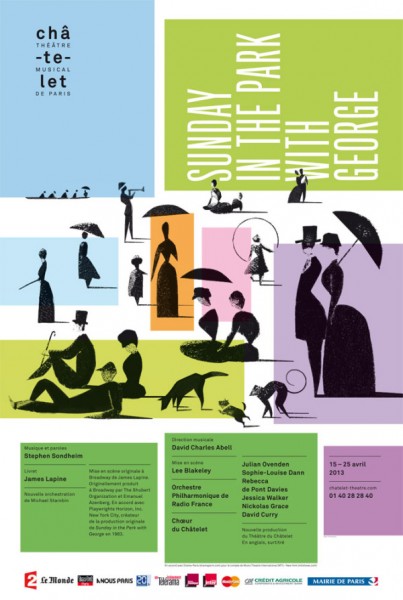
 Reviewed at the Theatre du Chatelet, Paris (April 15-25). The production is being broadcast on European arts TV channel Mezzo on May 5, 24 and 28.
Sunday in the Park With George is a rare jewel, a special treat, one of the rare musicals and works of art which can lift you up from the real world and its rampant mediocrity.
That’s the kind of elevation I felt while attending a performance of the Menier Chocolate Factory revival at the Wyndham’s Theatre, London in spring 2006. At the opening night at the Theatre du Chatelet, Paris, with Stephen Sondheim present in the balcony, some of the delicacy of the piece was lost amid the huge auditorium and the sound of the 46-piece orchestra.
Sunday in the Park With George doesn’t have the orchestral opulence of Sweeney Todd or the lushness of A Little Night Music’s waltzes. So these two previous Sondheim works were better suited for the operatic treatment that they, along with Sunday, have received at Chatelet. According to the theatre’s director Jean-Luc Chopin, the genre of the Broadway musical is “an exotic, unfamiliar, even experimental-seeming art-form to many in France”. It’s therefore understandable that in a theatre which, since 1862, has been housing concerts by Tchaikovsky, Strauss, Mahler and Debussy, that Chopin favours musicals best suited for operatic treatment such as Carousel, The Sound of Music and Street Scene.
This has sometimes been to the detriment of the acting, although that was not the case here. However, I do wish Chopin would one day venture into more ‘showbiz’ or contemporary-orientated Sondheim musicals like Follies and Company.
The cast for this production, except for some French chorus members, was all English and top-notch. Julian Ovenden was a terrific George, giving us strong vocals and sensitive acting, especially in Act II. Sophie-Louise Dann was equally brilliant, maybe more as Dot than as Marie. A very competent cast also included Chatelet veteran David Curry as Soldier/Redmond and Rebecca Bottone as Celeste/Betty.
On the evening I attended, however, some of the singers were occasionally drowned-out by the swelling orchestra, despite the impressive re-orchestrations from the original production’s Michael Starobin. On a second viewing, these problems had happily been solved. The improvement in all aspects of the show was indeed astonishing, the harmony between music and singing had been brought to perfection. There were empty seats though, which begs the question what appeal Sondheim has for French audiences, even though a first French language book has just been written about him.
Librettist James Lapine’s ultimately rejected idea of having Act I in English with French subtitles, as it takes place in Paris, and Act II in English with French subtitles might have helped, but would have been very difficult to pull off since Sunday in the Park With George is not a sung-through musical and includes a great deal of dialogue. Finding an entire cast of singer/actors with no accents in both languages would have been impossible, along with the usual translation challenges.
Lee Blakeley did a great a job in directing, as he he did previously in Night Music and Sweeney Todd at Chatelet, considering the challenge of staging what was originally a chamber piece musical in such a large space. Sunday was at first a one-act show when it debuted at Playwrights Horizons almost 30 years ago, and I must say that Act II added at the last moment for the first Broadway production has never worked better or been more emotional than in this Parisian incarnation.
Set designs by William Dudley were handsome, as were the costumes by Adrian Linford. Lighting by Oliver Fenwick was also near perfection, but the use of technology was again much less effective than in the London revival. The use of video by Matthew O’Neill in the Act II reception scene appeared out of context. Lorena Randi’s choreography was a welcome addition. David Charles Abell provided excellent musical direction.
This new version of Sunday in the Park With George incited a lot of interest abroad, especially from London. True, a transfer to the ENO might be a good idea, since many of the cast and crew came from the UK. In the meantime, the show has been broadcast on France Musique Radio and filmed for the television channel Mezzo, which guarantees this short-lived revival will be preserved for posterity.
Next on the Chatelet Sondheim cycle agenda is Into the Woods, scheduled for next year, maybe in synch with the movie version. Hopefully, this one will speak more to the French, who have proved through the years their disinterest in Broadway musicals set in France or with French related subject matter: French language versions of Les Miserables and La Cage Aux Folles failed in the 1990s and, remember, France might be one of the only countries in the world where The Phantom of The Opera has never been produced!
Sondheim and Lapine were nevertheless more than happy to see their show at last produced in Paris where it naturally belongs, in the country of Georges Seurat and a few miles from Ile de la Grande Jatte.
Patrick Honore
SHARE THIS POST:


Comments are closed.