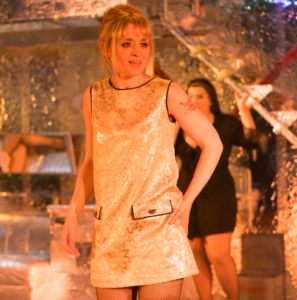
Anne-Marie Duff in Sweet Charity at the Donmar Warehouse, London. Picture: Johan Persson
Sweet Charity continues at the Donmar Warehouse until 8 June 2019.
Star rating: four stars ★ ★ ★ ★ ✩
There are two very different views of New York in the Swinging Sixties. There is the achingly hip art-hobo chic of The Velvet Underground and Andy Warhol’s Factory on the one hand; on the other, the brassy, big band bossa nova of Broadway.
Josie Rourke’s revival of Neil Simon and Cy Coleman’s Sweet Charity butts the visual stylings of the former against the musical stylings of the latter. At first, this culture clash is jarring, especially when the Velvet Undergound’s ‘Venus in Furs’, which plays over the cast’s pre-show onstage work, crashes into musical supervisor Gareth Valentine’s assertive brass.
But the handmade industrial chic of Robert Jones’ set design brings an unusual charm to this revival from the off. From the moment Anne-Marie Duff’s Charity Hope Valentine makes her debut on a swing above a gigantic ball pit, you know this is not going to be your typical revival.
Nor does Duff make for a typical Charity. It is a bold move on Rourke’s part, for sure, to cast a non-dancer as a character who is a ‘taxi dancer’, a woman paid to dance and talk to customers in the precursor to today’s euphemistically-titled “gentleman’s clubs”.
But as a result, we get to see a different side to the character. Duff’s Charity may not be a great dancer – a clue, maybe, to why she’s been stuck at the Fandango Ballroom for eight years – but she is a winner when it comes to charisma. This is a Charity whose force of personality believably enthrals all the men she meets: a woman who looks for the best in everyone, to the point of gullibility in extremis — but who cannot help but find it.
As the men in her life, Martin Marquez gives a fun turn as Italian movie star Vittorio Vidal, but it is Arthur Darvill’s nervy Oscar who becomes the perfect partner to Duff’s assertive, ebullient Charity. The power play between the couple – from their first meeting, trapped in an elevator to their date stranded atop a perilous Coney Island fairground ride – is joyous. Jones’ use of a see-sawing stepladder in the latter visually captures the perpetual shift in balance between the couple.
Wayne McGregor’s choreography, while on occasion nodding towards Bob Fosse’s original work, is rather more concerned with evoking the 1960s for an audience 50 years more advanced — and is all the better for that.
Sweet Charity has so many numbers which have become standards in their own right – from ‘Big Spender’ to ‘If My Friends Could See Me Now”, ‘There’s Gotta Be Something Better Than This’ and ‘Rhythm of Life’. Director Rourke, in conjunction with Valentine’s musical arrangements and McGregor’s footwork, acknowledges those numbers’ stature in the musical theatre pantheon while also ensuring they do their storytelling job, Dorothy Fields’ lyrics feeling like a natural extension of Neil Simon’s witty book dialogue.
As a final flourish of gimmickry, Rourke has chosen to cast the role of Daddy Brubeck, the singer of the classic ‘Rhythm of Life’ number which gives the top of Act II a shot of adrenaline, with a series of guest appearances. Future performances will see the role taken by Le Gateau Chocolat, Beverley Knight, Clive Rowe and Shaq Taylor. On press night, Adrian Lester exploded on to the stage as a sequin-bedecked dynamo: he may only have been on stage for a few minutes, but his cameo made the impact Rourke clearly intended.
And that goes for the rest of this production: it’s far from a typical revival of a Fosse classic. But it’s all the better for that. Like Charity herself, Sweet Charity is rough around the edges, but it’s driven by love — and deserves to receive the same in return.
Scott Matthewman
SHARE THIS POST:


Comments are closed.