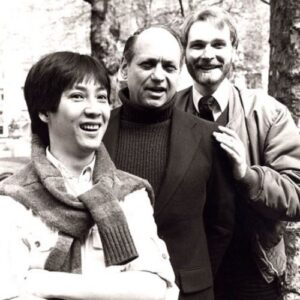
John Yap with composer Charles Strouse and director Hugh Wooldridge during the performances of Nightingale at Buxton Opera Festival
John Yap, founder of international record company JAY Records, pays tribute to his friend and collaborator, the award-winning composer CHARLES STROUSE.
Although I had been expecting to read the inevitable news of Charles Strouse’s passing, I was still devastated and sad to read that he had left us. My memories of our friendship and collaborations on my recordings of his wonderful musicals are even more precious now.
I first met Charles when I decided to record and preserve his and Lee Adams’ London musical I and Albert for posterity, almost 10 years after it closed at London’s Piccadilly Theatre. That was in 1981. I saw I and Albert in 1972 and loved it. I was very excited to read in the programme that Paramount Records were recording the original London cast album.
Strouse and Adams’ Applause with Lauren Bacall opened in London 10 days later in 1981 and was a smash hit. People were flocking to see the other Strouse and Adams Broadway musical and neglected their lovely London musical. I was very disappointed when Paramount Records changed their minds about recording the album.
The lovely score of I and Albert never left my mind and when I was in a position to record whatever I wanted to record, I decided to embark on an impossible dream and make an Original studio cast album of I and Albert with the principal stars of the London production.
I thought that it was a simple task of just getting the original orchestrations from Charles’ office and contacting the original stars. I telephoned Charles to tell him of my plans to record his London “baby” and to ask him for the original orchestrations. He was taken by surprise but was delighted. On the other hand I was surprised and devastated when he told me that not only did he not have the original orchestrations, but didn’t know where they were.
I wasn’t going to be disappointed again; I couldn’t bear the thought of missing out on hearing the lovely score of I and Albert that had haunted my mind for ten years. I started to ask around if anyone knew of the whereabouts of the original orchestrations. Most people assumed that they were thrown away or destroyed after the production closed at the Piccadilly Theatre. I didn’t give up and continued the search.
As luck would have it, one day the private secretary of Richard Pilbrow (managing director of Theatre Projects: they provided all the stunning projections in the production of I and Albert and managed the production) came into my record shop. I founded and owned the That’s Entertainment shop in Drury Lane which later became Dress Circle.
I knew of Theatre Projects’ involvement with the production and asked her if she knew anything about the original orchestrations of I and Albert. I couldn’t believe my ears when she said she knew where there were. She then told me that everything to do with the production had been seized by the Bankruptcy Court and kept under lock and key in a warehouse outside London. She had the keys to the warehouse in her office desk drawer.
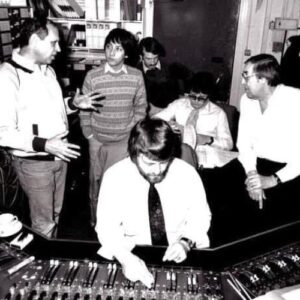
In the studio during the cast recording of Charles Strouse’s musical Nightingale
I then asked if I could gain access to them. She replied that she would ask her boss. A few days later she came to the show and handed the keys to me. I went to the warehouse and there they were! After the recording I obtained permission from Richard Pilbrow to let Charles keep them, which he did. Charles’ appreciation and gratitude were reflected in the fact that he mentioned me and the recording of I and Albert in his autobiography, Put On a Happy Face.
For almost 43 years, Charles and I remained close friends and colleagues. Although he had written some famous hit musicals, I made it a quest to record as many of his shows that did not make it to ‘hit’ status. I recorded his next London musical, Nightingale. It was Sarah Brightman’s second appearance in a Charles Strouse musical. The first was when she appeared as one of the Royal children in I and Albert.
It was the first time that I had worked with Sarah and it was also the first time that I met Lord Lloyd Webber. I used to go out to the lobby of Abbey Road Studios when he arrived to pick Sarah up at the end of her recording sessions. When the production of Nightingale was in rehearsal at the Lyric Hammersmith, Charles invited me to one of the them. I was amused to hear the ‘Guards’ in the production shouting the word ‘Hei’ several times to command the Servant Girl to move on. I informed Charles that the word in Cantonese meant ‘c**t’. The correct word in Cantonese is ‘Hung’. I was impressed that Charles changed the word to the correct one. I guess that was the tiny way I contributed to the libretto of Charles’ musical Nightingale.
Although Charles and I spoke about collaborating on some of his unrecorded works, including his ‘classical’ compositions, we did not manage to record any of them and that included Dance a Little Closer. Charles and Alan Jay Lerner wanted me to record the Broadway cast album but I wasn’t able to do so as I was already in the studio making the cast album of the 1983 Broadway revival of On Your Toes.
By coincidence, both recordings were mixed at the same time in the RCA Studios between 43rd and 44th Street on 6th Avenue, New York. Because Charles was so grateful for my dedication to recording and preserving his “babies”, he got Alan Jay Lerner to gift the recording of Dance a Little Closer to me. They controlled the ownership of the cast album.
That was the first time that I met Alan Jay Lerner and befriended him. It led to me making the first and only complete recording of My Fair Lady.
After some unrealised recordings of Charles’ secondary works, we finally came to one that totally needed to be recorded for posterity. Richard Maltby Jr, Arthur Laurents and Charles’ musical Nick & Nora was one of the most well-known, unsuccessful musicals on Broadway. Although I did not see the show, I did read the script and had a few detailed conversations with Charles and Richard in preparation for the recording of the cast album.
Charles wanted to experiment by writing his compositions as “dialogue” over music, underscoring as in the movies, and not as “songs”. That approach hadn’t worked so we decided that we had to create a musical score of songs. Jonathan Tunick, who had orchestrated the score for the stage production, was engaged to create new linking sections for those songs that were written as “dialogue” over underscored music, to transform them into self-contained “songs”.

Picture: Roy Tan
We decided to record the music tracks of the adapted score in London and Charles, Richard and Jonathan came over to London to work on the songs and the recording. They came prepared and ready with the scores and charts of all the songs, including the adapted ones. Musical director Martin Yates joined us as musical director and conductor.
Two incidents almost stymied the recording. The first one was when I received a phone call from Arthur Laurents’ agent who demanded that we stopped the recording immediately. Arthur did not agree with the musical being recorded or the songs and his dialogue being changed.
Charles and Richard were advised by their respective lawyers that they could proceed with a recording on a 2-1 majority vote. I was given the task of placating Arthur. At the time, I had never worked with Arthur although I had been contemplating making a recording of the original Broadway three-act version of Anyone Can Whistle. When I mentioned my intentions to Arthur, he seemed intrigued. I told him that I would record Anyone Can Whistle after Nick & Nora and on that basis he agreed for the latter to go ahead.
A second, potentially more serious incident happened the next morning. After a successful recording day, we went home very happy. Unbeknownst to us, the musicians left all the unrecorded charts on the floor next to their chairs, in readiness to be used. Late that night, the studios’ cleaners cleared all the charts off the floor and threw them into the industrial bins outside the studios, together with all the rubbish from the rest of the building, including the restaurant and kitchen rubbish. When we arrived the next morning to a sparkling clean and empty studio, we enquired about the whereabouts of the charts. To our horror, we were told that they had been thrown away! Worse still was the news that the bins would be collected and emptied soon.
Charles, Richard, the engineer and I rushed out and scrambled in the bins to try and recover as many of the charts as possible. It was a miracle that we managed to salvage them all, albeit that some were stained with coffee and a whole lot more. If we had arrived later, there would be no recording of Nick & Nora with the original Broadway cast.
It was an indication of the love and affection that the cast held for the musical, that they all agreed to return to New York to record the album without any hesitation. They even flew to NYC at their own expense and arranged to stay with friends during the week that we were overdubbing them. In spite of the fact that the musical did not work on Broadway, we all had a wonderful time in the studio and were proud and privileged to have recorded and preserved, I believe, Charles’ final musical for Broadway.
All three musicals that I had the pleasure to record were not ‘hits’, but they contained the wonderful music that only Charles could conjure up. I am beyond thrilled and proud that I recorded and preserved them for posterity and for Charles’ legacy.
Each of the recordings are wrapped up with significant situations that impacted and enriched my life. The most notable one was meeting and getting to know Arthur Laurents, which led to Sondheim publicly pronouncing that my complete recording of Anyone Can Whistle finally made him “proud of it”.
Nightingale introduced me to Andrew Lloyd Webber, Sarah Brightman and Hugh Wooldridge, whose all-star tribute concert to Sondheim, Sondheim Tonight, I had the pleasure to record ‘live’. If anyone wants to listen to a rendition of ‘The Ladies Who Lunch’ that rivals the version by Elaine Stritch, they should check out Dame Edna’s version on that recording.
I had many conversations with Charles about recording his musicals that did not get to Broadway, Marty and Minksy’s. Alas those recordings did not happen, as with the first London production of Rags and the first London revival of Golden Boy (both starred Sally Ann Triplett).
Thankfully I managed to record at least a few songs from those scores with their respective original orchestrations and the new song that Charles and Lee Adams wrote for the London revival of Golden Boy. You can hear the two songs that Sally Ann Triplett sang in the Golden Boy revival (‘Lorna’s Here’ and ‘Golden Boy’) on Sally’s solo album for JAY, ‘Anything Goes’. The rest can be heard on The Musicality of Strouse recording.
After Charles told me of his decision to concentrate on the ‘classical’ aspects of his creative gift, I decided to work on a complete recording of his biggest hit, Annie. He was delighted and even helped to secure the original orchestrations from Columbia Pictures for me to record the new film songs. The whole recording has been completed and is ‘in the can’. Hopefully I will have enough time to finish and release it before long.
Thank you Charles for all your wonderful gifts to the world, for your friendship and for enriching my life. May you rest in peace.
SHARE THIS POST:


Comments are closed.