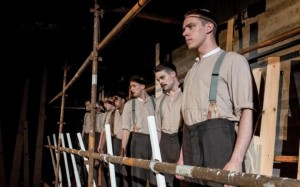
The 306: Dawn at the Dalcrue Farm, Perthshire. Picture: Manuel Harlan
The 306: Dawn continues at the Dalcrue Farm, Perthshire until 11 June.
Rating: four stars ★ ★ ★ ★ ✩
There are many productions claiming to take the audience on a journey; few mean it as literally as this show.
The audience travels by coach to the venue through the beautiful rolling Perthshire countryside to Dalcrue Farm. Walking towards the barn, we pass a shell-blasted ruin of a farmhouse, surrounded by a barricade. The interior of the barn is highly stylised with shards of wood surrounding the audience and raised stages, linked by wooden catwalks. The cast observes the audience taking their seats – each seat is different in style, but uniform black in colour. As the audience is watched, it is palpable that our presence means little to them. There is a ritual ahead: a ritual where ghosts will review their final days.
Just as Blackwatch used ritual to tell the soldiers’ eternal stories at the birth of the National Theatre of Scotland, so The 306: Dawn has ritual. A series of rituals that keep the audience at a distance. As the audience, we are eavesdroppers – we are not included in these stories – there is a sense that even if the barn were empty, these stories would still be told.
From the outset, the score is thrilling – literally spinetingling. Cello, violin and piano weave a stunning original underscore throughout the piece and provide the accompaniment or dissonance against which the characters sing, matching the mood to perfection. The opening sequence echoes Penderecki’s ‘Threnody to the Victims of Hiroshima’; that this is achieved by the Red Note trio is a credit to Gareth Williams’ composition and Jonathan Gill’s musical direction.
The play focuses on three central characters: Joseph Byers (Scott Gilmour), Willy Stones (Joshua Miles) and Harry Farr (Joseph Davies). In creating this piece, Oliver Emanuel has written their stories as meticulously as he could – research has been painstakingly undertaken to find out as much as was possible about these three men. Respect and honesty are clearly not only objectives, but easily met in the text and songs for each of the trio.
Many will recognise the sequence of events where Joe signs up as a volunteer recruit. My own grandfather lied about his age to join up at just 15. He was lucky, he came back. Joe was one of those who ignored warnings and became one of the ‘brave’ young boys who volunteered. Joe’s naivety is sensitively played; and Scott Gilmour owns one of the sweetest and true voices I have heard for a long time.
In the tale of Willy Stones – a clearly intelligent and rational young soldier – did exactly as instructed by his commanding officer. That officer now being dead, there is no witness that he was following orders. Miles plays Stones with absolute honesty and credence – every syllable is totally clear. Acoustics in the venue does make hearing every word of dialogue a challenge at times, but Miles handles the challenge brilliantly.
Harry Farr is recalling his wife, Gertrude (Emily Byrt) and the inherent intimacy of their relationship is portrayed beautifully in exquisite ‘ritual’ dance (movement director Eddie Kay must be extremely proud). Gertrude appears in white, as the temptress of Farr’s dreams. We next see her in scarlet (a force to be reckoned with) and in blue; she and Harry find complete congruence and the patriotic colour sequence is complete. Her voice is soaring and crystal clear as she sings – a perfect balance with Farr.
He conjures memories of Gertrude to combat his debilitating shell shock. His reliance on her goodness and strength of character to see him through the torment is so consuming that it comes between him and his reality.
The ensemble cast is simply outstanding – there is not a false note sung nor a false move made. A coherent sense of understanding and performance mode runs throughout Laurie Sansom’s brilliant direction.
At times, there are difficulties in hearing all of the dialogue – it is a challenging auditorium – but this is forgiven in the coming together of the whole. Indeed, even the weather is behaving, which is useful for the coup de theatre for the finale.
Maybe the ghosts from the Somme are blessing Sansom and his company so that nothing distracts from what we witness in the barn – ‘Perthection’!
As you leave the barn and step into the light, there is a part of you that stays there: listening to the stories as their ghostly ritual begins again.
Go. See. Feel. This is important.
Fiona Orr
The 306: Dawn is a National Theatre of Scotland, 14-18 NOW and Perth Theatre co-production in association with Red Note Ensemble.
SHARE THIS POST:




Comments are closed.