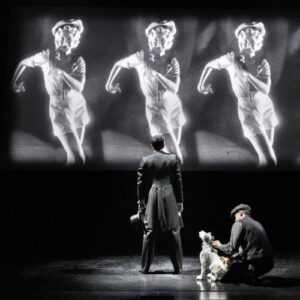
Picture: Mark Senior
The Artist at Theatre Royal Plymouth.
Star rating: four stars ★ ★ ★ ★ ✩
The Artist, a film by Michel Hazanavicius, premiered to critical acclaim in 2011 with its celebration of filmmaking and in-depth look at the tumultuous time of transition between the era of silent movies and the introduction of the ‘talkies’.
It tells the story of silent movie star George Valentin, who, while helping young actress Peppy Miller’s star to rise, finds his own falling rapidly as Hollywoodland embraces the technological advancements of movie sound. While those around him find their voices, he cannot, or perhaps will not speak. The world is moving on without him, as Peppy becomes the Hollywood sweetheart and he is left in the shadows with only his dog for company.
Adapted here for the stage by Lindsey Ferrentino and Drew McOnie (also director/choreographer), The Artist becomes an all-dancing, some-singing piece of art that stands out from the norm of stage productions. Running at roughly one hour and 45 minutes without an interval, the production immediately paints itself as something unique by having roughly half performed entirely in mime and dance. No one speaks, and the audience is instead invited to read the lines from screens, as if watching a silent movie.
The Artist sees award-winning international dancer and actor Robbie Fairchild take on the role of George Valentin with grace, style and emotional punch. Spending the vast majority of the piece in complete silence, Fairchild lets dance and facial expressions do the talking. He is a man in turmoil, fighting to stay in a world that doesn’t really exist anymore. Noise becomes almost a physical pain to him, and the idea of speaking is a real fear. We see the transformation to talkies via his viewpoint, and it is at times nightmarish, as George spirals – and quickly.
Briana Craig, in the role of ambitious young actress Peppy Miller, is a real find. With a proud proclamation of “I’m Peppy Miller, and don’t you forget it” (at first read from a screen, silent movie style), this character is the driving force of the story, the tipping point that pushes the studio from silent to sound. In high-kicking, somersaulting style, Craig shines with fizzing energy and oozes the grace of those Golden Age movie stars. As a double act, Craig and Fairchild share an air of timelessness, lifted from those classic movie musicals we all know and love and placed gracefully upon a modern stage.
Comedy comes in the form of Gary Wilmot’s studio boss Al Zimmer, Tiffany Graves’ behind-the-scenes movie host Gertie Gams, and Thomas Walton, the man behind the wonderfully charming puppet of Uggie the dog. While we may be used to seeing Wilmot in more jolly roles, here he plays a stricter studio boss with constant requests of ‘again’, we celebrate when he is put in his place. Graves’ Gertie is the larger-than-life Hollywoodland gossip who delights the audience with her love of the glitz, the glamour, and the personal life dramas of the stars themselves. Walton’s face remains partially hidden behind the rim of a hat for the entirety of the show as he brings the puppet of Uggie to life with an immense amount of personality, and a shrill bark when sound is introduced.
Set and costume designer Christopher Oram creates a glamorous world in black and white, with touches of silver and gold. Style and storytelling work hand in hand to create this exploration of Hollywoodland and the introduction of talking pictures. McOnie’s choreography is beautiful, intricate and detailed, performed with seemingly effortless grace by the cast.
The decision to have a great deal of the production performed in the style of silent movies works for the story it is telling, but the move into noise and speech comes just at the right point as the novelty perhaps begins to wear thin. That being said, the choice to have the first word spoken by Peppy, and for that first word to be a strong and determined ‘no’ in response to yet another bossy instruction from a man, gives the piece a sense of ‘girl power’ as we see women stepping up into stronger roles. The inequality between male and female performers in that Golden Age of Hollywood is touched upon with Peppy’s line to George: “I’ll have to be twice as good as you to do half as well,” and it would have been nice to see this explored to a deeper level.
Overall, The Artist comes to the stage as something completely unique. Neither musical, a play with music, nor a ballet, but instead a combination of all three, its use of mime and dance focuses the audience’s attention on the performers’ expressiveness and deeper emotion. It is a love letter to the Golden Age, depicting how quickly stars can rise and fall with advancing technology and the impact of that. Following its premiere at the Theatre Royal Plymouth, it will be interesting to see where this piece of art goes next. Could it be West End bound?
Becky Wallis
SHARE THIS POST:


Comments are closed.