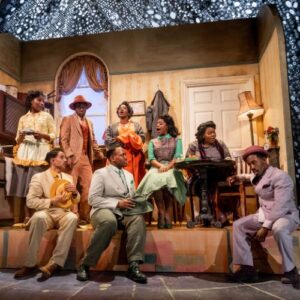
Picture: Mark Senior
The Big Life continues at the Theatre Royal Stratford East until 30 March 2024.
Star rating: four stars ★ ★ ★ ★ ✩
Paul Sirett and Paul Joseph’s ska musical The Big Life first opened at Theatre Royal Stratford East 20 years ago. Transporting some of the plot points of Shakespeare’s Love’s Labour’s Lost, the musical sees four young men step off the Empire Windrush into 1950s London, where they each foreswear women and other vices for three years. Unfortunately, the four women with whom they share a boarding house look set to scupper their plans and steal their hearts.
Billed as a “ska musical”, Joseph’s score mixes ska with jazz, blues, soul and calypso sounds. Indeed, the uptempo beats one most often associates with ska often play second fiddle to slower, more overtly romantic melodies as befitting the nature of the story. But The Big Life opens strongly, with the numbers ‘Big Time’ and ‘In Inglan’, setting out the musical’s stall: this is a celebration of Caribbean culture and what the Windrush generation brought to enrich English life.
That spirit is also reinforced by the character of Mrs Aphrodite, a lively older woman sitting in a box beside the stage. Tameka Empson (reprising her 2004 role, and now justly given a co-writing credit) is part Emcee, part music hall barker and part heckler. With her routine firmly rooted in the modern era, with references to Will Smith and Jada Pinkett-Smith, Andrea Levy’s Small Island and nods to Epsom’s full-time role as Kim Fox in EastEnders, Empson initially pops up to cover scene changes. One could, though, quite happily spend the entire evening in her company.
That’s not to say that Tinuke Craig’s production flags whenever the action returns to the stage. Far from it: the core octet of characters consistently entertains, even though the characters of the four men always feel more strongly drawn than the women’s roles. Despite that, Rachel John makes a strong impression as Zulieka, the boarding house landlady who dreams of the day she can return home to visit her ailing father. Gabrielle Brooks, Juliet Agnes and Leanne Henlon also provide more robust characterisation than the book alone would suggest.
Among the men, Khalid Daley’s Dennis draws the eye as the performer who extracts the most from Ingrid Mackinnon’s choreography. Ashley Samuels proves to be the standout vocal performer as the gentle philosopher Ferdy. Nathanael Campbell and Karl Queensborough further complement the main cast with performances that ensure that the musical’s three-hour running time never feels like it flags.
Some elements of the staging hamper proceedings, most notably with some aspects of Jasmine Swan’s set design. While one can forgive the precarious wobble of the large statue of Eros that recurs in the musical’s frequent Piccadilly Circus-set scenes, the musical’s most frequent location is Zulieka’s boarding house, played out on a tissue-thin set that restricts action far too much. The intention may be to portray such accommodation’s close, cramped conditions, but it restricts the performers to the show’s detriment. While the actors valiantly rise above the set’s limitations, one yearns for the ebullience visible when the entire stage is available.
Among all the jollity and romance is another story. This generation of people, who left their families to come to England to help with its post-Second World War reconstruction, boarded the Empire Windrush expecting their generosity to be met with a kindly welcome. Instead, they were more likely to be met with racist reactions, struggling to find even the most menial of jobs and forced to feel like outsiders in the country that had invited them to come.
Such references are integral to the protagonists’ stories; the musical never shies away from them. But while its 2004 run was one of the first opportunities the Windrush generation had to see their lives portrayed anywhere – to be followed by works such as Small Island in novel, TV series and play form, and ITV drama Three Little Birds – in the two decades that have followed, the story has changed. One of Empson’s Act II monologues explicitly and angrily references the Windrush scandal, which saw people wrongly detained, denied legal rights, threatened with deportation and worse.
While that is acknowledged, it is fitting that The Big Life concentrates instead on the joy, hope and cultural enrichment that is the true post-Windrush legacy. Mrs Aphrodite starts proceedings by reminding us that this is not merely a Caribbean or minority story; it is England’s. We cannot look away from the racism and the awful treatment that has followed, but we all can join in the celebration, too. The Big Life is a cultural document that should not wait two decades between revivals. It is our Guys and Dolls, and it deserves to be recognised as such.
Scott Matthewman
SHARE THIS POST:


Comments are closed.