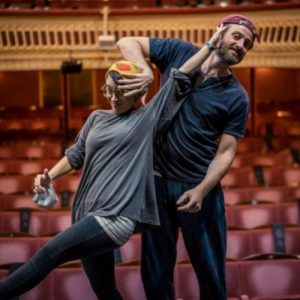
Audrey Brisson and Chris Jared. Picture: Ian Bowkett
Amélie the Musical has had a remarkable journey: from a Broadway under-performer; to an exciting British reinterpretation at Manchester’s Hope Mill Theatre, on tour, and at London’s Other Palace Theatre; to an acclaimed run reopening the West End’s historic Criterion Theatre after the Covid-19 shutdown.
Musical Theatre Review’s Ian Bowkett spoke to four of its incredibly talented actor-musician cast, who told us about their journey with this remarkable, five-star show.
How was your Covid-19 lockdown experience?
Audrey Brisson (Amélie): Professionally it has been extremely daunting and scary, and full of sitting tight and waiting.
Chris Jared (Nino): Pretty trepidatious wasn’t it? For everybody who was self-employed, not just in this industry. It was quite frightening to not know how to make the next pay cheque.
Jez Unwin (Raphael/Bretodeau): I had Covid myself. I didn’t have to go to hospital, but I had it quite badly. I had four or five months of bad breathing issues. I’m an asthmatic and I think that made it worse. It was pretty shite, I’m not going to lie.
Samuel Morgan-Grahame (Joseph/Fluffy): I had a baby! So that was mad. We had to navigate the hospital system in the middle of the pandemic, and I wasn’t allowed to go in with my wife.
I do think it is absolutely mad that we built this show however long ago and a major scene at the end is about Amélie saying: “I’m going to take one step closer to you” and Nino responds: “I’m going to take one step closer to you” and so on. To come back and do that scene after all of this. There’s this anxiety that we’ve all had, like on a train: am I too close to other passengers? Or even meeting up with mates like, “is this ok? can we hug? What are the rules?” The fact that our show addresses that too is just kind of mind-boggling.
MTR: What was it like coming back into rehearsals?
Chris: Exhausting [Laughter]. It was tough for the whole company. [Director] Michael Fentiman was very conscious of the fact that we weren’t all match fit, and there are three new babies in the company! Everybody’s energy had shifted somewhat – and we had all been professionally stagnant for 15 months – so there was lots of care taken with negotiating masks in the workplace and not being able to embrace others. Some parts of the show had to change. Social interaction was completely different and negotiating those differences was surprisingly exhausting. It’s always on the mind.

Samuel Morgan-Grahame and Jez Unwin. Picture: Ian Bowkett
Audrey: Socialising is surprisingly exhausting when you haven’t done it in so long. It feels it’s the topic of now: people who are struggling to connect with other people. I think that’s something Amélie definitely feels and I think to a certain extent all the other characters of the show feel it.
Jez: Well, definitely my character Raphael – who is Amélie’s father – is very isolated. His wife dies and then he just spends all of his life never leaving the house. It’s quite sad, he literally isolates himself. But when he does eventually come to the café in Act II to see his daughter and breaks this pattern… That’s going into the light, and that’s what I feel every day now. We are all isolated in our own little broken world, so Amélie becomes a much more poignant story to tell.
Samuel: I’ve definitely had that thing of watching nightclub scenes on Netflix and being like – oh, why are there so many people?!
Jez: Yeah, when you see it, you’re like – is that the past now? Are we ever going to go back to that sort of relaxed social situation ever again? It’s extraordinary.
Audrey: Our director – Michael Fentiman – was very passionate from day one of rehearsal, saying the time was about us inviting the audience to come out of isolation and the pandemic blur and chaos and come back to the West End and rediscover how to socially connect.
MTR: You have all been with this reimagined UK production from the start. What was the approach to making it connect with audiences more than the less-successful-than-hoped original Broadway version?
Jez: I think treating it like a brand new show was what made it. And because it was an actor-musician show unlike before. There’s so much importance in who plays what instrument, and that has added some new colour to it. The Broadway version was what it was, but I think for us to do this show we had to do something brand new and completely different. And we did!
Samuel: On day one it was quite a strange vibe. We came in and we were told: “we have to fix this, we have to do something different than has ever done before and it’s not going to be easy. We have to throw everything out and work it out properly.” A lot of us came in thinking: “well it’s something that’s already been done so at least there’s going to be groundwork to build off” and that wasn’t actually the case. We had to find it in the room. For me, personally, I was excited to be part of a new musical, and it was an extra bonus that we were building an absolutely new version: we weren’t just re-doing something that had been done before.
Chris: Michael Fentiman is very comedic – he’s a brilliant man, really bright – but he’s got this distorted view on things and he likes to see mischief in the room. He’s really keen to not pull people from their ideas. He’s very receptive to it and he’ll beg for more of that. Those first four weeks of rehearsals were a lot of brilliant minds coming together, channelling some good ideas and wrestling with some terrible ideas which eventually got ditched. There was a lot of playing.

Audrey: I usually think, I don’t want to say a ‘good actor’, but a receptive actor, would be someone who, if given a note and doesn’t really understand how it works – instead of going “my character wouldn’t do that” – would ask: “how do you make it work? How do you make sense of this note that has been given?” Here, if Michael gives you something absolutely bonkers to do and you try to make sense of it, he will come to you and say: “don’t make it make sense, it has to be weird.” It’s like, don’t make too much sense out of this particular element, let it live in its bonkers-ness.
MTR: Beyond the shining reviews, have you had much feedback from the audience themselves over the course of performing this show?
Jez: When we did the run at The Other Palace, the tickets were a bit cheaper, so we had younger people coming, 20-30 somethings who didn’t like musical theatre but who knew the film well. Definitely the feedback in that room was very positive because in a way we take the film and take it further.
Samuel: It’s one of those things that can be difficult about doing a film to musical adaptation: if an audience loves the film and it’s not exactly the same as the film, are they going to like it? I think with this film in particular, it is its own thing, and you hope – and it seems to have translated – that people will go, “oh, Amélie the Musical is its own thing too, very separate to the film”. Though of course they’re linked.
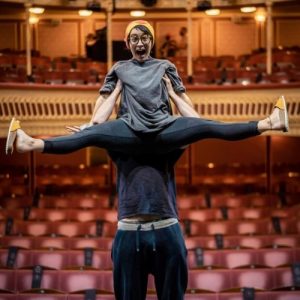
Picture: Ian Bowkett
Audrey: Coming out of lockdown, it has been interesting that we were in a café on stage, ultimately, before we were even allowed to do that in real life. I think the audience has reacted to that really well. It’s been really warm. Personally, I wondered how it would be, would I personally want to go to an indoor area with a bunch of people masked? I think I would, because I’m so desperate to go to the theatre, but I wondered if it would be a general feeling. The front of house team has definitely done a great job here of dealing with that anxiety. You could even get a drink brought to your seat! I mean how bliss is that?
Chris: Graham Norton was in on press night and he was very excited about people bringing him a drink!
Audrey: It makes you feel very important and glamorous!
MTR: And it even makes the audience part of that café experience, having your drinks brought to you by a server…
Chris: How would you have liked it if we had served the drinks? I’m sure that would have been breaching some Covid rules but, intermission drinks, each cast member taking turns…
Audrey: Sweaty actors…
Chris: With no waiting skills… [Laughter]
- Amélie the Musical is playing at Criterion Theatre, London. Tickets are available at ameliethemusical.com
- Readers may also be interested in: Amélie the Musical at the Criterion Theatre, London (Review)


Comments are closed.