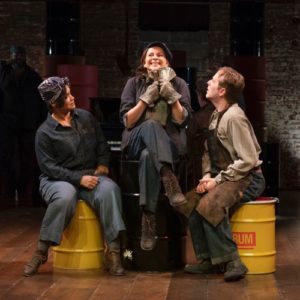
Rema Webb, Sally Ann Triplett and Ian Lowe in The Cradle Will Rock at Classic Stage Company, New York. Picture: Joan Marcus
The Cradle Will Rock continues at Classic Stage Company, New York until 19 May 2019.
Star rating: five stars ★ ★ ★ ★ ★
Marc Blitzstein’s 1937 almost sung-through “play in music” The Cradle Will Rock could be seen as a relic of Great Depression-era agitprop: recurringly relevant, but still a product of times gone by.
Its music echoes the staccato, occasionally jazzy drive of the Bertolt Brecht-Kurt Weill collaborations, which so indelibly mark the theatre of Weimar Germany. And its story of corrupt Steeltown USA, where the capitalistic boss, Mister Mister, has bought the allegiance of just about every faction of the town to combat the threat of unionism, has the clang of undiluted Leftist dictum.
However, this Off-Broadway revival by Classic Stage Company, directed by John Doyle, its artistic director, is triumphantly alive, with its 10-member ensemble bringing passion, immediacy and theatrical acuity to the script’s thesis, its music and sardonic, bitter humour. In this particular time, with the widening chasm between the haves and the have-nots and the continuing epidemic of political influence for sale, The Cradle Will Rock is indeed relevant. What Doyle and company succeed in doing is making it thrillingly relevant.
The production reflects the minimalism that is pretty much Doyle’s trademark. The Doyle-designed set is dominated by piles of oil drums, which the cast members move about to suggest various locales, with the lighting by Jane Cox and Tess James, expertly defining the spaces. The costumes by Ann Hould-Ward have a period plebeian look, even those playing the town’s better-off folks. It’s as if a company of everyday (but sumptuously talented) workers are putting on the show for us.
The musical accompaniment comes from a single upright piano centered upstage, and the playing of it is shared by four of the performers, who sometimes speak their lines from the piano. With the performers taking on multiple roles with little or no change in look, the storytelling can get a little muddled now and then. It’s helpful that Blitzstein often has his characters’ names prominently included in the dialogue when they appear in a scene.
But the thrust of the story is never in doubt. It’s union organising night in Steeltown, and the steel company is out to stop it at any cost. Members of the management-support group, The Liberty Committee, have been brought into court as part of the crowd that was listening to an inflammatory speech by a union organiser.
As the show progresses forward and backward in time, we see Mister Mister (David Garrison) and his wife Mrs. Mister (Sally Ann Triplett) paying off a series of influential citizens to join the Liberty Committee. They include the Reverend Salvation (Benjamin Eakeley); the newspaper’s Editor Daily and the university’s President Prexy (both played by Ken Barnett); the representatives of the art world, violinist Yasha (Ian Lowe) and artist Dauber (Rema Webb), and finally, Dr. Specialist (Eddie Cooper).
Doyle’s staging has both Mister and Mrs spewing dollar bills about like sinister confetti as they talk the important citizenry into joining their Liberty Committee. The biggest pile of money comes falling out as Mister confronts the union organiser Larry Foreman, and of course, he rejects it, going on to deliver the roof-raising call to action that ends the show, a battle cry predicting a storm that will rock and bring down the cradle, the cradle containing all the forces suppressing the common man.
Tony Yazbeck, one of Broadway’s leading song-and-dance guys, does a terrific job as Foreman. In addition to his fiery side, he shares a tender exchange with Moll (Lara Pulver), the streetwalker who gets caught up in the chaos. Yazbeck also movingly enacts the despair of Harry Druggist, a well-meaning store owner whose life is shattered by anti-union violence.
While it may take a while for ears to adjust to the emphatic rhythms and seeming tunelessness of Blitzstein’s opening music, the score eventually reveals its riches and it’s all handled superbly by the company. One of the high points is Webb’s portrayal of a sister of a murdered union member with her majestic rendering of the aria ‘Joe Worker’, asking how many deaths it will take before people will wake up to the injustice of it all. Similarly affecting but in a quieter vein is Pulver’s impassioned delivery of one of the show’s most well-known ballads ‘Nickel Under the Foot’.
Every now and then the score also slides into a song capturing the pop music of the day. For example, there’s the delightfully seductive ‘Honolulu’, in which Mister Mister’s ineffectual son, Junior Mister (another of Cooper’s roles), is lured into taking a job there (“where nothing ever happens”) as a correspondent for Editor Daily’s newspaper. Cooper’s Junior also cavorts merrily with his sister, Sister Mister (Kara Mikula), as two rich kids enjoying their kiddie boredom in ‘Croon Spoon’. Junior likes to croon; the bubbly Sister likes to spoon, as in kiss and cuddle. And in a deliciously extended sequence, Lowe’s Yasha, Webb’s Dauber and Triplett’s Mrs. Mister let us know how much the wealthy enjoy showering their luxuries on artists and how much artists enjoy the showering.
In the annals of theatrical history, The Cradle Will Rock is probably better known for the circumstances of its very first performance than for the merits of the show itself. Financed by a government agency in the midst of the Great Depression, the show, with Orson Welles as its director, was cancelled at nearly the last moment, and hit by union restrictions as well, prohibiting the union actors from appearing on stage. Budget revisions were cited, but presumably the show’s radical nature had a lot to do with it.
Cast, crew and the audience members who showed up were locked out. But then, another theatre was found, a piano quickly rented, and the company and audience marched to the new venue. There, obeying the union restrictions, the actors recited their lines and sang from the auditorium, and the only person on stage was Blitzstein at the piano. (The tale is well dramatised in the 1999 Tim Robbins-directed film Cradle Will Rock.)
Certainly, Classic Stage’s revival can hardly match the off-stage drama of that premier performance, but it certainly adds to our appreciation of this iconic and meaningful piece of musical theatre.
Ron Cohen
SHARE THIS POST:


Comments are closed.