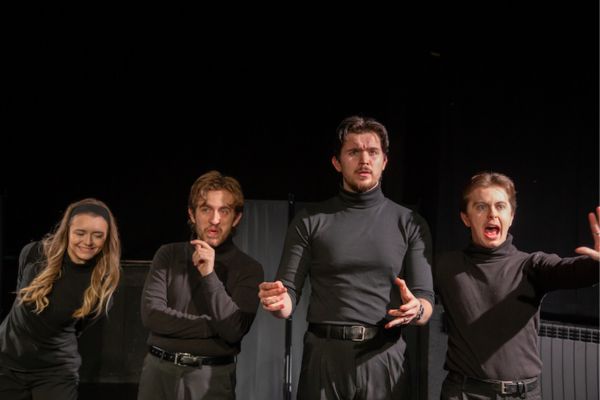
The Dance Plague of 1518 was reviewed at Upstairs at the Gatehouse, London.
Star rating: four stars ★ ★ ★ ★ ✩
Historical musicals have become immensely popular over the years, and while The Dance Plague of 1518 belongs to the same genre as the likes of SIX and Hamilton, the heart of the show is far from it.
Four Theatre in Education actors must put on a show teaching the story of ‘The Dance Plague of 1518’, except there is one issue – they simply do not know it. With a Wikipedia page of information, and the mindset of let us ‘fill in the gaps’, the audience is witness to the creation of their show.
Caoimhe De Brun introduces audiences to the character of Princess Frau in the second number of the show with an impressive performance of ‘Getaway’, a Disney-esque ballad about wanting to escape from her life as a princess. Despite the powerful vocals, it is hard to focus on the sympathy aspect when the audience is being thrown constant one-liners. This becomes a characteristic of the show.
The show only progresses further into chaos as the princess and her love interest escape her castle, and they end up in Strasbourg. It is here they interact with many of the show’s 30 characters, all played by the small cast of four performers.
Despite adding a level of ridiculousness and humour to the show through the many costume and accent changes, this does at times appear slightly overbearing when the actors ‘break’ and return to their Theatre in Education characters. These switches produce some of the duller moments in the show, despite being the most blatant attempts at giving moments a punchline.
With pop culture references and witty irony being the main drive of the comedy throughout, these moments occasionally feel too on the nose, making the jokes less funny than intended.
Sam Trotman’s role as the show’s villain, a Catholic priest accompanied by a kidnapped choirboy who also happens to be a puppet, is particularly enjoyable. His evil anthem, ‘The Priest Song’, truly channels that panto-villain campness. It is this unapologetically absurd humour that makes for some of the show’s best moments.
Despite having some notable moments, Act II of the show feels a lot more rushed than the first in terms of plot, and there seems to be a slight dip in energy. It does, however, begin on a high as the audience is treated to the techno track ‘O.I.A.F’, starring Harrison Macdonald-Taylor. The song stands out from the more conventional musical theatre score featured throughout the rest of the show.
Another Act II track that impresses is De Brun and Macdonald-Taylor’s rendition of ‘Love is Not a Slow Dance’. This is arguably the most recognisably contemporary musical theatre number, and one of the only moments that demonstrates any real level of depth throughout the show. Again, the performance is not entirely humour-free, with the ongoing dance plague rejecting any sense of stillness that the emotional vocals seem to invite.
Love stories, dysfunctional families, global moral debates and a small dose of historical accuracy, all drenched in witty irony throughout. Where the show lacks depth, it makes up for it with personality, while the variety displayed by the actors throughout the performance is impressive, to say the least. In terms of on the nose, slapstick comedy, this show ticks the boxes. Sometimes that is all theatre needs to be.
Libby O’Connell
SHARE THIS POST:


Comments are closed.