-

- Pictures: Roy Tan


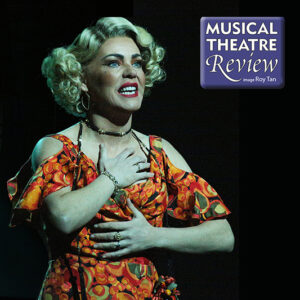
The Great Gatsby: A New Musical continues at the London Coliseum until 7 September 2025.
Star rating: four stars ★ ★ ★ ★ ✩
Echoing F Scott Fitzgerald’s verdict on the American Dream, the perfect stage adaptation of The Great Gatsby – a production that pleases both superfans of the book and more casual theatregoers – may be impossible to achieve. Since the copyright expired on Fitzgerald’s beloved 1925 novel in 2021, we have seen attempts ranging from ‘immersive’ to ‘featuring songs by Florence Welch’, but The Great Gatsby: A New Musical by Kait Kerrigan (book), Jason Howland (music), and Nathan Tysen (lyrics) caused quite the stir in New York last year.
Though not an enormous hit with critics, it built a loyal fanbase thanks to Broadway favourites Jeremy Jordan and Eva Noblezada in the starring roles, its well-produced cast recording, and the sheer spectacle of the production. Retaining its US director Marc Bruni, how will British audiences respond now it has taken over the London Coliseum until autumn?
Despite centring themes of disillusionment with American capitalist society, there is reason to believe the story’s themes could resonate on this side of the Atlantic. Emotions being repressed? A class system standing as an insurmountable hurdle to social mobility? Binge drinking to escape the realities of daily life? Are we sure The Great Gatsby isn’t British?
Frequent visitors to the London Coliseum will know the auditorium’s impressive opulence and size can sometimes work against a production. Those balcony seats are almost another tube station away – though for this show they do start at a quite reasonable £20. Fortunately, more than any other production I’ve ever seen, The Great Gatsby: A New Musical is big enough, bold enough and spectacular enough to fit right in.
Paul Tate DePoo III’s set and projection design are impressive. I am always a little sceptical when theatrical productions rely on projection for scenic design, but not only do these projections work perfectly in tandem with the physical elements of the set, when combined with Cory Pattak’s glorious lighting work we are treated to some brilliant effects.
When cars (yes, plural) appear onstage, they convincingly move at speed through 1920s New York. A particularly wonderful moment comes during Jay Gatsby’s big Act II number ‘Past is Catching Up to Me’. As Gatsby sings the lyrics “it brings you closer, and closer, and closer…”, the staircase he is stood upon moves towards the audience as the projected background shot of his mansion expands outwards, creating a real-life dolly zoom effect sure to stick in the memory.
There are plenty of big numbers and set pieces to enjoy. With such a stellar cast – more on them later – it is wonderful that so many characters are given big songs with which to show off. Howland’s music is suitably clarinet-heavy and throbs with a vivacious, Jazz Age excitement in party scenes, while evoking lush, Menken-esque Disney ballad grandeur in the smaller moments. It is perhaps overly-amplified and some of Tysen’s lyrics get lost in the cavernous auditorium, but this show isn’t about the subtleties.
And fair enough. We are inviting London fun-seekers to enjoy the revelries of a Jazz Age night out and earn the Coliseum’s bars some welcome revenue as we do. The Great Gatsby is perhaps most famous for its depictions of bacchanalia, so why not profit? Fortunately, Bruni does show some restraint in this regard. The party scenes are huge – let’s be clear about that – but they do not overshadow proceedings. Rather, the incredible cast does a fine job of silhouetting somewhat darker human stories against these moments of glowing decadence.
For those unfamiliar with the book or its numerous adaptations, The Great Gatsby tells the story of upper-class Daisy Buchanan reconnecting with her less well-heeled old fling, Jay Gatsby. In the years since their separation – years in which Daisy has married and had a daughter – Gatsby has made himself rich enough through possibly nefarious means to build an opulent new life designed to win her back, even constructing his grand house across the bay from hers. It is not romantic. It is creepy behaviour. Gatsby is a creepy man. Enter Jamie Muscato.
Muscato has earned his reputation as one of our most remarkable stage presences. He is a much more likeable Gatsby than you might expect, but the creative team is clearly aiming for a lighter, more humorous, more ‘romcom’ Great Gatsby than the original novel. Muscato understands the assignment and makes this alternative interpretation of the character work. He also sings the house down frequently and with head-exploding virtuosity.
The primary joy of this production is its cast: one of the most talented and distinguished West End casts in recent memory. All shine as brightly as they ever have while gelling remarkably well as an ensemble. Frances Mayli McCann is particularly incredible as Daisy Buchanan, a character who could so easily be made either entirely unsympathetic or an agency-less victim by a less thoughtful performer. Instead, by the end of the tragic story she has become the tragic heart of the piece, hoping her daughter will grow up to be a fool so as to not suffer so acutely the myriad indignities of being a woman in this world. McCann’s outstanding vocals throughout the evening bring many of the show’s highlights.
Though this show’s Nick Carraway is less complex than the naively optimistic journalist portrayed in the novel, the stupendously charismatic Corbin Bleu narrates the story with charm and shows off some impressive singing talents of his own. Amber Davies expertly delivers many of the show’s funniest lines alongside her own knockout musical numbers as Carraway’s love interest Jordan Baker, while Joel Montague and Rachel Tucker bring significant and important stage presence, dramatic weight and humour to George and Myrtle Wilson: the story’s major representation of the ordinary world outside of West Egg’s wealth and frivolity.
Bridging the gap between rich and poor, glamour and criminality, West and East Egg, is John Owen-Jones as gangster Meyer Wolfsheim. Owen-Jones is always a delight, and here he carefully avoids caricature while exerting suitable menace. His ‘Shady’ number at the top of Act II is fantastic, showcasing some phenomenal vocals. Rounding off the main cast is the ever-wonderful Jon Robyns, who is perfectly despicable as the brutish Tom Buchanan, another character who could easily become a panto villain, but here his moral repugnance is made worryingly recognisable.
As you would expect with such a big stage and such enormous party scenes, the extended cast is quite sizeable with 20 more talented performers. Blessedly, they are utilised quite tastefully. Though some scenes are notably busy, Dominique Kelley ensures the stage looks spectacular, not simply overcrowded. Credit also to Linda Cho’s costume design which ranges from sparkly gorgeousness to the most sparkly and most gorgeous you ever did see.
Much like the fake swimming pool disguising the Coliseum’s orchestra pit, this production merely hints at greater depths than what is delivered onstage; murkier waters left unexplored. Still, boasting a production design to which every future ‘glamorous’ musical will be compared, a cast of bona fide West End superstars performing at the top of their game, and – crucially – two and half hours with not a hint of boredom, has anybody really been shortchanged?
Who says The Great Gatsby must only ever be one thing? This is our new Christmas Carol: certain to be adapted forevermore (and hopefully one day with Muppets). People of all ages left the theatre with big smiles on their faces and a spring in their step. Have a glass of champagne, enjoy the revelry, and if you’re left pondering deeper questions afterward, that is just a bonus.
Ian Bowkett
SHARE THIS POST:


Comments are closed.