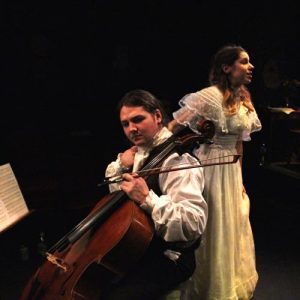
Cameron Harle and Eloise Kay in The House of Usher at the Lost Theatre, London. Picture: Elisha Adamson
The House of Usher continues at the Hope Theatre, London until 5 November.
Star rating: three stars ★ ★ ★ ✩ ✩
A tale by Edgar Allan Poe, the American Romanticist, is a great choice to open the Hope Theatre’s Gothic season.
The Fall of the House of Usher is one of his many short stories that helped to define what we have come to think of as literary horror, and itself includes references to musicality, performance and poetry that provide some convenient hooks in which to insert live performance.
But what also defines Poe’s tale is his characteristically dense, descriptive prose style, and hardly any dialogue.
As such, Richard Lounds’ unnamed Narrator has to carry much of the storytelling, relying on Poe’s words to paint the image of the House within the confines of a Fringe theatre.
The House of the title, after all, is a visual metaphor in the original tale, its large rupture from top to bottom being a representation of the fractures in the family, or ‘house’, of Usher itself.
Roderick Usher, the Narrator’s childhood friend who has become convinced that his family are subject to a terrible curse, is the most interesting character in both Poe’s original work and here.
Cameron Harle, dressed by Verity Johnson in Byronic leather and shades, reminiscent of cult vampire film Lost Boys, is a louche figure, somewhat out of time.
Writers Luke Adamson and Dan Bottomley craft for their Roderick some dialogue which varies between Poe’s prose (transposed into the first person) and a more modern argot.
Such variation in dialogue sits comfortably alongside a musical score which itself varies between Gothic gloom and Goth rock. A favourable comparison could be made with a certain other Gothic musical which has not done badly for itself – indeed, over one of The House of Usher’s piano riffs in particular, one can easily imagine ‘Beware the Phantom of the Opera!’ being sung.
Playing into such similarity, Roderick’s sister Madeline, the House’s only other resident and the musical’’s only other cast member, floats around in white garb, delivering a loud soprano trill.
Eloise Kay has the sort of ethereal quality befitting her mysterious background, but the tonal quality of her aria deliveries tend to sit uncomfortably with Harle’s rock vocals and Lounds’ softer tones.
When Adamson and Bottomley allow her to sing more smoothly and softly in duet with Lounds, the effect is much improved to both actors’, and the play’s, benefit.
What is most noticeable about The House of Usher is that it struggles to deliver its Gothic tale with any sense of pace – a key component of introducing and maintaining a sense of suspense and impending doom.
An introduction of Poe’s celebrated poem ‘The Raven’, retold in song by Harle’s Roderick as if relating a prophetic dream, feels like padding even as it slots into the musical with a consistent tone.
Rather than a full two-act musical, it feels as if Adamson and Bottomley have selected a story that has enough in it to make a substantial, and satisfying, one-act show.
By stretching it into full length, the musical gains cracks to match that spotted by the Narrator in the House’’s facade. And, sadly, we know how that turned out…
Scott Matthewman
SHARE THIS POST:


Comments are closed.