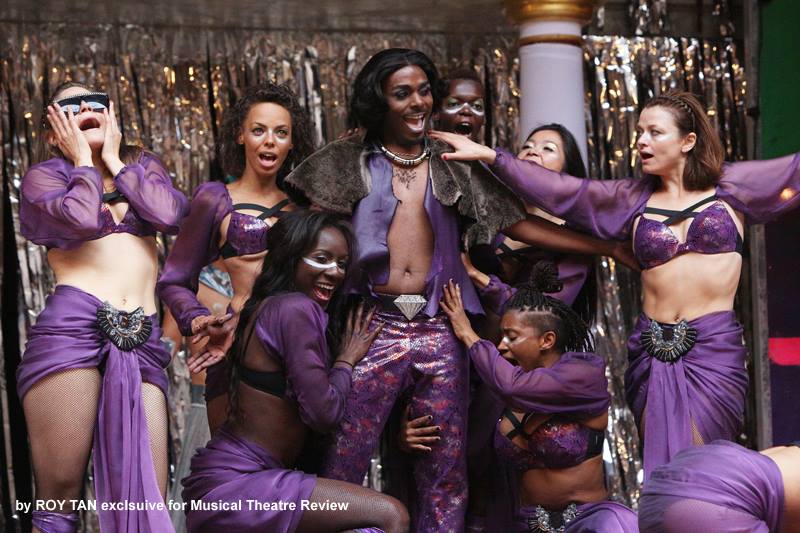
A scene from The Lightning Child at Shakespeare’s Globe. Picture: Roy Tan
The Lightning Child continues in rep at Shakespeare’s Globe, London until 12 October.
Che Walker’s 2008 play The Frontline – the first contemporary set play to be staged at Shakespeare’s Globe – remains one of the best modern pieces to be performed there.
Its sprawling urban tangle of midnight Camden lives made sense in the space, a market play for the modern age. The prospect of Walker’s return to the venue, to stage what’s being billed as the Globe’s first musical, was an exciting one, and the project – a contemporary reworking of Euripides’ The Bacchae – was nothing if not ambitious.
Walker’s play is more of a riff on Euripides than a straight-forward adaptation, a filthy-tongued, gold lamé glitter-gasm of a thing, encompassing multiple characters and storylines. The tale of Dionysus, the lightning child, and the bitter, hate-filled Pentheus is interwoven with a vast variety of sub-plots which showcase the heights of human achievement and the deep dark pits of human abasement. So Neil Armstrong and Billie Holiday share stage-space with a couple of bickering junkies and the volatile flatmate of a famous violinist. These threads are loosely connected by a narrator figure in the form of Ladyboy Herald, an omniscient dreadlocked creature, all sashay and fabulousness.
The cast attacks this expansive entity with energy and commitment – particularly the charismatic Clifford Samuel as Pentheus and Tommy Coleman as Dionysus. Yet this energy does not translate into a satisfying production. It feels bloated and messy rather than invigorating and thematically rich, and becomes a piece in serious need of dramaturgical guidance. The multiple narrative strands, the constant jumping from scene to scene, soon becomes exhausting rather than dazzling and it’s unclear what Walker wants his audience to take from the piece. The play touches on so many ideas: the fluidity of gender identity, the line between love and addiction, the nature of art and the creative process, motherhood and music. But director Matthew Dunster is unable to shape them into something cohesive. Arthur Darvill’s songs are funky but ultimately generic, lacking any truly ‘baadasssss’ hooks despite the presence of a foxy Cleopatra chorus.
There are times when the production feels like a number of play-lets stapled together rather than a fully formed whole. The domestic sniping of the two junkies – well-played by Harry Hepple and Phil Cumbus – has a bleakly comic appeal, but the fidgety style of the production makes it difficult to invest in their story. Despite the large cast and the shimmering set, with its colour-bomb backdrop, it doesn’t quite deliver in terms of spectacle either. All the gold lamé, purple Lurex and nipple-tassels in the world can’t quite compensate for a slight sense of under-rehearsal. This is a big production which plays well to the vertical as well as the horizontal – so important at the Globe – and yet the timing is often a little askew, the vocals lost in the void. “Don’t expect this to make sense,” Ladyboy Herald informs the audience, “you can figure it all out on the bus home.” That feels like a cop-out, a production making excuses for itself.
Natasha Tripney
SHARE THIS POST:


Comments are closed.