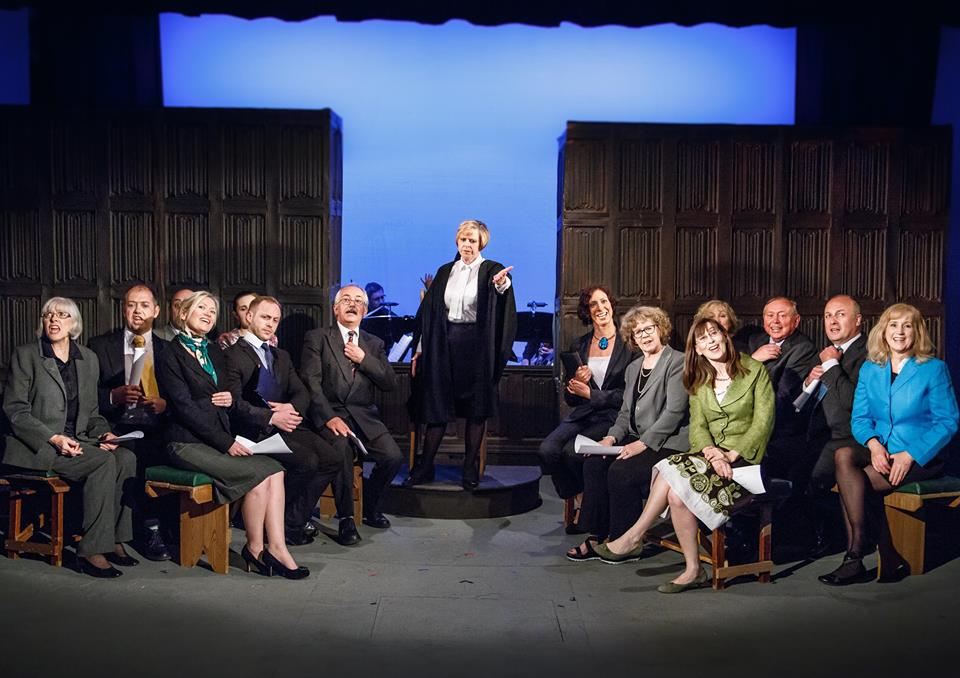
The Mandarin’s Dilemma was staged at The Nomad Theatre, East Horsley in Surrey
The Mandarin’s Dilemma, or Made Knaves by Duty was reviewed at The Nomad Theatre, East Horsley in Surrey.
Star rating: 3 stars ★ ★★
The sixth full-length stage work by composer and lyricist Joe St. Johanser, The Mandarin’s Dilemma, presents the story of an audacious plan to bring down the UK government coupled to an imminent nuclear threat posed by the dictator of the fictitious country Gondwana.
Set on the eve of the General Election, it encompasses the machinations of various leading politicians and civil servants including the vampish Deputy Leader of the Opposition, Rumena Haaridan, the senior mandarins Sir Tristram Seville and Sir Norman Persimmon, and their younger counterpart, rising parliamentary star Helena Besty.
Its premiere production at The Nomad Theatre, East Horsley benefited from excellent leads in Helen Semple as Besty and Anna Loveday as Haaridan, both of whom were highly convincing in their execution of their characters. Other principals delivered similarly assured performances, notably Peter Hart and Andrew Hamel-Cooke as two convivial mandarins, and Danilo Antonelli as the heavy-handed Prime Minister.
Director Nathan Farrell successfully originated a robust vision of a challenging work, the only discernible indications of uncertainty being a slight sense of hesitancy in some of the chorus numbers. Nonetheless, individual cast members shone in many commendable supporting roles, not least Nick Gee’s authoritative turn as the army commander-in-chief and Rachael Ball’s as his spirited aide.
The score of The Mandarin’s Dilemma creatively employs the constituent members of the nine-piece classical ensemble in an endless number of different combinations with its frequent intermezzi. Much of the music was conceived in terms of individual lines, often with a distinctly modal flavour, while the opening of Act II particularly exemplified the minimalist influences the composer acknowledges he had absorbed from Michael Nyman. As musical director, Joanna Bywater admirably navigated its inherent complexity and the relative dearth of obvious points of formal articulation or clear refrains beyond the ensemble numbers, and for the most part provided an effective yet unobtrusive underscore.
The cast were evidently undeterred by the intricacy of the plot, even notwithstanding a few moments at which it felt contrived or unbalanced. One scene sees Besty take to the catwalk at a fashion show because, somewhat implausibly, this is supposedly the only way she can have a private conversation with Haaridan. Another involved an elaborate song and dance number performed by a TV crew, by way of introduction to a hard-hitting political interview that was strikingly brief in comparison. The plan set in motion during Act II is the brainchild of Besty’s boyfriend, the PM’s scriptwriter Bernard Haplesser, who is conspicuously absent throughout. Perhaps this was all intentional, but it was a pity given the strength of Mark Bassett’s performance in the role of Haplesser.
Overall, this production represented a musical stage work on a quest to establish its own identity. The comedic aspects could have been brought out much more strongly had the interpretation of the piece been less serious – after all, the collapse of the British government and the threat of nuclear war are not matters over which an audience would necessarily wish to laugh. Likewise, the precise nature of the titular mandarin’s dilemma did not come across as clearly as it might, possibly because the crucial exposition was presented as a trio in which the two older civil servants repeated the heroine’s words in a routine that became rhetorical after a while.
In his programme notes, St. Johanser asks where The Mandarin’s Dilemma may be positioned in terms of genre. Leaving aside the classical influences of the music and the manner of its scoring, the interpretation taken by this production perceptibly leaned towards the operatic, with several principals evidently drawing on a blend of classical music college training and previous opera credits. The result was a performance that suggested more the profundity of a chamber opera than the light-heartedness of operetta or the easy listening of musical theatre.
Perhaps this is unsurprising given that the composer already has five operas to his name. The Mandarin’s Dilemma may be recognisably the latest addition to an impressively long line of works, but that should not detract from the scale of the remarkable achievement of this production for St. Johanser and the company alike.
Christopher Wiley
SHARE THIS POST:


Comments are closed.