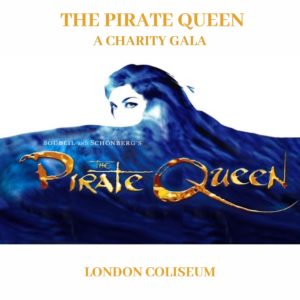
 The Pirate Queen – A Charity Concert was staged for one night charity gala at the London Coliseum on 23 February 2020.
Star rating: three stars ★ ★ ★ ✩ ✩
The historical swashbuckler written by composer Claude-Michel Schönberg and lyricist Alain Boublil (with additional lyrics by Richard Maltby, Jr and John Dempsey) – and inspired by a real-life female pirate – received its West End debut at the Coliseum. An epic production, it needed a house as grand as the Coli, drawing as it did on the forces of, at its peak, a whopping 96 performers.
This charity gala performance – directed by Drew Baker and produced by Tom Gribby in aid of Leukaemia UK – introduced the London audience to Grace (or Gráinne) O’Malley – a 16th-century Irish matriarch, “mother goddess” and “warrior queen” who, if Rachel Tucker’s performance was anything to go by, was one formidable woman. The title, initially referring to the Clan O’Malley’s shiny new ship, later becomes the honorific bestowed on Tucker’s character as she leads an uprising against the English and takes on Queen Elizabeth herself.
The Pirate Queen famously failed to negotiate the treacherous waters of Broadway when it sank to the bottom of Davy Jones’ locker in 2007. (It was Hadley Fraser’s Broadway debut, interestingly, although I’m sure the two are not connected.) Despite revisions from an early try-out in Chicago, the show failed to wow audiences and closed after just two and a half months.
The story is based on the fictionalised account Grania: She-King of the Irish Seas by the American-Irish historian Morgan Llywelyn and is suitably rich in Irish myth and legend. As remarkable as this folkloric yet true(ish) tale is, the book – devised by Schönberg, Boublil and Maltby – was far and away the weakest part of this audacious project. If this show was ever to set sail again, it would need a sizeable rewrite or even reconceptualising, preferably with the help of a dramaturg with a bit of distance from the original.
In a similar vein, Schönberg piratically plunders Irish folk music tradition – whistles, harps, bodhráns, uilleann pipes (and way too much mark tree!) – and turns the dial to 11, producing an epic soundscape that swells and roars like the Irish Sea. It’s cliched stuff, as you might expect when focusing so specifically on one musical style, and there’s a lot of it – 32 numbers if you discount the (lovely) overture and entr’acte.
Yet despite the Colcannon-level cheesiness, the almost-all-exposition storyline, and po-faced seriousness – thank the gods of the theatre for the light relief brought by Hannah Waddingham and her imperious Queen Elizabeth – the parts of this one-nighter proved to be greater than the whole.
No surprise, Tucker was perfectly cast as the flame-haired O’Malley, as was Waddingham as Elizabeth. Both were on top-notch form, and the audience was quivering in anticipation of the two characters finally meeting. Sadly, when this encounter does happen – reflecting a real-life meeting conducted in Latin at Greenwich Palace in around 1593 – the chat was conducted out of earshot, and their duet (‘She Who Has All’) falls short of what should have been the highlight of the show. No fault of the performers.
Daniel Boys did a fine job of the rather nasty Lord Bingham: the simpering, grovelling governor of Connacht who is determined to destroy the O’Malley matriarch. Boys managed to flesh out the otherwise one-dimensional panto villain, and I particularly enjoyed his first number, ‘Rah-Rah, Tip-Top’, sung with his fellow lords.
Two Britain’s Got Talent winners – Jai McDowall (2011) and Matt Pagan (who won as part of the quartet Collabro in 2014) – took on the roles of the two men in O’Malley’s life, Tiernan (the one she wants) and Donal (the rival clan heir she’s forced to marry). Both outfitted themselves well (‘I’ll Be There’ from McDowall was very well received) and only in a couple of instances let their more scoopy pop voices slip through.
Rounding off the principals were Earl Carpenter as O’Malley clan chief Dubhdara, Steph Parry as Majella, the impressive Emma Norman as Evleen and Shaun Dalton as Chieftain O’Flaherty.
A ‘featured ensemble’ of 11 – Pearce Barron, Jamie Birkett, Trudi Camilleri, Sabrina Carpenter, Adam Dawson, Callum Heinrich, Jade Johnson, Harry Mills, Charlotte Payne, Sophie Reeves and Jak Skelly – and 20-strong regular ensemble created a powerful wall of sound that was beefed up even more with a choir comprising the current crop of students from Arts Ed, Mountview and PPA. A sure-fire way of getting bums on seats!
Also on sparkling form were the dancers, led by Riverdance alumnus Jack Ludwig, Erin Brady, Max Chapman, Erin-Grace Cooke, Josh Harrison-Yellop and Amber Murphy. Their presence was always welcomed, filling up the Coli stage with their hammering clogs and gravity-defying legs.
Musically, it was all in the very safe hands of The Lion King regular Julian Kelly, who worked on The Pirate Queen’s ill-fated Broadway premiere. His 11-piece band – as insisted on by Schönberg for this evening, apparently – included star turns from Anna Cooper on violin, Phillipe Barnes on the uilleann pipes and whistles, Dave Oxley on French horn, Peter Whyman on clarinet and sax and Deian Rowlands on harp.
Writing this now, a couple of hours after the show, I couldn’t hum you a single tune. For me, it’s probably the weakest of the Schönberg & Boublil collaborations, and it was saved by the sheer determination of the talented cast and the generosity of the audience.
I felt a lack of cohesion in the material – it’s a bit of a ragbag of Les Mis, Gilbert and Sullivan and Riverdance, with the odd pop anthem thrown in (complete with Phil Collins-esque drum fills and electric guitar solos). There are moments of gorgeousness, for sure, but the fabulous cast deserved better.
It’s also too long – or feels too long, as the book is, despite the to-die-for subject matter, amazingly bum-numbingly boring. And it’s all just a bit too much – every song seems to be a lung-shredder or heart-blender. There’s at least blessedly fewer instances of recitative than we’re used to from S&B.
Until this show gets a serious revision, a semi-staged concert version like this is probably the best way to experience the material. This enormous cast and crew did a fantastic job of not-so-great material. There’s something here… it’s just in need of a rejig, if you’ll excuse the Oirish pun.
Craig Glenday
SHARE THIS POST:



Comments are closed.