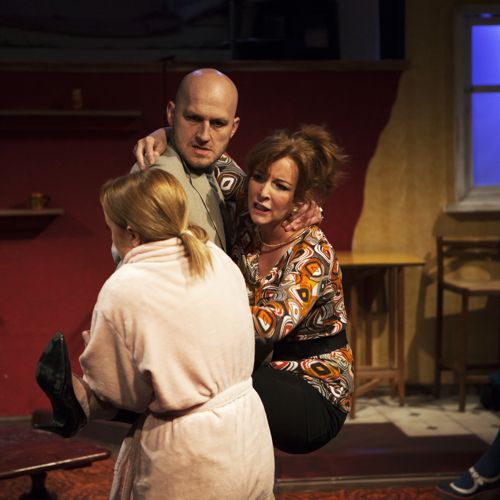
The Rise and Fall of Little Voice continues at the Kings Arms, Salford
The Rise and Fall of Little Voice continues at the Kings Arms, Salford until 29 April.
Star rating: 3 stars ★ ★ ★
The premise of Jim Cartwright’s 1992 bitter-sweet comedy drama – a play with songs rather than a true musical – alone makes it a strong contender for a modern northern classic. And the love its main character – mousy, grieving, put-upon teenager LV – has for the standards and female singers of popular music’s golden age, makes it ripe for revival and perfect for this intimate space specialising in modern musical theatre.
And Assembled Junk and James Baker’s first great achievement is in managing to convincingly cram LV and her drink-addled mother’s two-up-two-down – relocated from Scarborough to Salford in this version – into the Kings Arms’ bijou performing area.
The faded, man-made fabric-adorned décor harks back many decades – fittingly, as Cartwright’s story feels placed in a period far further back then the 1990s – but, crucially, never feels crowded. The transitions from this humble home to Mr Boo’s establishment for the club-set scenes are slick and pacey under Baker’s direction, although the time it takes characters to plod up and down the stairs to LV’s bedroom robs the action of some much-needed pace.
Textually, the salty poetry of Cartwight’s dialogue remains impressive – matriarch Mari’s declaration of a “twat-bum feeling” of delight among the many amusing verbal concoctions – although some of the more wordy and discordant lyricism threatens to undermine the naturalism of the characters.
Structurally, the play still has wrinkles to iron out. LV’s seemingly instantaneous onstage transformation from petrified wretch to sassy showboater and predatory showbusiness manager Ray Say’s slide from jovial cove to out-and-out, and out for himself, villain were better choreographed in the 1998 film version, and still don’t feel quite believable enough on stage.
That said, the cast are faultless. Jeni Williams embraces the tragi-comic whirling dervish of booze, quips and licentiousness that is mother Mari to full effect, while Liam Grunshaw brings a convincing Mancunian machismo and swagger to the role of Ray, his accelerated Act II shift to villainy not withstanding.
It would also be hard to better Laura Lindsay’s brilliantly subtle comic turn as Mari’s virtually monosyllabic and lumpen neighbor-cum-confidente and Sadie – a character who, in Lindsay’s hands, deserves her own spin-off – while Ben Sherlock brings a sweetness to his role as LV’s knight in shining armour Billy, the electrician who is similarly hiding his light under a bushel.
Josie Cerise has understandably very large shoes to fill as LV, a part specifically written to showcase the acting and mimicry talents of Jane Horrocks in the original production and on film. She makes a good stab at the vocal impressions and gets pretty close to most of them – although nailing a pitch-perfect Edith Piaf would be a bridge too far for most performers. But it is actually in her non-singing scenes that Cerise most excels, giving LV’s near-catatonic shyness and, when it comes, climactic boiling rage the emotional truth that gives the production an anchoring sense of reality that its more theatrical extremes threaten to overwhelm elsewhere.
Chris Bartlett
SHARE THIS POST:




Comments are closed.