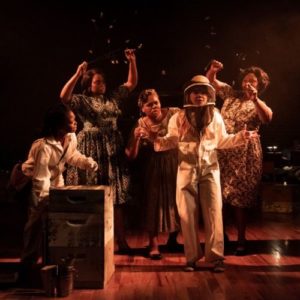
LaChanze, Jai’Len Christine Li Josey, Vita E. Cleveland, Elizabeth Teeter and Romelda Teron Benjamin in The Secret Life of Bees at the Linda Gross Theatre, New York. Picture: Ahron R. Foster
The Secret Life of Bees continues at the Atlantic Theater Company’s Linda Gross Theatre, New York until 7 July 2019.
Star rating: four stars ★ ★ ★ ★ ✩
Based on the celebrated 2001 novel by Sue Monk Kidd, The Secret Life of Bees, the Off-Broadway musical being given its world premiere at Atlantic Theater Company, is an ambitious undertaking, boasting a prestigious team of creators.
The result is a piece of work that engenders more admiration than adoration, never fully delivering the emotional wallop suggested by the credits and the material.
The book is by two-time Pulitzer Prize-winning playwright Lynn Nottage. It has music by Duncan Sheik, the singer-songwriter who won a Tony Award as composer for the musical adaptation of Spring Awakening.
The lyrics are by Broadway veteran Susan Birkenhead, with two Tony nominations in her resumé, and the show is directed by Sam Gold, one of the leading names in the current crop of conceptual directors and a Tony winner for Fun Home.
Heading the 13-person cast is LaChanze, who garnered a Tony nomination last year for Summer: The Donna Summer Musical and won one in 2006 for the original production of The Color Purple. LaChanze plays August Boatwright, who with her two sisters May (Anastacia McCleskey) and June (Eisa Davis), runs a successful beekeeping, honey-making business.
The African-American August gives refuge to a distraught white teenage girl, Lily (Elizabeth Teeter), escaping from the brutality of her father (Manoel Felciano) and haunted by the memory of her mother’s death. It’s a death Lily accidentally caused, when a shotgun she picked up from the floor went off during a fight between Lilly’s mother and father.
Accompanying Lily on her dash from home is the black housemaid Rosaleen (Saycon Sengbloh), who’s running from the law after a fracas with two white men while she was on her way to register to vote.
The locale is South Carolina, and the time is 1964. President Lyndon Johnson has just signed the Civil Rights Bill guaranteeing black Americans the right to vote, a cataclysmic event in America’s long-segregated South.
As the cast sings in the opening number: “There’s a rumble in the distance… I think a storm is coming/Not just eventually… soon.”
It’s against this tense background that the main thrust of the narrative is played out: how Lily and Rosaleen both find healing and a sense of fulfillment among the Boatwright sisters, their bees and their community.
But before we get to that, there’s a lot of backstory and subplot to get through, giving the script a crowded, fragmented feel. There’s the explanation of the religious rituals the sisters and their friends celebrate in front of a salvaged masthead figure of a woman, now seen as representing a black Madonna. The celebrants call themselves “the daughters of Mary”.
There’s also the fractious love affair between the stern June, who is a school teacher, and her persistent suitor, the school principal Neil (Nathaniel Stampley).
Lily also finds romance, with Zachary (Brett Gray), the smart and genial high school student who works for the ever-helpful, big-hearted August. But another crisis develops when the police stop Lily and Zachary riding together in his car and Zachary is wrongfully arrested and beaten.
Then, there’s the reveal when we learn how August is connected to Lily’s mother. Spoiler: She was her nanny and family housekeeper, earning the money that enabled her to support her sisters and acquire the bee business. She also took Lily’s mother in for a time when she ran away from Lily’s father.
Director Gold uses the wide-open set design of Mimi Lien for a fluid staging with easy set-ups to suggest the multiple environments, helped by Jane Cox’s focused lighting. Candles are also plentiful around the set.
Nevertheless, except for the ritual scenes around the statue of the Black Madonna, replete with lots of flowers and more candles, there’s a palpable lack of atmospherics. It’s sort of like watching a final rehearsal before a company’s move onto the actual set. The extreme freshness of the look of many of the women’s costumes (Dede Ayite is the designer) adds to the feeling.
Furthermore, many turns of the plot – while convincingly enacted – seem to play out like self-contained incidents, with little climactic connective build to heighten audience involvement.
Sheik’s dynamic music and the vibrant orchestrations by Sheik and John Clancy almost make up for this, played with grand energy by the nine musicians spread out along the border of the set. Conductor and music director Jason Hart is at the piano.
It’s a varied score, rich with hymnal flavours and excursions into soul, rhythm and blues with a classic feel and samplings of showtune verve. You could well believe that Sheik had written many of them to show off the vocal prowess of the individual performers. The singing is without exception glorious and right.
Nevertheless, many of the musical numbers seem truncated, finished before they can make a deep impact, cut short to make room for the ever-unfolding plot. Given their full due, however, are the numbers depicting the rituals before the black Madonna. They have sustained power, excitement heightened by infusions of Afro-beats and the choreography of Chris Walker.
All in all, it’s obvious that the makers and performers of this show worked like bees to create something wonderful. No secret there. They didn’t quite succeed, but as with a sampling of honey, let’s appreciate what they have delivered.
Ron Cohen
SHARE THIS POST:


Comments are closed.