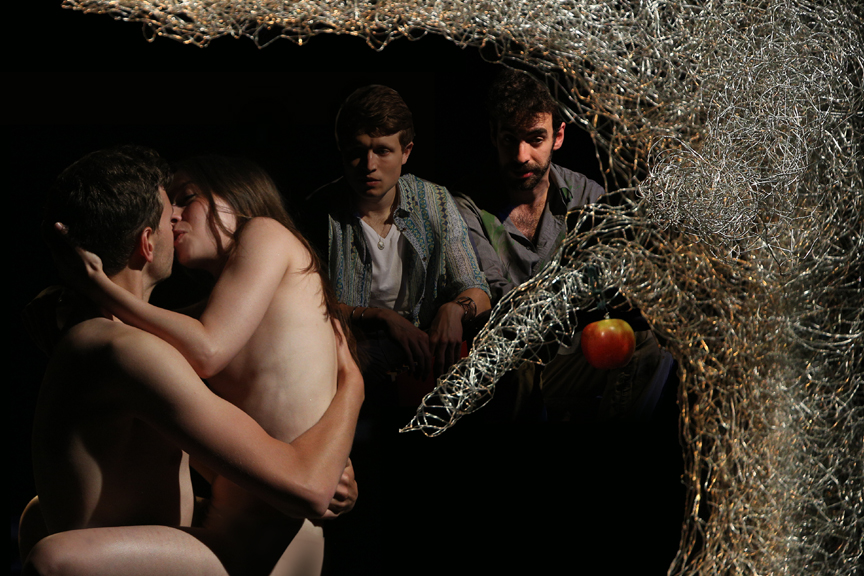
A scene from Up From Paradise at the New Wimbledon Studio, London. Picture: Roy Tan
Up From Paradise was performed at the New Wimbledon Studio, London.
Arthur Miller is not a name you associate with musical theatre. Up From Paradise marks the playwright’s only foray into the genre.
It’s a curious piece, based on Miller’s play The Creation of the World and Other Business, a rare flop from the Pulitzer-winning scribe. From the ashes of that failure, composer Stanley Silverman persuaded Miller to adapt it as a musical. The result is an unusual piece of theatrical history – but one which struggles to be effective in its own right.
The story of Adam and Eve and their fall, Miller’s script bounces between a witty retelling, with the Garden of Eden as the setting for the world’s first sitcom, and a more serious contemplation of the nature of faith and fealty to one’s god. Silverman’s score picks up on this, marrying several numbers that are tonally rooted in the history of liturgical chant with others that are pure Tin Pan Alley.
This clash of styles works better in the music than it does in the presentation of the play as a whole. Laughs are played with the broadest of strokes, the angel Uriel is played as an uber-camp queen for no reason relevant to the story, and all too often the main players are having to play in front of some overblown, distracting comedy ‘business’ that adds nothing to the scenes. Far more effective are those moments where Miller’s wry wit is allowed to speak for itself, and which allow for the more serious elements of the story to sit alongside the comedic.
Musically, the members of the cast deliver their all to perform the variety of styles with true conviction. Niccolo Curradi’s God has, as you’d expect, a commanding presence in song which unfortunately is less effective during the show’s book moments. The close harmonies of his angels (Steve Graney, David Herzog and Louie Westwood) work well both for the traditional choral numbers and more modern barbershop-style singing.
As Adam and Eve, Alexander Elwood and Susanna Squires start as naive, lost souls, until the apple they have been instructed never to eat opens their eyes. Their growth from children in adults’ bodies to the loving, if frustrated, parents of Cain and Abel is effectively played out, ensuring that wherever else the play has faults, its nominal central relationship offers a core of assuredness.
But while Adam and Eve get the best tunes, it is the Devil who really captivates. This story of The Fall is as much about Lucifer’s descent from the right hand of God, and Alex Wingfield’s fallen angel Lucifer becomes easily the most captivating character, and performance, of the show.
Ultimately, the show is so uneven that one can find it easy to see why it is not better known. But while director Patrick Kennedy does at times hobble the show with even more inconsistency than already exists within its script, he should nonetheless be praised for reviving such a theatrical curio.
Scott Matthewman


Comments are closed.