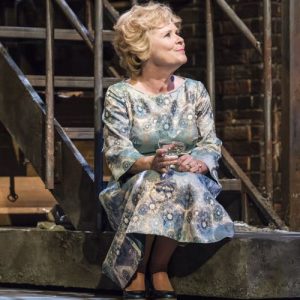
Imelda Staunton in Follies at the National Theatre, London. Picture: Johan Persson
Follies continues at the National Theatre (Olivier), London until 3 January.
Star rating: five stars ★ ★ ★ ★ ★
We’ve waited long enough, 30 years unless you count the limited-run version at the Royal Festival Hall in August 2002, for a full-scale revival of one of Stephen Sondheim’s finest creations and now we’ve got one with bells on.
Gorgeous to look at, dazzlingly choreographed by Bill Deamer, on a superb Vicki Mortimer set dominated by a giant Follies sign already in the throes of being demolished, Dominic Cooke’s stunning production takes off from the moment the orchestra strikes up ‘Beautiful Girls’ and never lets up.
Cooke worked with the 1971 Broadway script (book by James Goldman), which ran for 1,500 performances yet lost every nickel of its $800,000 investment through its lavishness, not the 1987 West End version with Diana Rigg that brought in some song changes.
While we often grumble about the cost of theatre tickets, just consider how many mouths there are to feed here, a cast of 37, a 21-strong orchestra under musical director Nigel Lilley, 160 costumes to make, plus 200 production staff and apprentices.
And while the vast Olivier stage is perfect in many ways for handling such a big cast, the intimate moments between the two sets of lead couples, Imelda Staunton and Peter Forbes as Sally and Buddy on the one side, Janie Dee and Philip Quast as Phyllis and Ben on the other, are harder to achieve.
They play the two showgirls and the two stage-door johnnies who married them – two couples growing further apart as time marches on.
Homebird Sally always had a crush on Ben, who went on to a big career in business and charity work, but had to make do with Buddy, who became a travelling salesman and unfaithful with it.
The Weismann post-war get-together is their chance to reflect on ‘The Road You Didn’t Take’ and marriages that don’t work. The ageing showgirls arrive for a final reunion before the theatre is demolished and are given sashes denoting the between-the-wars year they danced there when those Ziegfeld-style revues flourished.
One great musical theatre classic follows another, with Quast in magnificent voice for a pain-filled ‘Too Many Mornings’ and ‘Live, Laugh, Love’, and Dee at her cutting best on ‘Could I Leave You?’ and triumphant on ‘The Story of Lucy and Jessie’.
The idea of five-foot-nothing Sally somehow getting past longer-limbed ladies for a job in the Follies chorus takes a bit of getting used to during Staunton’s hauntingly-good versions of ‘In Buddy’s Eyes’ and ‘Losing My Mind’.
‘The Right Girl’ is Forbes’ big moment as he realises what Sally means to him. There are great solo opportunities too for Tracie Bennett’s Carlotta, defiant but funny with it in ‘I’m Still Here’, while Di Botcher rips into the showstopping ‘Broadway Baby’ with rare abandon. Dynamic Dawn Hope also leads a brilliant team effort on ‘Who’s That Woman’.
Geraldine Fitzgerald’s lively Solange makes ‘Ah, Paris’ electric, and although I still don’t know what that pretty little ‘One More Kiss’ is doing in the show (because it doesn’t really fit in), it does give Josephine Barstow, 77 this month, the chance to use that opera-trained voice as Heidi, and Alison Langer as her ghost, to show us what that voice might have sounded like in Heidi’s halcyon days.
The young ghosts of the four leads are beautifully played by Zizi Strallen, Alex Young, Adam Rhys-Charles and Fred Haig in this gem of a revival which has already been extended from November to the start of 2018.
Jeremy Chapman
* Follies will be broadcast by NT Live to cinemas in the UK and internationally on Thursday 16 November: www.ntlive.nationaltheatre.org.uk
* Readers may also be interested in:
Follies at the National Theatre – new gallery of production images – News
SHARE THIS POST:


Comments are closed.