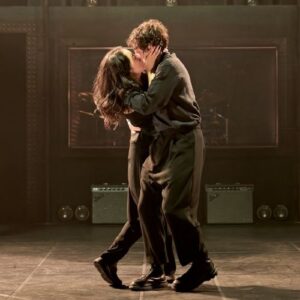
Ami Tredrea and Samuel Blenkin in Hamlet Hail to the Thief at the Barbican Theatre, London. Picture: Manuel Harlan
Hamlet Hail to the Thief continues at the Barbican Theatre, London until 23 January 2027.
Star rating: five stars ★ ★ ★ ★ ★
To get the obvious out of the way: yes, a mashup with Radiohead’s 2003 album Hail to the Thief isn’t the traditional way to present Shakespeare’s Hamlet. Bit strange.
Still, there are common themes of mental instability, rage and corruption, and with frontman/songwriter Thom Yorke is on board as a co-creator and orchestrator alongside co-creators/co-directors Christine Jones and Steven Hoggett there is surely some method in this madness. Can Hamlet Hail to the Thief do for grumpy 6 Music dads what & Juliet did for nostalgic 2000s pop fans? Will it tap into some dormant well of teenage ecstasy and bring a new audience not just to theatre but to Willy Shakes himself?
While & Juliet’s cheesy treatment of Max Martin’s undeniable bops proved universally charming, Hamlet Hail to the Thief might be a harder sell to those with no pre-existing interest in either Radiohead or the Bard. Every element, from AMP Scenography and Sadra Tehrani’s recording studio-inspired set to Jessica Hung Han Yun’s striking but sometimes blindingly hard lighting to Gareth Fry’s sound design, serves here to alienate. That latter element is particularly remarkable with sung vocals drenched with reverb near to the point of unintelligibility and dialogue compressed and midrange-boosted so as to imbue every scene with stark loudhailer artificiality.
Many will attend just for the music, but even then there are few Radiohead superfans who would consider 2003’s Hail to the Thief to be their favourite album. Yorke describes it as the one Radiohead “record that got away” due to its rushed recording and release. Here, the songs are cut up and rearranged even further, into musical “shattered pieces of glass” in his words. Much is refigured into an unrelenting ambient soundtrack that pushes scenes even further into uncanny and unreal territory.
So, like all Radiohead projects, this project risks being divisive and even impenetrable. But at the same time as we are held back from getting too close to the action, as we let these waves of noise and lights wash over us, we are swept away. In a trance-like state, the sheer humanity inseparable from this music and this immortal story jumps out and becomes impossible to miss.
Samuel Blenkin stars as a Danish prince with perfectly appropriate teen angst and ambiguously affected madness. His emo inflections and otherworldly physicality bring a disquieting unease to a plot so familiar. This is a Hamlet of half the length which does necessarily lean into the play’s ‘greatest hits’ (“To be…”, “Alas…”, etc.), so to have a central performer bringing more to his role than the standard modern Shakespearian dramatic pause or full-chest bellow is a delight.
Blenkin is particularly majestic when throwing himself around the stage and Jess Williams’ kinetic choreography is masterful. Paul Hilton as Claudius also impresses here, bringing shades of overconfident CEO at the company disco to a dance language built around the unconventional ticks and spasms of Yorke’s live performances.
As a testament to her astoundingly human portrayal, Claudia Harrison’s Gertrude is sympathetic even in her incestuous collusion, while Miles Barrow and Halim Diwani’s Rosencrantz and Guildenstern bring levity and impressive physicality to the etherial evening.
Elsewhere, Alby Baldwin’s Horatio is a perfect confidant for Hamlet, and the audience too. They serve as a relatable way into a story far removed from typical modern life. By their concluding speech after Shakespeare’s greatest and bloodiest tragedy – rendered here as a dizzying dance to ‘Sit Down. Stand Up’ – we are as teary-eyed as them.
However, the evening’s biggest heartbreak might just be Ami Tredrea’s Ophelia, whose death mashes up Hamlet’s most famous speech and the Radiohead track ‘Sail to the Moon’. Combined with stunning projection design by Will Duke and a masterclass in pathos by Tredrea, this is an astonishing stage moment which brushes surprisingly close to traditional musical theatre.
Those who come solely for the music will not be disappointed. Tom Brady’s eight-piece band of rock and jazz veterans shake the Barbican’s Brutalist concrete to its core, despite being kept safely behind glass. This is theatre with real volume and real instruments. From the modular percussion to the parade of ever-changing single-pickup guitars to the full acoustic drum kit, no corners have been cut for the sake of logistics. The programme features a wonderful photograph of Yorke helping to programme a patch on a Prophet-10 synthesiser. This isn’t convenient MIDI and digital modelling, these are real musicians putting in the work to make a glorious analogue noise.
As you might imagine, given the apparent absurdity of ‘Radiohead Shakespeare’, there is a small demographic who will fall in love with this show with every fibre of their being and another small demographic who will be left alienated, confused and complaining of tinnitus. That much seems unavoidable.
What is remarkable about this production is how it manages to appeal to those in the middle. The partners brought along. Those who love one element of this piece but are sceptical of the other. The Radiohead score sounds absolutely exquisite and invigorating, the Shakespeare is condensed but not dumbed down, and when combined with the endless invention of the talented creatives working on this piece, the combination is irresistible.
Ian Bowkett
SHARE THIS POST:



Comments are closed.