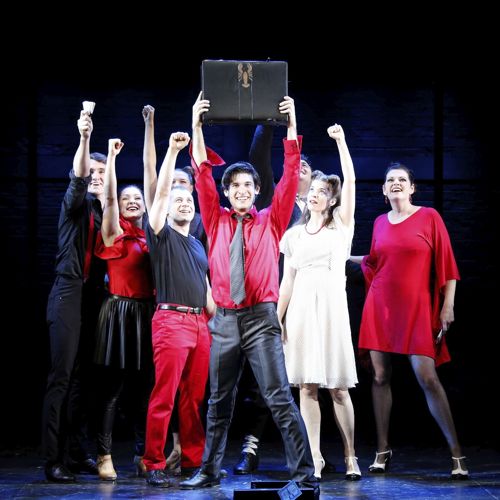
A scene from Revolution in the Elbow of Ragnar Agnarsson Furniture at the Minetta Theatre, Off-Broadway, New York
Revolution in the Elbow of Ragnar Agnarsson Furniture Painter continues at the Minetta Lane Theatre, Off-Broadway, New York.
Don’t you wonder what goes on up in that Nordic conclave called Iceland? After all, it’s the country that gave us Björk, the singer-songwriter whose fashion sense sometimes created more attention than her unique musical abilities, particularly the swan dress she wore to the 2001 Academy Awards.
Now a group of Icelanders have put together a new musical called Revolution in the Elbow of Ragnar Agnarsson Furniture Painter. It’s a show they’ve brought to New York for an Off-Broadway world premiere at the Minetta Lane Theatre, and it almost lives up to the wackiness of its title.
The book, music and lyrics are the work of Ívar Páll Jónsson, with a story credited to Ívar and his brother Gunnlaugur Jónsson. The composer-writer, as his programme bio tells us, hails from Reykjavik, and after a career in journalism he “adhered to his true calling and made music and theatre his life at the rather tender age of 37. Having perfected his craft through the years by writing thousands of songs and doing a lot of creative writing, he embarked on the project that became Revolution (etc).”
The story is inspired by the global financial crisis of 2008, a crisis that hit Iceland particularly hard. And there is an anti-government, anti-banking bitterness that pervades the script, but it’s couched in a fable-like tale that comes across just as head-scratchingly befuddled as it is sometimes clever. As the audience enters the theatre, they are greeted by a huge video of a burly man projected on the back wall of the stage. Presumably, this is the titular Agnarsson, and he seems to be continually waking from and falling back into a troubled sleep. It’s a pretty unsettling vision.
Once the show begins, a smartly dressed young fellow bounds on stage, pulls out a revolver and shoots himself with a projection of spreading blood on the back wall. Also, a narrator takes over and with the help of another projection – a schematic map of Agnarsson’s body – informs us that within this body there are many societies. Some of them are pretty major communities – such as Knee York and Hipsburg – but the show centres on a backwater place called Elbowville, where the citizens make their livings in the lobster trade.
The show then goes into flashback, Elbowville has an idiosyncratic, ambitious mayor and she wants to build up the town’s status as her legacy. So, she puts out a call for ideas. Peter, the guy who will eventually commit suicide, appears with a prosperity machine, a contraption that prints out money for all-comers in exchange for lobster promissory notes. And indeed prosperity takes over the town, until Peter’s scheme falls apart, and the citizenry, suddenly faced with calls on their debt, begin rioting. That’s when Peter does himself in and the mayor is deposed, but that’s not the end of things. After a seemingly democratic election goes awry, the mayor comes back into power, and a fascist-like government takes hold. This has the populace restless once again, and the show ends with a grim chorale calling for revolution.
At least, I think that’s what happens. The storytelling sometimes gets a little blurred among jokey references to Agnarsson’s body parts and the peculiar religion of the folks who inhabit his anatomy. They worship Robert Redford as their supreme being, and one of the prayers we hear is made up of the titles of his various movies. (It seems that Agnarsson is the proud owner of the official VHS collection of Robert Redford films.)
The generous score goes from lively ditties to some pretty heavy ear-splitting rock, that’s slammed out with vigour by the four-man on-stage band and the vocal prowess of the cast. A lot of the musical numbers aren’t so much songs as crescendo-filled settings for phrases that are repeated ad infinitum. They do on occasion build dramatic power, although it can often feel like you are being pounded on the head with an insistent hammer as well.
The show has been directed by Bergur Ingólfsson, whose most recent work was the Icelandic production of Mary Poppins, which – again as the programme relates – “became the most popular musical in history in Iceland, with the audience number reaching 1/16th of Iceland’s population in 2014.”. His staging is brisk, incorporating a lot of lively choreography from Lee Proud. A Londoner, Proud is a non-Icelandic member of the creative team, but he did do the dances for the aforementioned production of Mary Poppins.
Ingólfsson has gotten infectiously enthusiastic work from his cast, a talented assemblage of New York-based performers pulled together with the help of the New York firm, Calleri Casting. The biggest name is Cady Huffman, who makes an imposing, short-fused figure as the mayor. Huffman won lots of huzzahs, including a Tony Award, for her turn as Ulla in The Producers.
Marrick Smith makes Peter an extremely winning character despite his financial skullduggery, and he handles some twisty rock vocalising and energised dancing with impressive aplomb. There’s also appealing work by Jesse Wildman as Brynja, the girl who wins the heart of both Peter and his brother, the more restrained Alex, played with appropriate sincerity by Graydon Long. Other notable contributions come from such players as Patrick Boll, portraying the mayor’s duplicitous lackey who really only wants to cuddle and also acts as the narrator taking us through the thickets of plot; Brad Nacht as Stein, another somewhat hapless brother of Peter, and Kate Schindle as Stein’s noisy wife.
There are certainly elements of Revolution that recall other musicals. As the mayor addresses her subjects from a balcony, you might well think of Evita. When Peter and assorted townspeople break into a nifty tap number celebrating their newly minted prosperity, memories of any number of Susan Stroman-directed epics may wash over you, and as the people gather together in formation to call for revolution, it’s Les Misérables time in old Elbowville.
Still, Revolution has so much quirkiness of its own making, it’s an open question as to whether New York theatregoers can take the show to its bosom. But you can’t help feeling empathy for these brave folks from the North who have brought their dream and their cash to New York in search of Off-Broadway validation.
Ron Cohen





Comments are closed.