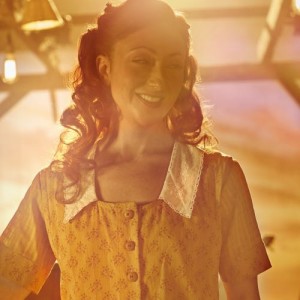
Carmen Cusack in Bright Star at the Cort Theatre, New York. Picture: Nick Stokes
Bright Star continues at the Cort Theatre, New York.
Star rating: three stars ★ ★ ★ ✩ ✩
Another week, another bluegrass musical comes to New York theatre. The third and latest arrival in this minor epidemic is Bright Star, an astoundingly uneven stew which has opened on Broadway carrying the imprimatur of one of the more celebrated and multi-talented names in showbusiness, Steve Martin. He’s not in the show, but he created it with a collaborator, pop singer-songwriter Edie Brickell. The exact and somewhat tangled credits have Martin responsible for ‘music, book and story’, and Brickell for ‘music, lyrics and story’.
The pair have already produced two albums, realising their songs were sort of forming a narrative. That led them to create a musical, but at the same time they had to find a story they wanted to tell. Things solidified when they came across a real incident from more than a hundred years ago: a baby was found in a satchel, apparently tossed from a train passing through a rural stretch of the state of Missouri. The boy was adopted by the farmer who found him and grew up to lead a normal life, although the legend and folk song – ‘The Ballad of the Iron Mountain Baby’ – that told his tale brought him a lot of unwanted publicity.
The fiction Martin and Brickell have concocted from this event centres on a poor but frisky and smart Southern small town lass named Alice Murphy (Carmen Cusack). She’s in love with the mayor’s son (Paul Alexander Nolan) and becomes pregnant with his baby. The mayor’s son is a nice guy in love with Alice, but his father’s a real rich-guy meanie (Michael Mulheren), who is determined to have his son marry a woman of higher standing.
Ater the baby is born in seclusion, the mayor wrests the infant away on the pretence of giving it up for adoption and boards a train. Well, I’m sure you can guess what happens next.
Despite the pain of losing her child, Alice, believing only that her son has been adopted, moves on with her life, goes off to college and, putting her red hair neatly on top of her head and donning spectacles, becomes the hard-nosed, respected editor of a prominent Southern literary journal.
Alice’s history is spilled out in flashbacks, and it shares the stage with the story of an aspiring writer, Billy (A.J. Shively), who has just returned to the home of his farmer-father (Stephen Bogardus) after soldiering in the Second World War.
Billy finds moral support from his platonic gal pal Margo (Hannah Elless) and goes off to the big city – Asheville, North Carolina – to submit his stories to Murphy’s journal. There he gets initial rejection but encouragement from Murphy and eventually gets published. All the while, Murphy feels a strange attachment to this young man. I can’t tell anymore without sending spoilers into the air, but I’ll bet that just like before, you can guess what happens.
Most of this glum narrative plays out in exceedingly sincere fashion. It’s reminiscent of some early Barbara Stanwyck movie melodrama, made when out-of-wedlock sex was whispered about behind closed doors.
Still, it has its moments, but then come a series of relentlessly happy endings that not only challenge credibility but almost make the whole enterprise seem ridiculous. This unevenness is reflected in Walter Bobbie’s direction and Josh Rhodes’ choreography. The constant shifts in time and locale and a few lively dance numbers are handled well on Eugene Lee’s woodsy open set. But then there are times when members of the ensemble hover in the shadows engaged in abstract movement, like some parody of overly arty expressionistic theatre.
What is spectacular about the show is the score. Martin, an accomplished banjoist, has found almost infinite variety within the bluegrass genre, from familiar and infectious foot-stompers to affectingly mournful ballads, inspiring hymnals and chorales, and arias of pristine beauty. The orchestrations by August Eriksmoen are terrific, and they’re performed with grand enthusiasm by the ten-member orchestra.
The scene in which the baby is brutally taken from Alice features dialogue that is sung almost throughout by all the actors on stage and takes on an intense opera-like grandeur. Brickell’s lyrics sometimes reflect a banal but appropriate folksiness, and at other times achieve genuine poetry.
The cast cannot be faulted. The performances, one and all, are as convincing as the material allows, sometimes moreso. Easily handing the continual changes of Alice from young rural girl to hard-nosed middlle-aged executive, Cusack, who had performed in both London and around the USA, makes a notable Broadway debut. Her singing is luminous while incorporating a genuine country sound.
There’s much to admire in Bright Star, and these lines in Alice’s opening number stick in my mind: “If you knew my story, you’d have a good story to tell.” I can’t help wondering what kind of story Martin and Brickell might have told if they hadn’t be led astray by Iron Mountain Baby.
(PS. If you’re curious, the other two bluegrass musicals that opened this past month are Off-Broadway. They are Southern Comfort, a new work dealing with contemporary transgendered folks finding love and facing death, and a revival of The Robber Bridegroom, relating the folkloric adventures of some lively characters in Mississippi Territory circa the late 1700s.)
Ron Cohen
Readers may also be interested in:
The Robber Bridegroom – Laura Pels Theatre, New York – Review
Southern Comfort – The Public Theater, New York – Review
SHARE THIS POST:


Comments are closed.