 You Give Me Fever –The Phaedra Cabaret was performed at Café Mila, Godalming.
Star rating: four stars ★ ★ ★ ★ ✩
Presented by LynchPin Production Theatre Company’s ScripTease, You Give Me Fever – The Phaedra Cabaret is the brainchild of local playwright and director Jack Lynch (himself no stranger to ScripTease events), and performed by singer-actress Pippa Winslow, accompanied by James Shannon on jazz guitar.
Its inaugural outing at Godalming’s Café Mila may have been billed as a ‘rehearsed reading’, with stage directions read from the wings, but in reality the evening offers a very polished performance in which Winslow makes only minimal reference to the book.
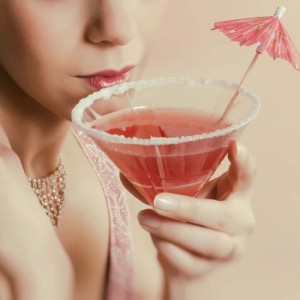
You Give Me Fever – The Phaedra Cabaret retells one of the classic tragedies of Ancient Greek mythology through the eyes of Winslow’s character Fey, a reimagining of the eponymous protagonist as a glamorous 1950s chanteuse.
Lynch’s script combines Fey’s monologue with some 30 standards, several of them drawn from musical theatre, including the delightfully performed ‘Bewitched, Bothered, and Bewildered’ (Rodgers and Hart, from Pal Joey). The resulting cabaret-style show is a distant cousin of the jukebox musical, but with a more novel, creative feel about it such that it eludes classification. It is a particularly welcome change of pace that the instrumental accompaniment is provided by a single guitar, expertly played throughout by Shannon, rather than the ubiquitous piano or multi-piece band.
Act I focuses on the story of Theseus and the Cretan Labyrinth, and Act II on Phaedra’s affair with her stepson Hippolytus. The script is replete with intellectual references to Ancient Greek mythology (Theseus, for example, is described as ‘so very full of bull’) and points of etymology (mention of the derivation of the word ‘hypocrite’ from the Greek for ‘actor’ is especially apt).
Once or twice, allusions to such elements as Hades or the gods of Mount Olympus seem to sit uncomfortably with the 20th century setting established for the show, and this is an incongruity that the audience does need to look past. That said, the deliberate departure from standard retellings of the myth towards the end of the evening puts a refreshingly original spin on Phaedra’s story.
Winslow plays the character of Fey in an intimate vein throughout, and her execution of Lynch’s well-paced narrative is consistently engaging. The script moves seamlessly between speech and song, one particularly ingenious instance being the segue into ‘Mad About the Boy’ (Noël Coward, from Words and Music) in Act I. Some of the reprises lie very close to the song’s initial presentation on the set list, not least in the case of ‘Little White Lies’ (Walter Donaldson), which bookends just one other number, ‘Lovers Will’ (John Hiatt). While unusual, this seems to work well within the narrative to lend some wider framing to the series of standards.
Many of the songs are presented incompletely, and sometimes I wished they might have run on a little longer. One of the briefest is the a cappella fragment of ‘Crazy’ (Willie Nelson), one of several numbers that are anachronistic within the show’s 1950s context, in that it was not written until 1961.
Just occasionally the reversion to music following a long stretch of unaccompanied monologue can be jarring, as it is challenging for the guitar to break its silence unobtrusively. Conversely, much effective use is made of delivering speech over quiet musical accompaniment, the instrumental version of ‘Misty’ (Erroll Garner) being a particularly effective example of Shannon’s sensitive underscoring of the narration, and this technique offers one means of smoothing the transitions.
Occasionally I felt that greater musical variety may have been warranted given that the succession of slow jazz standards can become a little monochromatic after a while. Even ‘Stop! In the Name of Love’ (Holland-Dozier-Holland), a potential opportunity for the performance to step up a gear, is reinterpreted as a slow ballad quite far removed from The Supremes’ original.
Some possibilities for contrast are indeed capitalised upon, for instance, the sequence of ‘Embraceable You’ (George and Ira Gershwin, from Girl Crazy) followed by ‘Mad About the Boy’ and the title song, ‘(You Give Me) Fever’ (Eddie Cooley and John Davenport). Nonetheless, it may be advantageous were future presentations of the show to tweak the set list such that it yields a slightly greater sense of light and shade.
You Give Me Fever – The Phaedra Cabaret’s retelling of Ancient Greek myth through the medium of jazz standards represents a pleasingly innovative and creative approach. Its development benefits from an illuminating post-show talkback with the audience following each performance, a commendable endeavour for a work in progress that should be encouraged for more new theatre works. Notwithstanding one or two junctures in which further fine-tuning might perhaps be considered, the show is rich in potential for repeat performance and would doubtless meet with much success as a touring production.
Christopher Wiley
Readers may also be interested in:
Just a Housewife – Guildford and Touring
SHARE THIS POST:


Comments are closed.