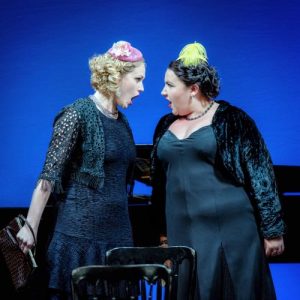
Kathryn Walker and Amy J Payne in Berlin to Broadway With Kurt Weill at the City Varieties, Leeds. Picture: Ant Robling
Berlin to Broadway With Kurt Weill at the City Varieties, Leeds.
Star rating: five stars ★★★★★
As a rule, I am not a fan of shows that harvest the ripest plums from a musical or opera. ‘O mio babbino caro’, taken out of context, too often becomes a sickly hymn of praise, when in fact it’s a humorous piece depicting a manipulative daughter trying to get her own way using the prettiest of tunes.
I could be persuaded to adjust opinion, however, when I see shows like Opera North and West Yorkshire Playhouse’s Berlin to Broadway.
Drawing initially on Kurt Weill’s cooperation with Bertolt Brecht, we are taken on a journey from Weimar Germany to 1940s Broadway. On the way, the ensemble talks us through Weill’s life and loves, including his on/off relationship with Lotte Lenya. The first part of the show is entirely devoted to Weill’s music for Brecht.
It is unjust to select one or two performers from such an accomplished cast, all members of the Opera North chorus, but I will do so just to indicate the strength in depth of this undecatet.
Stuart Laing opens the show strolling through the auditorium crooning the opening lines of Weill’s most famous composition, ‘Mack the Knife’. With the ensemble, he closes in similar style.
However, it is the ladies who light up the first half. The sheer savagery and misandry of Laura Kelly-McInroy’s ‘Pirate Jenny’ takes the breath away. The credits say Brecht, but recent theories that some of his words were actually those of female collaborators can have no more convincing evidence than this song.
Similarly, Amy J Payne injects considerable venom into ‘Surabaya Johnny’. The acting out of a woman’s hatred is electric.
The second half introduces us to a much wider emotional range and some distinguished collaborators as Weill escapes Nazi Germany and moves to New York.
Ensemble pieces such as ‘Wouldn’t you like to be on Broadway’ and ‘That’s Him’ contrast Weill’s feel for humour with the astringency of the first half, while Kelly-McInroy and Laing’s duet, ‘Speak Low’, charts the emotions of lovers separated by war.
However, it is Dean Robinson’s world-weary ‘September Song’ and Kathryn Walker’s wistful ‘My Ship’, that light up the second half. Both of these have been covered by greats such as Ella Fitzgerald and Frank Sinatra, but there is nothing like the immediacy of a live performance.
Director Giles Havergal and designer Catherine Morgan choose an austere set with just chairs and piano on stage. Musical director Martin Pickard plays unobtrusively, but the spareness of his piano complements the set and black costumes.
Something must be said too for the decision to stage the show in the cramped surroundings of the City Varieties theatre. The single piano, the limited set, the closeness of the audience to the performers – all these contribute to the cabaret intimacy of the music, particularly for the first half.
So, am I a convert to this early form of jukebox musical? When done like this, the answer is definitely yes.
Mike Tilling
SHARE THIS POST:


Comments are closed.