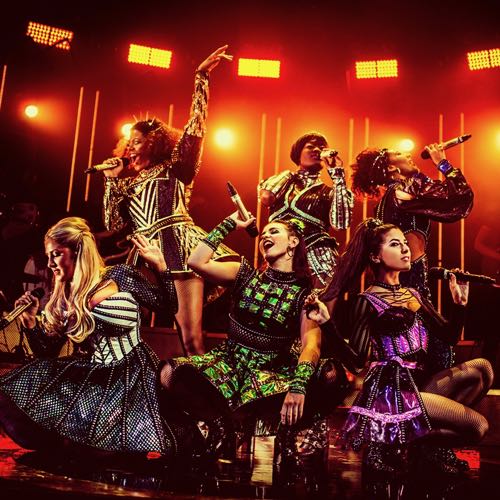
Six continues at the Arts Theatre until January 2020.
Star rating: five stars ★ ★ ★ ★ ★
All too often when one returns to a West End musical after over a year, some of the sparkle has gone, and there’s a sense beginning to creep in that those on stage are just starting to go through the motions.
Nothing could be further from the truth with Six, which is currently enjoying a near-permanent residency at the Arts Theatre. Toby Marlow and Lucy Moss’ inventive re-imagining of Henry VIII’s wives as a pop sextet showed what it was capable of during a brief run in the same venue early in 2018. Since then, its creators and producers have taken the show, given it some polish, and returned it even more dazzlingly, precociously brilliant than before.
The conceit remains the same: each of Henry’s wives attempts to sing about why they should be the Queen of Queens, based on the hardship they endured as consort to a misogynist, philandering king.
The show’s X Factor-meets-Horrible Histories vibe is the perfect vehicle for its sextet of young performers, this week nominated jointly for Best Supporting Actress in a Musical in this year’s Olivier Awards. The Oliviers’ acting categories rarely see ensemble nominations, but theirs feels especially deserved: there is no one leading lady here, but six powerful women in support of one another.
Of course that ensemble feeling isn’t always shared by the characters they play, with each one attempting to put the others down while they try and claim the top prize. Millie O’Connell’s Anne Boleyn, portrayed as the Snapchatting youngster of the group, is perhaps the cattiest of the lot, but only because hers is perhaps the most well-known story.
That should change for those watching Six, though, because the historical facts peppered throughout Marlow and Moss’ lyrics inspire one to explore each of the women’s stories in more depth. Historical tidbits such as Anna of Cleves coming to Henry’s attention via a Holbein portrait, his dissatisfaction with the real thing, and her receipt of Richmond Palace in the subsequent divorce, are tossed in as lightly as possible, allowing the composers’ talents for pastiche and reference to infuse some cracking tunes.
Elsewhere, Natalie Paris’ Jane Seymour – who died shortly after giving birth to Henry’s only son – is presented as being the closest he came to finding “the one”, even though she is well aware that the gender of her child had plenty to do with his affection for her.
Indeed, the exploitation of the women of court by their monarch and other men is a recurring theme. This is particularly apparent in the later numbers, as Aimie Atkinson retells the upbringing of Catherine Howard. Initially dismissed as “the wife nobody cared about”, Atkinson slowly reveals that was true in a devastatingly true, and horribly modern, way: passed from man to man from the age of 13 she was, in modern parlance, groomed to please men.
Atkinson’s take on the character, in the sublime ‘I Don’t Need Your Love’, slowly peels away the layers of bravado to reveal the vulnerability and pain that come with years of abuse. And while that torment is obvious, it’s a credit to performer, writers and directors (Moss co-directing with Jamie Armitage) that the number never feels too heavy.
But it is in the closing numbers where the women, led by Maiya Quansah-Breed’s survivor, Catherine Parr, come together instead of fighting each other. While their stories are only known because they were married to the same man, it is also men who originally wrote their histories, and made them appear secondary in the tales of the Tudor court.
In this reinterpretation, the women take back control of their own story. And while the attempt to write alternative histories for each woman – stories in which nobody dies, divorces or gets beheaded – is still the least effective song of the evening, the overall effect is the same: Six tells stories of women on their own terms.
When Thomas Cromwell was describing Catherine of Aragon, he decreed that “if not for her sex, she could have defied all the heroes of history”. On the basis of Six, her five fellow wives could well claim the same thing.
When last reviewing the Arts Theatre’s previous production of this work, I gave the show five stars. Were it possible to add another to this rating, it would be fitting: for there are six stars on stage, backed by an impressive four-piece (and, incidentally and powerfully, all-female) band.
It is no surprise that the show has picked up five Olivier nominations: one feels that more accolades will come to a production which has a long, long future ahead of it.
Scott Matthewman
SHARE THIS POST:


Comments are closed.