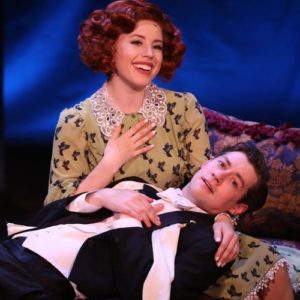
Allie Trimm and Chris Dwan in Enter Laughing: The Musical at The York Theatre Company, New York. Picture: Carol Rosegg
Enter Laughing: The Musical continues at The York Theatre Company, New York until 9 June 2019.
Star rating: four stars ★ ★ ★ ★ ✩
For audiences with a deep nostalgia for old-time Hollywood and rather rosy feelings about getting through the hard times of the Great Depression, the Off-Broadway revival of Enter Laughing: The Musical at The York Theatre Company should be as warming and comforting as a rich bowl of homemade chicken soup.
Theatre-goers with a taste for the sophisticated and contemporary might find it a bit creaky and one-jokey as it unwinds the tale of a young Jewish guy from the Bronx (one of New York’s less glamorous boroughs), David Kolowitz, whose mid-1930s dreams of becoming an actor far surpass his initial talent. He does do not-terribly-good impressions of such oft-impersonated movie stars as Ronald Colman and Edward G. Robinson.
The script details David’s workaday life as a delivery boy and general toiler in a machine shop, his complicated if not very sensual love life juggling three different ladies, and his calamitous stage debut with a seedy theatrical troupe, which nevertheless only further fires up his thespian ambitions.
Still, there’s no denying the affection the York company feels for this work and the care it has lavished on this mounting, with its enthusiastic cast of 11 (including a cameo appearance by York’s producing artistic director James Morgan), its trio of musicians and a cheery-looking physical production, set in an old-fashioned proscenium frame. (Multi-tasking Morgan designed the set. However, the period-evoking costumes are not by Morgan. They’re by Tyler M. Holland.)
Like many pop culture artefacts hitting the musical stages these days, Enter Laughing has gone through varied iterations. Its basis is the 1958 semi-autobiographical novel by the showbiz stalwart of many hats, Carl Reiner, who has found success as a writer, director, producer and performer.
In 1963, Joseph Stein, the librettist and playwright whose credits are topped by Fiddler on the Roof, transformed the book into a Broadway hit comedy which ran for a year and won stardom for Alan Arkin playing the actor wannabe David Kolowitz. A well-received movie version (without Arkin) followed in 1967.
Then in 1976, came the Broadway musical adaptation, originally titled So Long, 174th Street, with a book by Stein and a score by Stan Daniels, an accomplished TV sitcom producer and writer, making his only Broadway stand as a songwriter with this show.
The stream of success ended abruptly. The musical closed in less than three weeks.
Undaunted, however, York some ten years ago, with its wide-ranging devotion to musicals old and new, hits and flops, resurrected the show, with revisions by the director Stuart Ross and rechristened it (not too originally) as Enter Laughing: The Musical. And as York happily recalls in its press material, it scored “a runaway hit”.
Its remounting now, with Ross again at the helm, is hailed as a celebration of York’s 50th anniversary, and the production does exude that celebratory feeling, plowing through the musical’s deficiencies – its stereotypical cartoonish characters, its occasional staleness – with a determination to offer a feel-good, laugh-inducing night out at an Off-Broadway theatre.
Taking on the role of David Kolowitz with a charming bravura is Chris Dwan. He has an inherent clean-cut demeanour in his open-faced good looks, and it would be hard to mistake him for a klutzy Bronx native, But he handles the plentiful slapstick well, sings pleasantly and with fervour when needed. He also moves quite nimbly through Ross’ musical staging and Jennifer Paulson-Lee’s fairly simple choreography.
Surrounding him are an array of familiar characters. As Marlowe, the head of the acting company, David Schramm imbues great-man-of-the-theatre affectation with an Orson Welles-like heft. As his daughter and his company’s leading lady, Farah Alvin knows little subtlety in her lascivious longing for Kolowitz, but it fits the parody of a torch song she is given to sing: “The man I can love must have a nose/No more than two arms, and about ten toes.”
Alison Fraser mixes sweetness with sternness as David’s mother, who is determined he become a pharmacist and firmly nixes his actorly ambitions. She plays nicely off Robert Picardo as David’s father.
As David’s established girlfriend Wanda, Allie Trimm seasons the character with a touch of daffiness, while Dana Costello is all amiable sexpot as a secretary at a hat company to which David makes deliveries.
Rounding out the cast in capable fashion are Ray DeMattis as David’s boss; Raji Ahsan as Marlowe’s gruff but helpful stage manager; and Joe Veale as David’s best pal.
Perhaps the show’s biggest conundrum is Daniels’ score. His songs are mainly comedy numbers, filled out with simple melodic lines and a lot of obvious jokes. The show often seems needlessly cluttered, with songs and production numbers tied to the slightest provocation. For example, after a bad rehearsal, David wishes he were dead, and a big song-and-dance follows portraying mourners at his funeral. However, some of it is truly funny.
Then, there is a question of taste. The most questionable number is ‘The Butler’s Song’. Wanda expresses her fear that if David becomes a famous actor, he’ll be surrounded by actresses wanting to be with him. And off we go into David’s imagination, as the show often does, to see Schramm’s Marlowe as David’s butler, talking on the phone to a Miss Garbo and telling her why David cannot speak to her.
“He’s screwing Dolores Del Rio,” the butler explains. He then goes on to detail David’s calendar of sexual appointments with just about every name lady on the Hollywood lots at the time.
For those in the audience whose memories may be failing or any young ’uns who may have wandered in, the programme provides a two-page ‘glossary of film stars mentioned in Enter Laughing’.
Who says musicals can’t be educational as well as entertaining?
Ron Cohen
SHARE THIS POST:


Comments are closed.