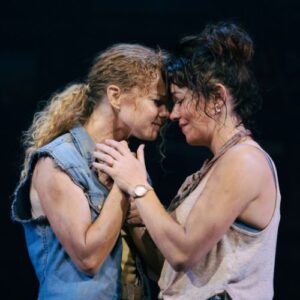
Amy Lennox and Rachel Tucker in Thelma & Louise at the Young Vic Theatre, London. Picture: Helen Murray
Thelma & Louise continues at the Young Vic Theatre, London until 24 October 2026.
Star rating: four stars ★ ★ ★ ★ ✩
When a man is described as a ‘ladies’ man’, all a woman sees is a creep. That disparity lies at the heart of Thelma & Louise, the 1991 Ridley Scott-directed film that saw Geena Davis and Susan Sarandon’s girls’ weekend turn into a crime-laden road trip that (spoilers for a 35-year-old film with one of cinema’s most famous endings) ultimately sees them drive off into the Grand Canyon and to their deaths.
The film’s writer, Callie Khouri, has adapted her screenplay into this new musical’s book herself, helping to ensure that there is a fidelity to the transition with which many film-to-stage works struggle. There is an acknowledgement that one is familiar with the source material: Rachel Tucker’s Louise and Amy Lennox’s Thelma are introduced next to the crashed car that presages their ultimate demise, a visual flourish that means little without the foreknowledge that knowing the film provides.
The car itself – in the film, a Ford Thunderbird – is not seen again. As the two women travel from state to state, its presence is merely implied through neon lights moving across the set, a midwestern bar area in which all scenes are enacted. Scenes from the film in which the two women drive across desert landscapes are replaced by songs delivered concert-style by Lennox and Tucker with stick mics.
The beautiful cinematography of the film could be missed sorely, but director Trip Cullman helps to ensure that the sense of the two women’s journeys is real even when its re-creation is not. A motel pool is created with a paddling pool and a comically small amount of water – but while the presentation is laughable, it’s never played up by the central characters, which sells the whole show to the audience.
Tucker is in excellent form as the older Louise, who starts off taking a protective role over Lennox’s naive Thelma. The latter effectively displays an enforced sense of immaturity, kept down by her husband Darryl (Samuel Edwards) and never permitted the sense of independence Louise wants to show her.
Of course, the simple plan of a weekend away in a friend’s cabin quickly goes wrong. A stop at a bar where Thelma gets drunk and lets her hair down helps to show off the musical’s line dancing-infused choreography (by Bobbi Jene Smith and Or Schraiber), until it ends with an attempted rape and Louise killing Thelma’s assailant. As they go on the run, local detective Hal (Trevor Dion Nicholas) pursues them, first as witnesses and then, reluctantly, as suspects.
The reasons Thelma and Louise go on the run, rather than heading straight to the police, are depressingly real. Because Thelma was drinking and publicly flirting with the man who attacked her, there would be a good chance nobody would believe that she was being raped. And because they could have got away, it would be unlikely Louise’s act of shooting him be regarded as self defence. That part shows a murkier motive, but one which explorations of Louise’s backstory – in song by Tucker, and in the subtext of phone conversations between Louise and Hal, after the detective uncovers her history – help to explain, rather than justify.
The presence of Jordan Luke Gage’s charming cowboy conman provides a further injection of charm, as well as moving the central characters’ story along after his actions leave them both on the run and penniless. His chemistry with Lennox helps the latter sell Thelma’s post-coital rebirth as a denim-clad badass, conducting possibly the world’s politest armed robbery in order to gain some much-needed funds.
As with many a movie adaptation, there are many key moments that fans of the original film will eagerly await. But this is not the sort of relentless cash-in to which some other West End movie adaptations have proven prone. The story is preserved, so the scenes stick around, but throughout there is care and attention given to present Thelma & Louise as a stage musical in its own right, rather than a carbon copy of the film’s visuals.
That success is also down to Neko Case’s songs. The music is defiantly country in tone throughout, ranging from the genre’s most balladic moments to harder, rockier tones as needed. Case’s lyrics often eschew easy rhymes, which may hinder any of them from becoming instant earworms, but it helps fuse the songs into the narrative in a way that helps the whole piece feel truly organic.
The true success of any musical adaptation is whether it stands on its own apart from the source. One doesn’t need to have seen Pgymalion to appreciate My Fair Lady, for example, but at the other end of the spectrum, The Devil Wears Prada is heavily dependent upon recognition of, and love for, the film.
One can feel the hard work Thelma & Louise puts in to place itself firmly in the former category. Fans of the film will love this reworking, to be sure, but it’s a charming, compelling story in its own right. We don’t really need the upturned car at the start of the show – but by the finale, it’s not harking back to the film’s ending but foreshadowing the musical’s. Thelma & Louise’s road trip keeps going for ever – but now it’s destined to continue as a terrific musical.
Scott Matthewman
SHARE THIS POST:


Comments are closed.