 Fiddler: A Miracle of Miracles plays in UK cinemas from 13 December 2019.
Star rating: four stars ★ ★ ★ ★ ✩
The genesis and subsequent production of the stage and movie versions of Fiddler on the Roof are explored in unprecedented depth in a new cinematic documentary by filmmaker Max Lewkowicz. Fiddler: A Miracle of Miracles is the most detailed and richly observed account of this record-breaking show’s life to date, and is a must-see for fans of the musical.
Lewkowicz, the son of a Holocaust survivor, has amassed a veritable Who’s Who? of Broadway theatre to recount the tale of the dairyman Tevya and his journey off the pages of Sholem Aleichem’s books and on to the stage and silver screen. Creators Jerry Bock (music) and Sheldon Harnick (lyrics) are joined by the likes of Hal Prince (the original producer), Austin Pendleton and Joanna Merlin (original Motel and Tzeitel), Stephen Sondheim (who first recommended Jerome Robbins as director), and the cast and creatives of recent productions, including Tevyes Danny Burstein and Harvey Fierstein, and Bartlett Sher, director of the most recent Broadway revival.
Also featured heavily is Fiddler fan Lin-Manuel Miranda – who we even see performing ‘L’Chaim’ at his own wedding.
The documentary follows the chronological telling of how the musical came to fruition, starting with the short stories of Sholem Aleichem – the pen name of the Yiddish playwright and novelist Solomon Naumovich Rabinovich. It was his short stories, collected as ‘Tevye and His Daughters’, that caught the attention of lyricist Harnick, who shared his passion for the stories with composer Bock.
“They’re such wonderful stories,” says Tony- and Pulitzer-winner Harnick. “They’re moving, they’re funny, they’re gripping, they’re dramatic… What more do you want as the basis for a musical?”
A search for a director, via Sondheim and Prince, leads Bock, Harnick and book writer Joseph Stein to Jerome Wilson Rabinowitz – better known, of course, as Jerry Robbins, who opted to mask his Jewish heritage. Here we are offered a fascinating insight into the abrasive approach of the somewhat demonised Robbins, who seems to have rubbed everyone up the wrong way, not least the leading man, Zero Mostel. Robbins’ testifying to the House Un-American Activities Committee did him no favours among his colleagues.

Picture: Johan Persson
To paraphrase Sondheim, Jerry was a nightmare, “but would I work with him again? In a heartbeat. You get more creative when working with him”. The abuse we hear the prickly director dishing out to a young actor is unacceptable, yet he redeems himself by devising the ‘Bottle Dance’ – one of the most memorable dance sequences ever staged, beautifully symbolising the precariousness of life in the shtetl. “It’s a communion with God through movement,” explains the violinist Itzhak Perlman most eloquently.
There are countless delightful little gems like this throughout: Bock and Harnick don’t write together but instead communicate by sending cassette tapes, which we get to hear; Robbins feels unable to accept the job of director until the writers define what the show is actually about (‘Tradition!’); designer Boris Aronson is inspired by the work of the Belarusian Jewish painter Marc Chagall, whose painting ‘The Green Violinist’ partly inspired the show’s title; Topol’s success in the role being attributed by one of his co-stars to his “powerful and sexy” performance; and so on.
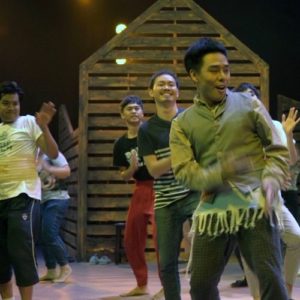
As the story of the show’s creation unfolds, so we simultaneously follow the plot of the musical. Interspersed throughout the documentary is footage from a few recent productions, including Sher’s 2015-16 staging at the Broadway Theatre with Burstein as Tevye, the 2017 Chichester Festival Theatre production starring Omid Djalili, and, most insightfully, Toho Stage’s Japanese-language version in Tokyo, where the show somehow resonates with the domestic market, who seemingly can’t quite believe that it wasn’t written originally for a Japanese audience.
What’s clear from the talking heads is that Fiddler is a truly transcendent work of art, a piece that did more than just shape and help define Jewish culture in the USA and beyond in the 1960s; Lewkowicz convinces us that it also touched – and continues to touch – the disenfranchised of all forms: refugees, feminists, the gay community, people of colour…
“Fiddler is really not just about violence that is visited on a single person but violence that is visited on an entire culture,” says former New York Times critic Charles Isherwood in his piece to camera. “Really it’s about what we now call ethnic cleansing, in the end, and these forces are still very much alive in the world. Bigotry, oppression, sometimes disguised as mere conservatism, it’s eerily and perhaps sadly relevant today.”
 Fiddler’s success, then, comes down to it universal themes, which continue to resonate with audiences of all ages. As well as grander parallels drawn with the civil, feminist and LGBTQ+ rights, more personal connections are made, particularly in regard to fathers’ relationships with their daughters.
“Daughters make feminists of all fathers,” says interviewee Gurinder Chadha, director of Bend it Like Beckham, a message echoed by Burstein: “Tevye is remarkable because the universal part of him, the human part of him… stems from his relationship with his family and his love for his daughters.”
While not particularly artistically creative or earth-shattering, A Miracle of Miracles is an interesting historical document of one of the most important musicals ever written, albeit one that ‘has no memorable songs’, according to a reviewer after sitting through one of the try-outs in Detroit. It’s not particularly cinematic in its approach – it feels like a rather pedestrian TV documentary – but it’s no less compelling because of this. In any case, it will certainly have a ready-made audience in the countless fans of the show. If you love the musical, you’ll appreciate Lewkowicz’s 100-minute labour of love.
Craig Glenday
SHARE THIS POST:


Comments are closed.