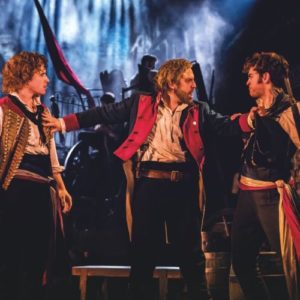
Ashley Gilmour, Jon Robyns and Harry Apps in Les Misérables at the Sondheim Theatre, London. Picture: Johan Persson
Les Misérables continues at the Sondheim Theatre, London.
Star rating: five stars ★ ★ ★ ★ ★
In 2020, Les Misérables is as much a cornerstone of West End musical theatre as a chorus line, a love duet, or an overpriced interval drink. Even your joyless work colleague who can’t stand musicals knows the basics. It has that Susan Boyle tune in it. It’s about a French uprising. The stage spins around.
Except in this new staging of the riotous, revolutionary musical about an attempted revolution, the stage does not revolve. But fear not: it is still a riotously enjoyable night of theatre.
I can barely believe I’m typing this, but until this evening, I’d never seen Les Mis on stage. It seems such a shameful confession but I was always put off by its popularity among those off the Clapham omnibus (and those joyless colleagues), and the gushing, nearly religious adoration it received from all quarters of the musical theatre establishment. Snobbish idiot, I know, but I shunned the show, just as I vowed never to watch Breaking Bad, read Captain Corelli’s Mandolin or eat garlic bread… three things which I instantly fell in love with on first sight/read/bite. I can now add Les Mis to that list.
When Cameron Mackintosh’s London production of Boublil and Schönberg’s musical premiered in 1985 (with English lyrics by Herbert Kretzmer), reviewers panned the show. Nevertheless, the tale of Jean Valjean’s quest for moral redemption in the shadow of both Paris’ 1832 June Rebellion and his relentless nemesis Javert has gone on to thrill generations of theatre fans – and do unprecedentedly good business along the way.
A fair amount of credit for its success must be given to the heart-stopping score, played flawlessly yet passionately here by MD Steve Moss’ 14-strong orchestra, all of whom presumably grew up listening to these tunes.
The bold orchestrations – reworkings of John Cameron’s original scoring courtesy of Stephen Metcalfe, Christopher Jahnke and Stephen Brooker – sound alternately bombastic and delicate over the gorgeous new Sondheim (né Queen’s) Theatre’s state-of-the-art sound system. The grey area between these two extremes is admittedly less well-served, but given we are experiencing all the highs and lows of a not-uneventful 365-chapter novel in just under three hours, the subtlety and depth of detail that remains is remarkable.
Despite the fast pace and emotional extremes in co-directors Laurence Connor and James Powell’s reworking, there’s no shortage of deeply human moments.
Eponine, for instance, a character who could easily slip from an audience’s sympathy, is fully fleshed-out by the libretto and made instantly relatable by Shan Ako’s charismatic performance. She sings ‘On My Own’ with such familiar heartbreak that the audience responds with the loudest and longest applause of the evening.
Fantine could be a diva’s dream role: sing a huge song, disappear backstage for a two-hour nap, then return at the end to sing the audience home (with added heavenly reverb). However, nobody could accuse Carrie Hope Fletcher of apathy: she throws herself whole-heartedly into an unforgettably affecting and physical performance.
Providing a masterclass in comic relief are Madame and Monsieur Thénardier, played by the ever-reliable Josefina Gabrielle and, at short notice, Ian Hughes (who temporarily covers for Gerard Carey, currently indisposed owing to a vocal injury). Not a single line of ‘Master of the House’ goes by without some bit of physical comedy or unexpected line reading mined from the decades-old material. The audience’s love for the pair at the curtain call is palpable: a great achievement given how monstrous the characters are on paper.
Of course, tying the whole show together are Jean Valjean and Javert. These vocal parts were composed seemingly with no consideration for the limits of the human voice, but Jon Robyns and Bradley Jaden respectively show off a superhuman mastery of their instruments. The brilliance of their performances comes in their restraint. Many lines are delivered with surprising delicacy and barely sung at all, giving the evening a more earthy edge than might be expected.
This authentic, human feel is reinforced by Matt Kinley’s new production design based around projections of paintings by Victor Hugo, author of the original Les Misérables novel. Between these and Paule Constable’s stunning lighting work there is almost no need for sets. Nonetheless, factories, towns, and that infamous barricade all slide on and off the stage, each creating a new atmosphere yet still seeming very much of the same world.
So, was this new staging all worth it? I’m sure it’s a resounding ‘yes!’. Despite the baffling existence of people who claim to miss the 1985 synthesiser-heavy orchestrations since the switch to more traditional instrumentation ten years ago, it’s hard to believe that anybody could be disappointed with this new, revitalising interpretation. It may not be revolutionary, but it gets everything right and delivers an unforgettable evening of musical theatre.
Craig Glenday
Tickets for Les Miserables are available HERE.
SHARE THIS POST:


Comments are closed.