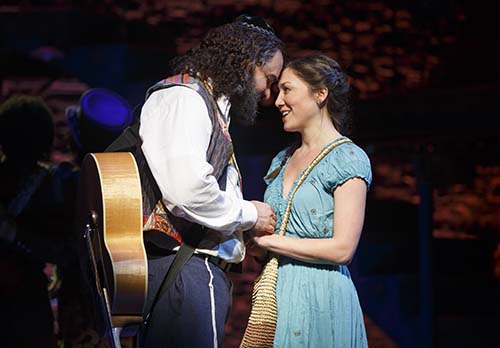
Eric Anderson and Zarah Mahler in Soul Doctor at Circle in the Square, New York
Soul Doctor has opened in the Circle in the Square theatre, New York, for an open-ended run.
Soul Doctor celebrates an unusual man in pretty familiar bio-musical terms. This new Broadway offering, which had a brief Off-Broadway run a year ago, tells the story of Shlomo Carlebach, a charismatic musician and sort-of-renegade rabbi who in the turbulent 1960s departed from the dour liturgical regimen of orthodox Judaism with buoyant new musical settings for Hebrew prayer – infused with lilting hints of soul and gospel. His goal was to bring disaffected Jewish youth back into the fold and, as he says in the show, instill “joy in the synagogue”. His music and humanity gave him a formidable career and a dedicated following, continuing even after his death in 1994. And the show itself comes to foot-stomping life whenever Eric Anderson – who, despite the Scandinavian ring of his name, gives a totally convincing portrayal as Carlebach – picks up his guitar and begins to sing his songs with unchecked jubilation. Thankfully, he does this quite a bit of the time.
When he isn’t singing, though, the production has a dispiriting feel as it unreels its by-the-numbers version of Carlebach’s life. The book, by Daniel S Wise, who also directs, brings to mind various movie musicals of yore which ran helterskelter – with little thought for dramatic validity – through the histories of noted composers, from Jerome Kern (Till the Clouds Roll By) and Richard Rodgers (Words and Music) to George Gershwin (Rhapsody in Blue).
The show is framed by a concert in Vienna, which has Carlebach returning to the city he and his family left 40 years earlier in an escape from the Nazis. Then in flashback, we are shown Carlebach’s youthful days in New York City, where he studies under his orthodox rabbi father, his coming under the influence of the messianic Hasidim and his realisation that he will have to depart from sombre and strict tradition to make his music meaningful to the young audiences he wants to inspire.
A chance meeting with the great jazz musician Nina Simone (Amber Iman) further motivates Carlebach to move ahead on a musical career. Simone then keeps turning up at various points in her role as soul-mate and muse, but the character, despite Iman’s warmly appealing performance and the occasional passing reference to her own civil rights activism, is thinly drawn, as is her relationship with Carlebach. And so are Carlebach‘s own conflicts as he attempts to balance orthodoxy, reform and the changing culture of the times. When drugs infiltrate the hippy synagogue he established in San Francisco, known as the House of Joy and Prayer, he simply, according to the show, packs up his congregation and takes them to Jerusalem for salvation. There may well be truth in this, but the simplistic way it and other events in Carlebach’s life are enacted kept me from ever getting really deeply involved, despite some nice supporting performances in the company. They include Jamie Jackson as Carlebach’s loving father, Ryan Strand as his devoted brother, and Zarah Mahler as a follower who keeps waiting vainly for Carlebach to narrow his love for humanity and focus it on her.
Wise’s staging, like his book, is efficient but uninspired. And Benoit-Swan Pouffer’s balletic choreography sometimes distracts more than it adds to the songs, with the dancers frequently swirling busily about the singing Anderson/Carlebach. The songs (often using English lyrics by David Schechter), however, are Soul Doctor’s raison d’être, and they do not disappoint.
Ron Cohen
SHARE THIS POST:


Comments are closed.