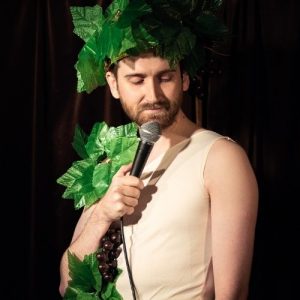
Sisyphus: A Rock ‘n’ Roll Musical writer and director Ian Bowkett posing as a Greek god onstage for unrelated reasons. Picture: Scary Boots
Sisyphus: A Rock ‘n’ Roll Musical, running at London’s Canal Café Theatre from 6-9 October 2021, marks the solo directorial and authorial debut of Musical Theatre Review contributor and composer Ian Bowkett.
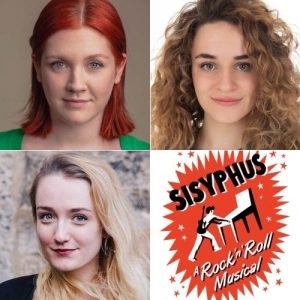
Ian has spent the last 14 months of lockdown refining the script and songs for the show and is beyond excited to finally share this piece with the world. The almost entirely sung-through show will be performed by just three actors (Bryony Purdue, Emily Rushton and Ciara Whiting) in the tradition of Ancient Greek theatre and features over 30 original rocking musical numbers.
Sisyphus: A Rock ‘n’ Roll Musical is a modern take on the Ancient Greek myth about the man who rebelled against the gods, only to receive the infamous punishment of having to push a boulder up a hill over and over again for eternity.
Performances will begin at 7pm and the show will last approximately 80 minutes without an interval. A limited number of tickets for the short debut run from are available from the Canal Café Theatre website.
MTR: Of all the characters in Greek Mythology, why Sisyphus?
Ian Bowkett (writer/director): To be embarrassingly honest, the title came first, and a silly pun is hard to resist! But as I started to research the character more, I realised there was a juicy story to be told. A human rebelling against the gods is always compelling, but what gives Sisyphus’ story extra dimension is his marriage to Merope, who is herself a divine being.
MTR: What attracted you to this project as actors?
Emily Rushton (Sisyphus/Zeus): As someone who is doing a PhD in Classics, looking at performance research in mental health, I was quite annoyed I hadn’t thought about doing it myself. This story is so pertinent right now. I think many people are coming out of 18 months of repetitive punishment and have had to navigate their place and mental health throughout. It’s exactly what the characters in this musical go through.
Bryony Purdue (Merope): I heard about Ian working on a musical through the London cabaret underworld that we are both part of, and I was delighted when we connected and I heard more. I loved the setting of Ancient Greece, the small cast, and then hearing the demo tracks, and I knew I wanted to be involved. Luckily, Ian thought so too!
Ciara Whiting (The Hunter/Death): I liked the modern and comedic approach to Greek myth. Adaptations of Greek theatre can sometimes be old fashioned and traditional, but with this show, I fell in love with the modern, feminist, comedic twist that really brings something fresh.
MTR: How was the process of auditioning online during the Covid lockdown?
Bryony: Having got used to Zoom meetings and video self-tapes, it was absolutely fine and actually felt, in many ways, more straightforward than travelling to an audition room. Less of that sweaty tube-journey rush.
Emily: My husband was deeply concerned that I was going to smash up the living room trying to do a full-on monologue through the computer, but luckily Ian didn’t put us through that embarrassment.
Ciara: I much preferred being able to pre-record a song rather than being put on the spot. This allowed me the time to carefully and creatively construct my own performance as well as delving into my own Greek research.
Emily: I was a bit concerned that I hadn’t met the other actors, but I think the concern very much transferred to the director when the cast all met, fell in love, and then became incredibly irritating to work with!
Ian: Oh yeah, you’re a nightmare. But without that chemistry we wouldn’t have been able to be so experimental and free in rehearsals, and the show would be much worse for it.
 MTR: Did you research a lot of history and mythology to prepare?
Ian: I surprised myself with how deeply I got into those classical texts! As with all myths, no two sources give the same account, but I tried to intertwine as many ancient variations on the story as possible – with a bit of artistic license to make it flow and work with three actors and a finite budget.
Emily: I saw into the future and decided to do several degrees in the subject, just in case… It’s actually been a really interesting experience analysing the myths in a different way and sharing everybody’s different interpretations. I definitely feel like the stories have taken on different guises now.
Bryony: When I studied Latin at school, I really enjoyed the mythology parts most – and my dad also loves it – so it was a dark, intriguing, very exciting world I knew a little about. I feel that talking about Virgil’s Aeneid in an audition is one of the coolest uncool things I’ve ever done!
MTR: What is the reasoning behind the all-woman cast?
Emily: About time! There are so many amazing women and non-binary beings in the ancient world who we never hear about and it’s time to reclaim the story.
Ian: A huge problem with adapting myths is that they are all rooted in the misogyny of those ancient societies. It seemed obvious and necessary to give non-male voices the spotlight, and to listen to the cast’s instincts on the story as we developed the show through rehearsals. I hope the cast feel as though they have had a say in how difficult parts of the story are presented, and that together we have created a show is more sensitively told.
Ciara: In Ancient Athenian theatre women weren’t even allowed to be cast in plays – they were seen as ‘weak’ – and to this day all-women casts for mixed-gender stories are rare. Fighting this misogyny in the modern day has proven to be an empowering experience. Being able to play traditionally ‘masculine’ roles has not only allowed me to grow as an actor, but also to emphasise to an audience that women can be powerful and defiant.
Bryony: I think there are fluid, fem./masc. elements to all of us. In this show, we all get a chance to be dominant whatevers, with no need for binary stickers. Audiences don’t need to be spoon fed that stuff, especially if the story and performers are such a winning combo!
MTR: How would you describe the music of the show? Is it all “rock ‘n’ roll” as the title suggests?
Bryony: ‘Spring Awakening meets Six with a peppering of something else altogether’, would be a good description. It’s more important that there’s a boulder reference in the title for the pun fans.
Emily: The music has been such a joy to work with – it’s multifaceted and genuinely does take you from laughing to cringing to crying.
Ian: I think it would have been very difficult to convey this complicated story with just one musical style, but hopefully I have thrown in enough electric guitar across the score that rock fans won’t go home disappointed!
 MTR: Did you look to any other famous portrayals of Greek heroes and gods to inform your performance? Or any other inspirations?
Bryony: I loved Lucy Lawless as Xena: Warrior Princess, which is obviously a mish-mash of all sorts but is a hell of an iconic powerful female in a similar anachronistic role.
Emily: My biggest inspiration for my performance – and in life – are my grandmothers. My Nanny, Kathleen, has always been an unwavering rock, working so hard to look after us but never shying away from doing what’s right. My Nana, Sybil, who sadly passed away a week after I found out I had been cast in the show, was a rebel to the bone. She had a very “fuck it” attitude towards the end that I try to channel. They are the biggest heroes I can think of.
MTR: With a cast of just three and the writer taking on the backstage side of things, this is a markedly smaller company than a typical musical. What have been the advantages and disadvantages of this?
Ciara: Having a small cast has allowed the three of us to establish a strong rapport with one another, and I think this comes through in our performances. Also, we’ve all had the opportunity to take on large roles, so we’re all important and essential parts of the production. The only slight disadvantage would be that being onstage for an hour and a half with very few breaks is a lot! But it never feels like work – we all want to make this the best show possible.
Emily: I could imagine it would have been a nightmare if we didn’t all get on so well! Of course, the difficulty has been remembering all the bloody lines for a whole musical between three of us.
Bryony: We have all had busy schedules and so the pressure to learn it is a lot – but it’s something I’d happily do again! I have absolutely loved being in this small cast. It’s very exciting to have so much input into the decisions we make for the characters; and getting to know each other well and quickly is really lovely. We also all have tonnes of stage time to show off our range as performers. It’s a very cost-effective model in a post-pandemic theatre landscape.
Ian: Absolutely. As dreamy as it would have been to have had a big team to deal with all the faffy admin, I’m proud of what we have achieved as a small unit. Hopefully, we can inspire others. Too many scripts end up abandoned in a drawer if the big production houses are too busy with their Phantoms and their Wickeds, and that’s a tragedy. Musical theatre fans – myself very much included – always want to see new and exciting shows, whatever the venue. Especially after the last year and a half of lockdowns.
Sisyphus: A Rock ’n’ Roll Musical will run from 6-9 October 2021 at the Canal Café Theatre in Little Venice, London. Tickets are available HERE.
SHARE THIS POST:


Comments are closed.