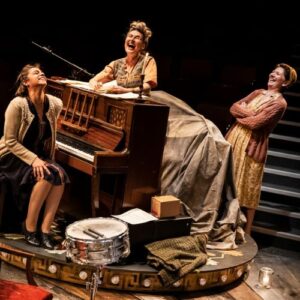
Picture: Pamela Raith
Blonde Bombshells of 1943 continues at the Stephen Joseph Theatre, Scarborough until 26 August 2023.
Star rating: three stars ★ ★ ★ ✩ ✩
Just when was it that actors went beyond the triple threat of acting singing and dancing and added playing a musical instrument and perhaps even gymnastic skills? Can you remember the first show you saw that made these demands?
Well, Blonde Bombshells of 1943 doesn’t quite require the full montgomery since there is no dancing, although there is plenty of movement about the set. This is to counterbalance the largely static nature of Act I during which the all-female, eight-piece band (presumably modelled on Ivy Benson) discusses their lives, men and the state of the world. It is a kind of ‘grumpy young women’ introduction. On the other hand, what we see is a group of women who have been liberated by the war and who are grasping the opportunity to determine their own futures.
The reason there are only four of the eight-piece is that they lose a band member each time they play a GI army base and they are gathered to audition four replacements. Gradually, we are introduced to the acolytes: first a sixth former (Lauren Chinery); then a nun (Gleanne Purcell-Brown); an upper-class twit of an army driver (Stacey Ghent); and finally, yes you guessed it, a male drummer (Rory Gradon). This motley crew fit right in and (suspension of disbelief time) they are told that they have a broadcast on the BBC that night.
Since we are in the 1940s, we are naturally treated to the music of that decade: ‘Tuxedo Junction’, ‘Body and Soul’, ‘Where or When’. Audience participation is ensured with ‘I Lift Up My Finger’, prompted by placards, held up by the cast, which sequences the responses.
The prelude to all this is an explanation by a young Elizabeth of how her grandmother learned a sharp lesson when she auditioned for the band in 1943. Elizabeth then turns up as her own grandmother, schoolgirl Liz, as the show gets into its stride.
We can now discern where the action is taking us: will the band overcome the unexploded bomb that appears in their rehearsal space? Will they be ready for a national broadcast? Can they survive the indignity of playing in Hull?
The four original band members on stage are world-weary and sardonic: leader and multi-instrumentalist Betty (Georgina Field); trumpet, Vera (Sarah Groarke); piano, May (Verity Bajoria) and bass, Grace (Alice McKenna). Despite their cynicism, they integrate the newcomers and we come to the part that the audience has been waiting for: the performance for the BBC (musical director is Greg Last).
New-girl Lily, the nun, to the amusement of the rest of the band, auditions with a risqué George Formby song (‘In My Little Snapshot Album’) and clearly has no inkling of the song’s double entendres. Chinery’s Liz has plenty of opportunities to exploit her innocence for comic purposes. She it is who forms a brief liaison with drummer Patrick who will soon be swept up in the war.
Not only do the eight women play as a band, they also require a vocal trio which is supplied by three of the newcomers – dubbed by Betty as the Valentino Sisters. They are encouraged to sound like The Andrews Sisters and, in performing ‘Don’t Sit Under the Apple Tree’, make a creditable job of it.
The finale sees the whole band, including Patrick, in red dresses and blonde wigs. It’s a bravura performance, as it has to be after such a lengthy build-up.
The show has some good jokes – ‘My sister worked at the Odeon selling ice creams… When she got married she walked down the aisle backwards’, but some fall a little flat and it doesn’t always feel like that the action has been adapted to the unique demands of theatre in the round.
Director Zoë Waterman seems to be happier when the action calls for movement rather than the stationary, dialogue-driven section of the first hour. Once the auditions begin, and she can play with various types of innocence and then with the dynamism of the band playing 1940s hits, she finds the appropriate pace.
Jess Curtis’ set design is, as usual for the Stephen Joseph, minimalist, but we do have to puzzle out why the cast is placing planks across a gap in the flooring. It took me some time to work out that they were covering a bomb crater. Later, an unexploded bomb appears in the same space.
Blonde Bombshells of 1943 could be seen as a Second World War jukebox musical, but in Alan Plater’s hands it layers in themes that resonate with any era – coming of age, camaraderie and the conviviality of music making. It adds up to a lively evening’s entertainment.
Mike Tilling
SHARE THIS POST:




Comments are closed.