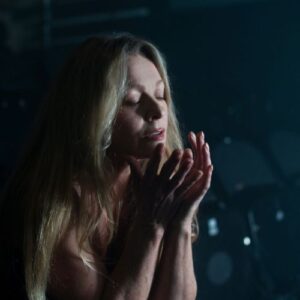
Picture: Kate Scott
What (is) a Woman continues at the Arcola Theatre, London until 4 May 2024.
Star rating: four stars ★ ★ ★ ★ ✩
Andrée Bernard’s script for her solo play What (is) a Woman feels autobiographical, or else it’s the conviction with which this actress sets out her tale.
Interspersed with erotic monologues that invoke that of Molly Bloom in the closing of Joyce’s Ulysses, her encounters with the ‘American’ who comes to dominate her life at the expense of the other men with whom she forms dalliances form the sexual thrust of the piece. Amidst the first frantic coupling, she spies an airline ticket knowing well that it is just a momentary fling, not anticipating his return at inopportune moments in her life.
Bernard’s tales of internet dating are well observed and some of the most humorous of the evening, from the self-flattering descriptions to the man who seems perfect in every way, observing her attire in detailed compliments, only to discover the previous partner he had been so candid about was a man.
Meeting what seems to be her ideal man at a Hampstead food fair – he cooks, reads, has a pension and is a dentist – she longs for him to ‘tear her clothes off’. The recounting of her three failed miscarriages, as the pair attempt to make their lives more complete, is extraordinarily moving. And then the ‘American’ returns, turmoil ensues, and she abandons the security of the Hampstead dentist, only to find herself alone once more.
And there’s the rub. The gist of the piece seems to be that the Woman defines herself by her need for male desire. Everything else seems extraneous. Rather than an exploration of her role in society, what it means to be a woman, and to be subjected to the ‘male gaze’, the emphasis is on a parade of relationships. The summing up comes right at the finish, after several false endings. There is no song list.
Now Bernard is an accomplished actress and differentiates between the men in her life with comic aplomb, the funniest being the phone calls with her agent ‘Chumley’. She also uses body movement to illuminate the monologues, with choreography by Lucie Pankhurst that has her yearning, stretching and contorting her body. It could almost be a solo dance performance. With a low-toned husky/speaking/singing voice, her range is small but expressive.
On the keyboards, musical director Daniel Looseley underscores the speech for most of the play, along with Jess Martin’s plaintive bass. However, there are times when less might be more effective, as proven in the unaccompanied description of abandonment by her lover. Michael Strassen’s direction keeps the play flowing, with effective lighting by Zoé Ritchie.
An absorbing play which is part contemporary dance, part musical, it has echoes of the work of Pina Bausch who never shied away from mixing movement and speech. Trimming and playing without an interval might have a greater impact, but it’s a worthy achievement on this, its first outing.
Leon Ferguson
SHARE THIS POST:




Comments are closed.