Picture: Johan Persson
Stiletto continues at the Charing Cross Theatre, London until 14 June 2025.
Star rating: three stars ★ ★ ★ ✩ ✩
The sexual politics inherent in the performing arts of centuries ago are curious. Just as the playhouses of Shakespeare’s day only allowed boys and men to play the roles of women, so too the opera houses wrote female characters to be played by high-voiced men.
Boys’ voices normally drop as they become men, of course, rendering them unsuitable to play the soprano roles. And that is where the castrati come in. Boys with good singing voices would be castrated before puberty, the successful ones retaining a purity of sound in the higher registers into adulthood.
As well as being barbaric and inhumane, the practice, as featured in Stiletto, set in early 18th century Venice, was allied with other dehumanising treatments. While the singers would be outwardly lauded and may receive patronage, the system that produced the castrati was little more than a slave labour production line.
Not the cheeriest of topics, then, for a new musical. But Stiletto does its best, by lifting various styles from the 20th century musical theatre canon. Its opening scenes, of a crowded Venetian square bustling with the Cockney-accented lower classes, has more than a shade of Lionel Bart about it. Elsewhere, many of Matthew Wilder’s songs have tempos and rhyming schemes that sound uncannily like The Little Mermaid-era Ashman and Menken. More than once, one feels that a character will declaim their peers as ‘Poor Unfortunate Souls’.
There is a sense of mid-era Andrew Lloyd Webber, too. Not only with the numbers that start off in spoken verse, echoing the composer’s penchant for recitative; many of the musical numbers evoke the mood of The Phantom of the Opera, another musical about horrible people bestowing patronage upon talented singers for questionable reasons.
The story here is of Jack Chambers’ Marco, a castrato who attracts the attentions of Azzurra D’Orozco (Kelly Hampson), wife of the scheming Pietro (Douglas Hansell). Marco’s success is vital to the fortunes of his teacher, and lover, Faustino (Greg Barnett). But when Marco meets Jewelle Hutchinson’s Gioia, whose voice is purer than any castrato’s, his attempts to help her set a disastrous chain of events in motion.
The actual plot within Tim Luscombe’s book is nicely structured, barring an opening scene which is too busy introducing the panoply of characters to fully deliver on their personalities (by the time of Faustino’s big solo number in the middle of Act I, we’re still unsure of his motivations for doing anything). The script itself is far patchier, though, struggling to find the right line between camp comedy and sumptuous melodrama. The performances of Hampson and Sam Barrett as Luigi, her husband’s accountant and lover, help to traverse that divide, but otherwise it’s an often uncomfortable mix. Some moments of comedy are unintentional – when a character takes a poison that is supposed to provide instant death, he still has time to soliloquise and then listen to his lover sing a whole song about him – but otherwise it’s generally played straight, to the play’s detriment.
Perhaps the biggest struggle, though, is the portrayal of the castrato at the heart of the story. Chambers is likeable enough as Marco, and his affection for both Gioia and Faustino has its endearing qualities. But the portrayal of a super castrato performer with a high singing voice is beyond the range of a performer whose vocal range does not go higher than a normal tenor. We are constantly led to believe that Marco is perhaps the greatest castrato Venice has ever seen; in his performance of Wilder’s pop-rock score, he struggles to be even the best singer in the cast.
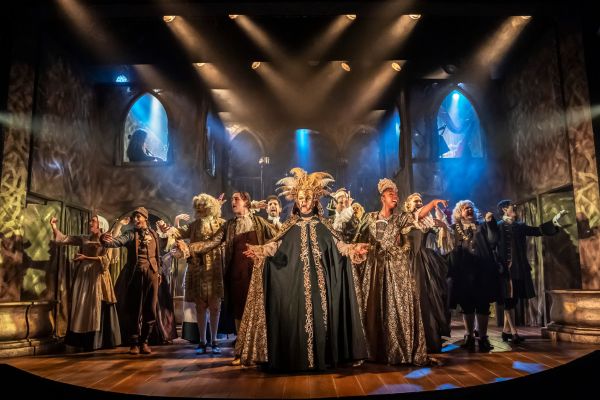
Instead, the one main number in which Marco performs as a castrato involves a body switch, with Jennie Jacobs (a mezzo soprano) taking to the stage. An ornate Venetian mask and cloak are supposed to maintain the illusion that this is the same character as portrayed by Chambers, but director David Gilmore mishandles the changeover. What could have been a charmingly handled sleight of hand becomes a walk offstage for no real reason, ruining the sense of illusion.
And that’s the sense throughout, that a little bit more care and attention could elevate Stiletto. Ceci Calf’s set designs initially look sumptuous, but the coarse brushwork suggesting Venetian marble does not stand up to two hours of scrutiny. Nor is the set held by two large candelabras which must be manhandled on and offstage for alternate scenes.
Musically, too, some slight tweaking might improve matters. Act I finishes with the biggest emotional moment of the entire play, but without any song to accompany it. Act II resumes the same scene with an extended song, credited in the programme as having parts one and two, plus a waltz conclusion. Moving some of that performance to accompany the action before the interval would help bridge the two acts far better.
One would also hope for a greater degree of baroque influence in the onstage 12-piece orchestra’s work. A couple of early numbers include some Vivaldi-like string work, but otherwise there is a disconnect between the time period of the music and the story being played out.
Stiletto is, then, unlikely to set the world alight and captivate audiences with its tale of Venetian duplicity and opulent degradation. But for a new musical at the Charing Cross theatre – a subgenre with a very poor hit rate – it’s enjoyable enough to pass the evening.
Scott Matthewman
SHARE THIS POST:


Comments are closed.